





Browse our current openings and find a role that matches your skills and ambition.
Know more ▸
Get a feel for our culture, our people and the way we work together every day.
Know more ▸
Health, flexibility and growth benefits designed to support you and your family.
Know more ▸

Kickstart your career with hands-on internship opportunities and mentorship.
Know more ▸

Written by 3Shadz Editorial Team
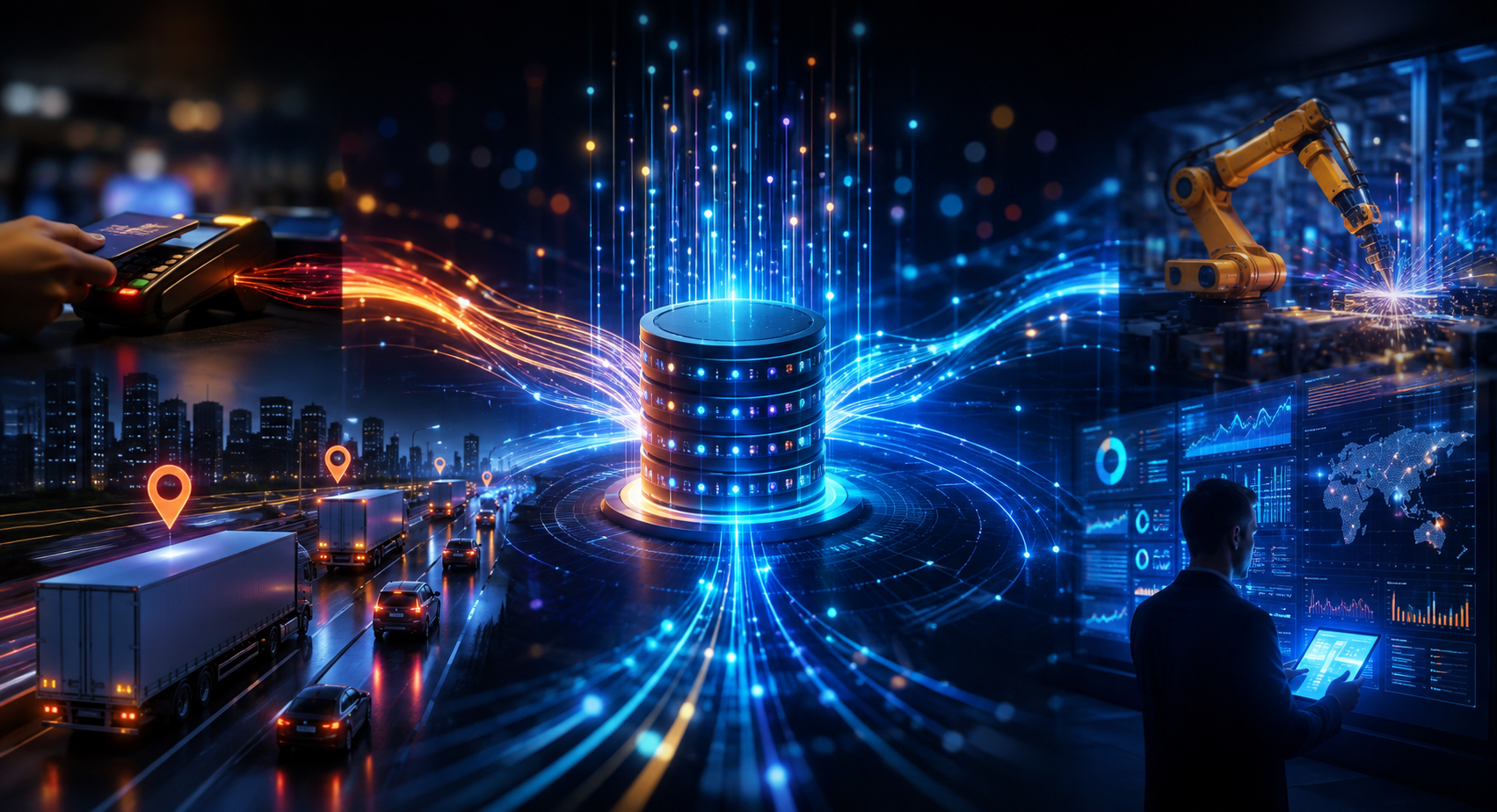
When a stolen card is swiped, a business has seconds, not hours, to react. When a delivery fleet hits traffic, the useful moment to reroute is now, not in tonight’s report. A growing share of business value lives in that narrow window between something happening and someone acting on it. Real-time data processing is how organizations close that window, turning events into decisions as they occur.
This article explains real-time data for technology and data leaders deciding where streaming fits. It covers:
For decades, data was processed in batches: collect it all day, run a job overnight, and read the results in the morning. That rhythm suits accounting and historical reporting, where a one-day lag is harmless. But an increasing number of decisions decay quickly. A fraud signal, a stock-out risk, a server about to fail, a customer about to abandon a cart: each loses most of its value within minutes.
Batch processing treats data as something you look back on. Streaming treats it as something you respond to. The shift is not merely technical; it changes what a business is able to do, from explaining what happened to influencing what happens next.
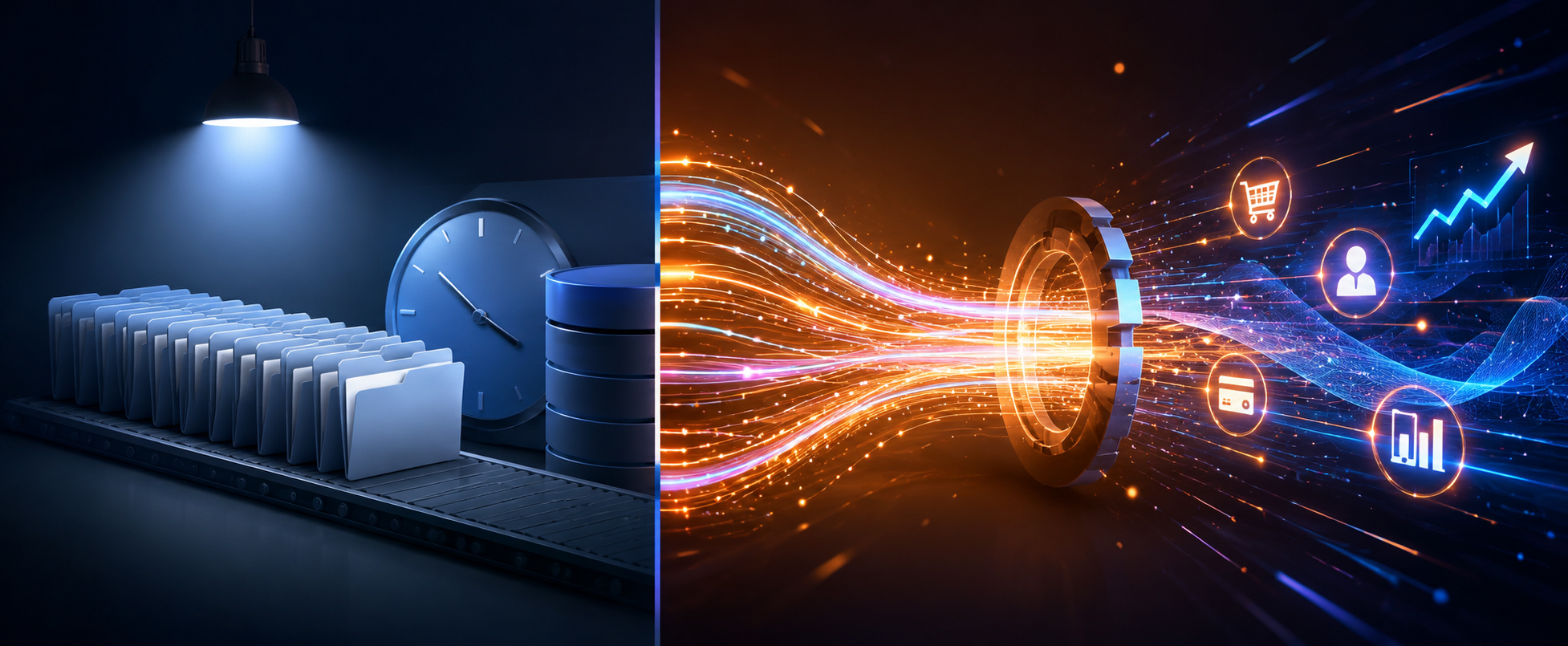
The two approaches are not rivals so much as different tools. Most mature organizations run both. The contrast helps clarify which job each is for.
| Characteristic | Batch processing | Stream processing |
|---|---|---|
| Data handled | Large sets at rest | Continuous events in motion |
| Latency | Minutes to hours | Milliseconds to seconds |
| Best for | Reporting, training, billing | Detection, alerting, live decisions |
| Question it answers | What happened? | What is happening now? |
| Complexity | Lower, well understood | Higher, always-on |
A real-time pipeline moves data through four roles. Understanding them demystifies what “streaming” actually requires.
Applications, devices, sensors, and databases emit events the instant something occurs: a payment, a click, a temperature reading, a change to a record. Each event is a small, timestamped fact.
An event broker, the durable backbone of the system, receives these events, orders them, and holds them reliably so that many consumers can read the same stream without losing data if one component slows down or restarts.
This is where the intelligence lives. Processors filter, join, and aggregate events over time windows, detect patterns, enrich data with context, and apply models, computing running totals, spotting anomalies, or scoring risk continuously rather than in nightly passes.
Processed output flows to where it drives action: a dashboard, an alerting system, a database, or another application that triggers a decision automatically. The loop from event to action can complete in under a second.
Streaming pays off wherever the value of a response falls sharply with delay.
Scoring transactions as they happen to block fraud before money moves, rather than discovering it in a next-day report.
Tracking fleets and shipments live to reroute around delays and keep customers accurately informed.
Reacting to what a user is doing in the moment: relevant offers and recommendations while intent is still fresh.
Watching infrastructure and application telemetry to detect failures and anomalies before they reach customers.
Real-time systems ask more of an engineering team than batch pipelines do. They run continuously, so there is no quiet overnight window to recover in; a late or duplicated event has to be handled gracefully; and reasoning about time itself, when an event happened versus when it arrived, introduces genuine subtlety. Operating an always-on pipeline also demands solid monitoring and the ability to replay data when something goes wrong. None of this is a reason to avoid streaming, but it is a reason not to adopt it reflexively.
It is the practice of ingesting and analyzing data as events occur, within milliseconds to seconds, so systems and people can act immediately, instead of waiting for a scheduled batch job to run.
No. Most organizations use both. Streaming handles time-sensitive detection and response, while batch remains ideal for reporting, billing, and training models on large historical datasets.
An always-on system generally costs more to run and operate than a periodic job. The question is whether faster action returns more than that cost, in prevented fraud, retained customers, or avoided downtime.
Beyond data engineering, teams need comfort with event-driven design, always-on operations and monitoring, and handling the realities of late or duplicate events. Managed streaming services reduce, but do not remove, that burden.
Modernize Your Cloud & Data
3Shadz helps businesses modernize cloud infrastructure and build secure, scalable data platforms that turn raw information into real-time insight and competitive advantage.