





Digital Healthcare Platforms
Custom web applications, patient-facing portals, provider tools and internal healthcare applications, designed around how each audience actually works.

Browse our current openings and find a role that matches your skills and ambition.
Know more ▸
Get a feel for our culture, our people and the way we work together every day.
Know more ▸
Health, flexibility and growth benefits designed to support you and your family.
Know more ▸

Kickstart your career with hands-on internship opportunities and mentorship.
Know more ▸
3Shadz helps healthcare organizations modernize software, data, cloud platforms and AI capabilities without losing sight of how clinical and operational work actually happens.
We don’t start with a generic technology stack and ask healthcare to fit into it. We start with the workflows, systems and constraints already in place, then bring software engineering, AI, cloud and data together around them.
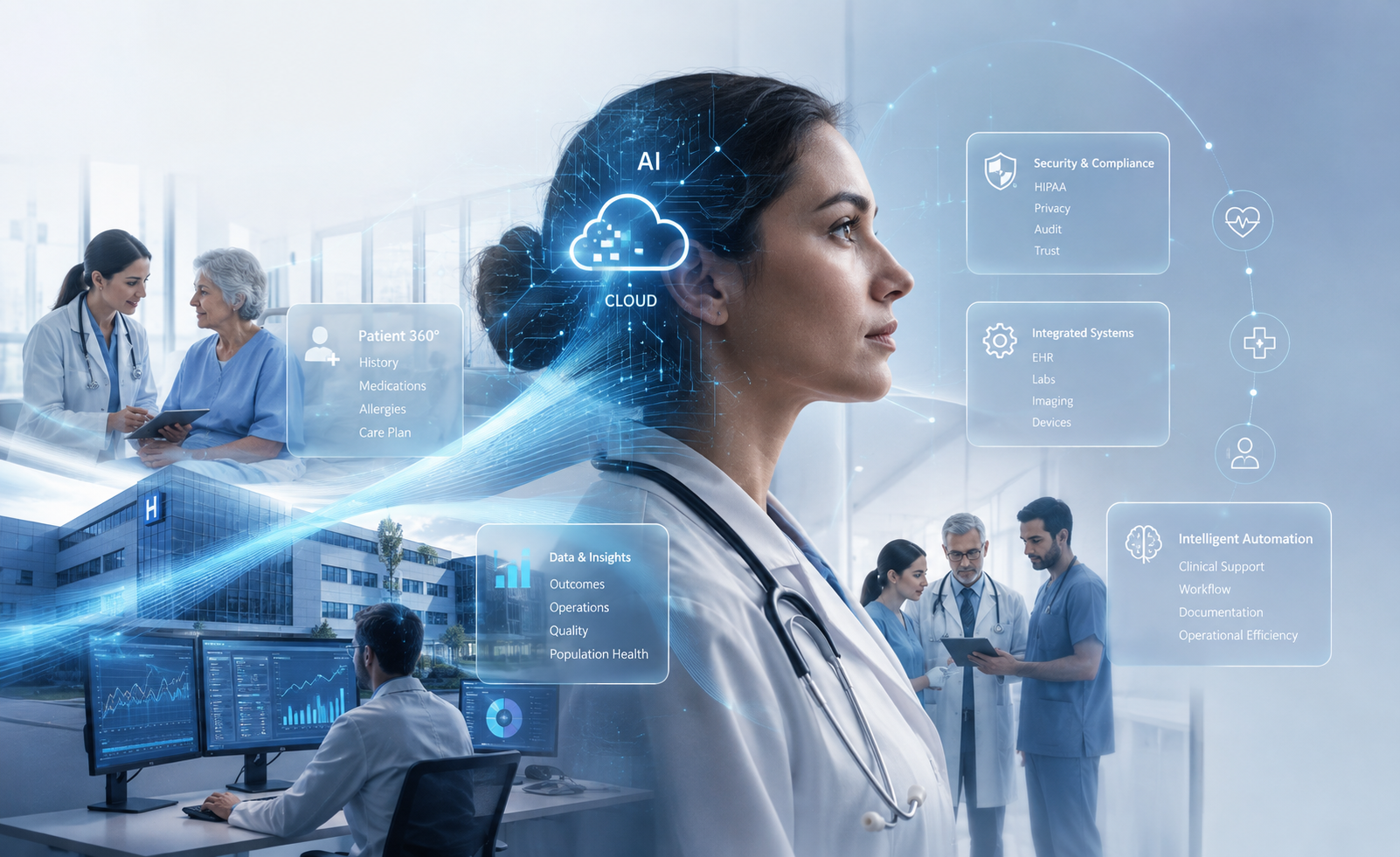
Healthcare rarely runs on a single platform. It runs on a web of systems (electronic health records, scheduling, billing, patient portals, clinical tools and internal operations software) that all have to work together, even when none of them were originally built to.
3Shadz approaches healthcare technology as an ecosystem rather than a series of disconnected projects. Before we design or build anything, we look at how information, people and systems actually move through the organization: what already exists, what depends on what, and where the friction really is.
That perspective shapes every recommendation we make, whether the work is a patient-facing application, an internal workflow tool, a data platform, or an AI capability layered on top of what’s already there.
Records, scheduling, billing and portals have to feel like one experience, even when they weren’t built together.
Patients, clinicians, administrators and IT teams each need something different from the same platform.
Patient information and operational data need care at every layer of the system, not just at the edges.
Technology has to support today’s workflow while staying ready for what changes next.
Every layer below feeds the next, from how patients and providers experience healthcare digitally, to the intelligence and infrastructure running underneath it.
Portals, scheduling, communication and self-service tools that make healthcare easier to access.
Purpose-built software for clinical teams, administrative staff and internal operations.
The scheduling, records, billing and workflow systems that keep an organization running day to day.
Turning information scattered across systems into something that can be reported on and understood.
Automation and AI applied to documentation, information retrieval and operational workload.
The scalable, secure foundation that every layer above it ultimately depends on.
These capabilities aren’t unique to healthcare on their own, what matters is how we apply them to the realities of clinical and operational environments.
Custom web applications, patient-facing portals, provider tools and internal healthcare applications, designed around how each audience actually works.
AI-powered workflows, intelligent assistants, document processing, knowledge systems and decision-support tools that reduce administrative and operational load.
Data engineering, analytics platforms, dashboards and reporting that turn information spread across multiple systems into something usable.
Cloud architecture, migration, scalable infrastructure and DevOps practices, built with the reliability and access-control expectations of healthcare in mind.
Modernizing legacy applications and platforms in a way that minimizes disruption to the people and workflows already depending on them.
User-centered design for patients, providers, staff and administrators: technology that fits how people already work, not the other way around.
Before recommending a direction, we start with the constraints that shape what a good solution actually looks like inside a healthcare environment.
We approach every one of these as a technology and operational challenge. 3Shadz provides software engineering, AI, cloud and data services: healthcare organizations remain responsible for their own clinical, legal and regulatory decisions.
These are the principles that guide how we approach healthcare technology work, from the first conversation through to what actually gets built.
We start by understanding the organization’s users, existing systems, workflows and technology landscape, not by proposing a solution before that work is done.
Integration and interoperability get considered before assuming something needs to be replaced. Most healthcare environments have more working systems than they get credit for.
When modernization is the right call, it’s guided by a clear architectural and business purpose, not change for its own sake.
AI gets applied where it solves a real problem for real users, not added because it is expected to be part of the conversation.
Technology decisions account for where the organization is headed, not just where it is today.
AI is a significant part of how 3Shadz approaches technology, applied to the operations, information and workflows that keep a healthcare organization running.
We position AI around administrative and operational work: helping teams find information faster, process documents, automate repetitive tasks, and understand what their own data is telling them.
That is a deliberate boundary. AI can support the people doing clinical and operational work: it is not positioned to replace their judgment.
Where our AI work stays focused: on operations, information and workflows, not clinical decision-making. We do not build AI intended to independently diagnose patients, prescribe treatment, or replace clinical judgment.
AI, automation and better decision-making all depend on a technology foundation strong enough to support them.
Healthcare data is often scattered across records systems, scheduling tools, billing platforms and department-specific software. Before AI or advanced analytics can help, that data usually needs a cleaner path: well-designed APIs, thoughtful application architecture, and a data platform built for how the organization actually operates.
We treat cloud architecture, data engineering, integration and DevOps as the foundation everything else in a healthcare technology strategy sits on, not an afterthought once the more visible features are done.
Good healthcare technology looks different depending on who is using it. We design with all three perspectives in view.
Digital experiences that make healthcare easier to access, understand and navigate.
Tools that reduce friction instead of adding another system to manage.
A technology foundation built for where the organization is headed, not just where it is today.
A consistent way of working, applied to whatever combination of software, AI, cloud and data the engagement calls for.
Understand the business, operational, user and technology requirements before proposing a direction.
Define the right technical direction: the systems, data flows and integrations the solution needs to work within.
Develop and integrate the software, AI, data or cloud capabilities the engagement calls for.
Improve existing technology where modernization creates real, measurable value.
Continue improving the technology ecosystem as requirements, teams and priorities change.
A compact set of technology categories rather than an exhaustive logo wall: each one shows up differently depending on the healthcare problem in front of it.
Tell us about the systems, workflows and technology challenges your organization is working with today. From there, we can help determine the right combination of software engineering, AI, cloud, data and modernization for your environment.