











When Data Outgrows the Pipeline, It Needs an Architecture.
Event streams, transactional systems, logs, IoT feeds, and external data now arrive faster and in more shapes than a single pipeline can hold. Big Data Engineering is how 3Shadz designs the distributed processing, ingestion, and storage layer underneath that volume: built to keep running, stay accurate, and stay affordable as data keeps growing.
Bigger servers and a distributed framework are not Big Data Engineering.
It’s the deliberate design of ingestion, processing, storage, and recovery for data that moves faster and arrives in more shapes than one system was built to handle.
Volume alone rarely breaks a pipeline. It’s volume combined with velocity (continuous event streams, high-frequency transactions, growing numbers of concurrent consumers) and variety (structured tables, semi-structured events, unstructured files), arriving together that pushes a conventional pipeline past what it was designed for.
3Shadz designs the distributed architecture underneath that combination: how data is partitioned and ingested at scale, how batch and streaming workloads run without competing for the same resources, how a lake or lakehouse is organized so it stays queryable as it grows, and how processing recovers automatically when, not if, something fails mid-run.

Four Signals a Standard Pipeline Has Reached Its Limit
None of these alone means you need distributed data engineering. Together, they usually do.
Volume
Datasets that no longer fit comfortably in a single warehouse compute cluster, where scans, joins, and backfills start taking hours instead of minutes.
Velocity
Data arriving continuously (transactions, clickstreams, sensor readings, application events), faster than a scheduled batch job can reasonably keep up with.
Variety
Structured tables, semi-structured JSON and logs, and unstructured files landing from dozens of sources, each shaped differently and changing independently.
Concurrency
Growing numbers of pipelines, analysts, dashboards, and models reading and writing at once, competing for the same processing and storage capacity.
A Distributed Data Platform, Built in Layers
Four connected layers, each addressing a different part of processing data at scale, designed together, not bolted on after the fact.
Ingestion & Movement
- High-volume, high-velocity ingestion from applications, databases, APIs, event streams, IoT, and files
- Change data capture for incremental, low-impact extraction from source systems
- Schema-aware ingestion that adapts as source structures evolve
- Partitioning strategy designed around how the data will actually be queried
Processing & Compute
- Distributed batch processing for large historical and periodic workloads
- Stream and near-real-time processing for continuously arriving data
- Event-driven processing workflows triggered by data arrival, not just a clock
- Distributed compute introduced where workload characteristics justify it, not by default
Storage & Architecture
- Data lake and lakehouse architecture connecting raw, curated, and governed zones
- Large-scale transformation and enrichment pipelines
- Schema evolution management across changing source structures
- Historical and incremental processing patterns, including replay and backfill
Reliability & Operations
- Orchestration and dependency management across interconnected workloads
- Fault-tolerant, checkpointed processing that recovers without manual intervention
- Data quality validation built into the processing layer, not bolted on after
- Observability, performance tuning, and cost optimization across compute and storage
Batch and Streaming, Engineered to Run Together
Most environments need both, not either/or. We design them to share the same governed foundation instead of pulling data through two disconnected systems.
Batch Processing
Best for: historical analysis, large periodic transformations, backfills, and cost-efficient bulk processing.
Jobs process large partitions efficiently on a schedule or trigger, with checkpointing built in so a failed run resumes from where it stopped instead of starting over.
Stream Processing
Best for: operational alerts, real-time dashboards, fraud and anomaly detection, and systems that need to react as events happen.
Pipelines process records as they arrive, with windowing and state management that keep results accurate even as data continues to flow in.
Both paths write into the same governed lake or lakehouse layer, so downstream consumers never have to know, or care, which path a given record travelled.
One Distributed Storage Layer, Organized in Zones
Raw data, cleaned data, and governed data don’t belong in the same undifferentiated bucket. We organize storage so each zone has a clear purpose and a clear owner.
Raw / Landing
Data lands exactly as it arrived: unmodified, timestamped, and replayable, so nothing is lost if downstream logic needs to change later.
Processed / Curated
Cleaned, validated, partitioned, and joined into structures built for efficient large-scale querying and transformation.
Governed / Consumption
Access-controlled, quality-checked datasets ready for analytics, BI, machine learning, and operational applications.
A lakehouse combines the flexibility of a data lake (low-cost storage, schema-on-read, structured and unstructured data side by side) with the reliability expected of a warehouse: consistent reads, version history, and governed access. We design which parts of your platform need that combination, and which are better served by a lake or a warehouse on their own.
Splitting Work So Nothing Waits in Line
Large datasets are only fast to process when they’re split intelligently (by time, by key, by workload) and spread across independent units of compute that run in parallel.
We design the partition key before we design anything else. A poor key concentrates load on a handful of partitions while the rest sit idle; a good one keeps every worker doing a fair, predictable share of the job. The same boundaries that make processing fast also make incremental and change-data-capture processing possible, and let historical data be reprocessed one partition at a time instead of all at once.
Failure Is Expected. Losing Data Isn’t.
Distributed processing runs across many machines, which means something will eventually fail mid-run. Pipelines are designed to expect that, not be surprised by it.
Validation Built Into the Processing Layer
At volume, quality problems compound fast. Every control below runs inside the pipeline itself, not as a manual review afterward.
Orchestrated to Run Unattended. Observable When It Doesn’t.
Distributed platforms rarely run one job at a time. Dozens of interconnected batch and streaming workloads need sequencing, and every one of them needs to report its own health.
Orchestration & Dependencies
We sequence interdependent batch and streaming workloads, manage retries and backfills, and make cross-pipeline dependencies explicit, so a delayed source doesn’t silently corrupt five jobs downstream.
Workload Observability
Every distributed workload reports its own health, so a slowdown is visible to the team operating it before it’s visible in a stale dashboard.
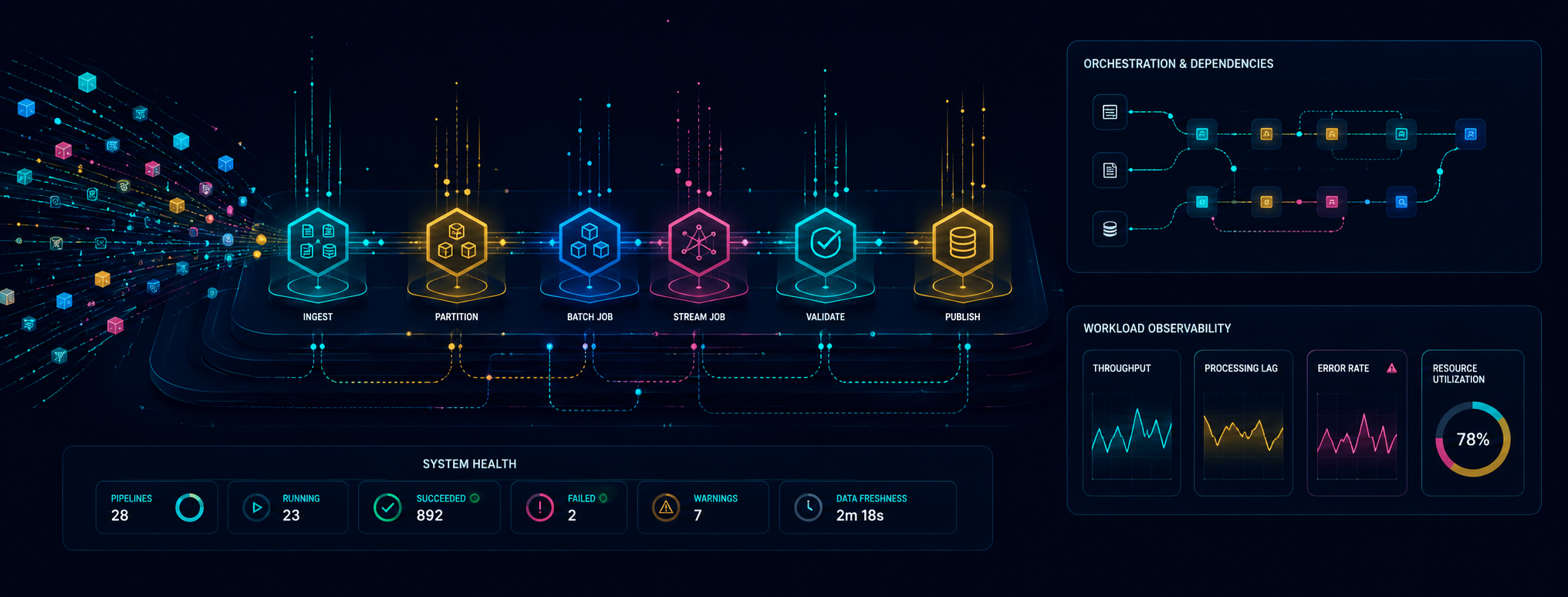
From Scattered Volume to Governed Scale
The same five stages carry every engagement, whether it starts with one high-volume source or a full distributed platform.
Assess & Architect
Profile volume, velocity, variety, and existing bottlenecks, then design a distributed architecture sized to the workload, not a default template.
Ingest & Distribute
Build high-throughput ingestion and partitioning so data lands split and organized for parallel processing from the first step.
Process & Validate
Build batch and streaming processing with quality checks, schema handling, and fault tolerance engineered in from the start.
Orchestrate & Operate
Sequence interdependent workloads, monitor for health and drift, and hand over pipelines that recover from failure automatically.
Optimize & Scale
Tune performance and cost as volume grows, adding capacity deliberately instead of over-provisioning upfront.
Distributed Where It Earns Its Keep
Distributed systems add real operational complexity. Here’s how we keep that complexity justified, not decorative.
Architecture Sized to the Workload, Not the Trend
Distributed processing is introduced because volume, velocity, or variety justify it, not because a bigger framework sounded impressive in a proposal.
Fault Tolerance Built In
Checkpointing, idempotent processing, and automatic recovery are part of the design, not an incident-response afterthought.
Batch and Streaming, One Platform
Both patterns share the same governed storage and quality controls, instead of running as two disconnected systems.
Observable From the First Deployment
Throughput, lag, and error signals are visible from day one, not added after the first unexplained slowdown.
Platform-Agnostic Engineering
Spark, Kafka, Databricks, or cloud-native processing services: chosen for the workload and your existing stack, not a vendor relationship.
One Team Across the Data Practice
The same engineers who build distributed processing also build the ingestion, warehousing, BI, and governance layers around it.
Chosen for the Workload, Not the Vendor
We select processing engines, streaming platforms, and storage formats that fit your data volume, latency needs, and existing cloud footprint.
Distributed Processing & Compute
- Apache Spark
- Databricks
- Apache Flink
- Cloud-native distributed compute
- Containerized processing clusters
Streaming & Messaging
- Apache Kafka
- Event-streaming platforms
- Change data capture tools
- Message queues
- Cloud-native streaming services
Lakehouse & Storage
- Delta Lake
- Apache Iceberg
- Cloud object storage
- Parquet & columnar formats
- Data catalog & metastore tools
Orchestration & Observability
- Apache Airflow
- dbt
- Workflow dependency management
- Pipeline monitoring & alerting
- Cost & resource optimization tooling
Big Data Engineering: Frequently Asked Questions
Data Engineering covers the pipelines that move and prepare data reliably at typical operational volumes. Big Data Engineering is the layer we add when volume, velocity, or variety outgrow what a conventional pipeline and a single warehouse cluster can handle: distributed processing, partitioned storage, and dual batch/streaming architecture.
Data Warehousing models and stores data for structured business reporting. Big Data Engineering handles the distributed ingestion and processing of much larger and faster-moving datasets, often landing curated output into that same warehouse, or into a lake or lakehouse that sits alongside it, so the two layers usually work together rather than replace each other.
If a standard warehouse and scheduled pipelines still finish comfortably inside your processing windows, you likely don’t need it yet. We assess actual volume, velocity, variety, and concurrency against your current architecture first, and recommend distributed processing only where the numbers justify it, not by default.
Both, usually side by side. Most environments need scheduled batch processing for historical and bulk workloads alongside stream or near-real-time processing for continuously arriving events, sharing the same governed storage and quality controls.
We are platform-agnostic. Depending on the workload and your existing stack, that includes Apache Spark, Apache Kafka, Databricks, Apache Airflow, Delta Lake and Apache Iceberg, and cloud-native distributed processing and streaming services across AWS, Azure, and Google Cloud.
Yes. Distributed workloads are monitored for throughput, lag, error rate, and cost after go-live, and the architecture is extended as data volume, sources, and consumers grow, rather than handed over and left to drift.
Let’s Build the Distributed Platform Your Volume Actually Needs.
Whether you need one high-volume pipeline, a batch-and-streaming platform, or a team to take over distributed workloads already in production, our Big Data Engineering team can help you get there.