











Data Doesn’t Help Anyone Until It Arrives.
Every database, application, API, file, and platform your business runs on holds part of the picture. Data Engineering is how 3Shadz designs, builds, and operates the pipelines that carry that information out of each system and into a form your analytics, reporting, and AI can depend on, on a schedule, with checks built in, and with a record of what changed along the way.
Moving data between two databases is not Data Engineering.
It’s the discipline of getting information from where it’s created to where it becomes useful: reliably, on schedule, and with proof it can be trusted.
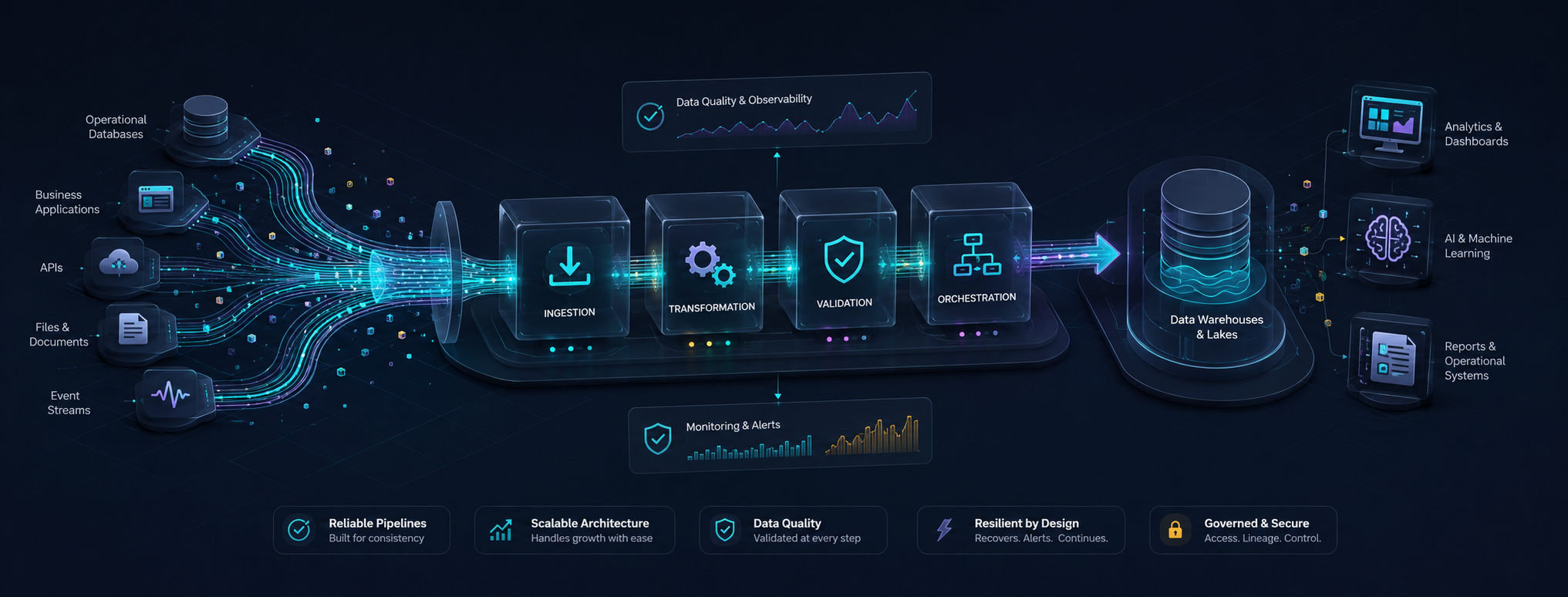
3Shadz designs and builds the pipelines that connect operational databases, business applications, APIs, files, event streams, and cloud platforms to the warehouses, lakes, dashboards, and AI systems that depend on them. That means deciding how each source should be read, how the data should be shaped for its destination, how failures are caught before they spread, and how the whole pipeline keeps running as sources, volume, and requirements change.
The goal isn’t a working connection on day one. It’s a pipeline that still runs correctly, unattended, a year later, and tells you clearly when something upstream has changed.
Data Engineering Capabilities
Each layer below can stand alone or connect into a single pipeline, from the first decision about how a pipeline should be shaped, to the monitoring that keeps it honest after launch.
Pipeline Architecture & Design
Before any code is written, we map source systems, decide batch versus streaming, and design a pipeline topology sized to your actual data volume, latency needs, and downstream dependencies, not a generic template stretched to fit.
Data Ingestion & Integration
Connecting to operational databases, SaaS platforms, APIs, files, and event streams, handling authentication, pagination, and schema drift so new sources don’t mean rebuilding what already works.
Data Transformation & Modeling
Cleaning, joining, and standardizing raw data into structures your warehouse, dashboards, or applications can use directly, using SQL-based and code-based transformation approaches suited to the workload.
Orchestration & Automation
Scheduling, sequencing, and dependency management so pipelines run unattended, retry safely after a failure, and support backfills when history needs to be reprocessed.
Data Quality Engineering & Testing
Automated checks for schema, null values, duplicates, and referential integrity built into every pipeline run, so bad data is caught at the point it enters, not after a report looks wrong.
Pipeline Observability & Monitoring
Freshness tracking, run history, and lineage, with alerting tuned to real failures, so an issue is visible to the team running the pipeline before it’s visible in a dashboard.
Scalable Data Infrastructure
Architecture that holds up as source count, data volume, and concurrent consumers grow, so scaling means adding capacity, not redesigning the pipeline from scratch.
From First Source to Running Pipeline
The same four stages carry every engagement, whether it starts with one pipeline or a full ingestion platform.
Map & Design
Inventory source systems and destinations, decide batch versus streaming, and agree on freshness and reliability requirements before building anything.
Build & Integrate
Develop ingestion and transformation logic with quality checks embedded from the first version, not bolted on afterward.
Orchestrate & Automate
Schedule, monitor, and hand off pipelines that run unattended, recover from failure, and alert on real problems.
Operate & Evolve
Track pipeline health and data quality after go-live, extending pipelines as new sources and requirements appear.
Built to Move Data From Anywhere It Lives
One engineered layer sits between everywhere your data is created and everywhere it needs to be useful.
Sources
- Operational databases (PostgreSQL, MySQL, SQL Server, Oracle)
- SaaS & business applications (CRM, ERP, support, marketing)
- APIs & third-party data feeds
- Files & event streams (CSV, logs, message topics)
- Legacy & on-premises systems
Destinations
- Cloud data warehouses (Snowflake, BigQuery, Redshift, Synapse)
- Data lakes & lakehouses
- BI & analytics platforms
- Downstream applications & APIs
- AI & machine learning pipelines
Every Pipeline Checks Its Own Work
Quality checks run as part of the pipeline itself, at the point data enters, not as a manual review once someone has already trusted the output.
Pipelines report on their own health (volume, freshness, and check results per run), so a problem is a signal your team sees, not a support ticket from someone downstream.
What Changes When Data Engineering Is Done Deliberately
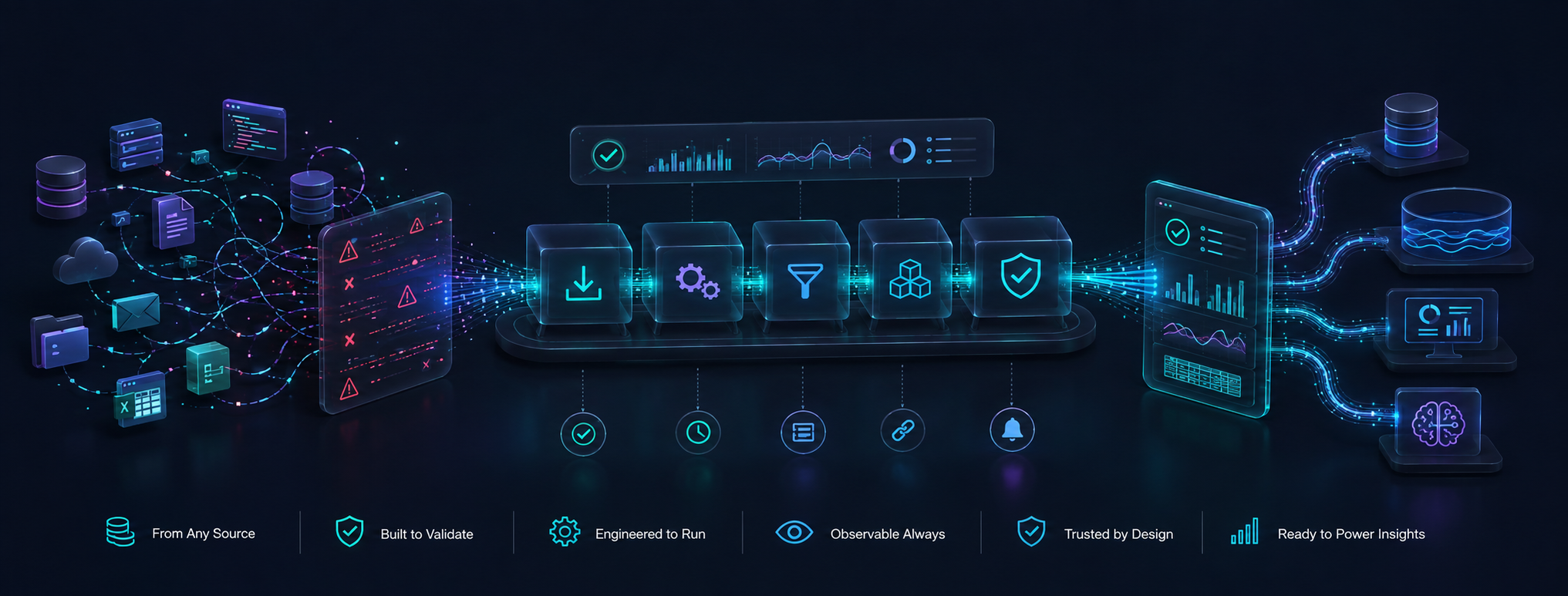
Without Engineered Pipelines
- Manual exports and one-off scripts nobody fully understands
- Reports that quietly break when a source system changes
- No record of where a number actually came from
- Failures discovered by the people reading the dashboard, not the team running the pipeline
With 3Shadz Data Engineering
- Version-controlled pipelines that run on a schedule and recover from failure
- Schema and quality checks that catch problems before data lands
- Lineage that shows exactly where every field originated
- Monitoring that flags issues before they reach a report
Pipelines Built Like Production Software
A pipeline that only works during the demo isn’t finished. Here’s what keeps ours running.
Engineering Discipline, Applied to Data
Pipelines are version-controlled, code-reviewed, and tested the same way application code is, so they don’t quietly rot after launch.
Orchestration by Default
Every pipeline is scheduled, retried, and alerted on, not run manually from someone’s laptop.
Quality Gates, Not Guesswork
Checks run inside the pipeline, so bad data is caught before it lands, not after someone questions a report.
Platform-Agnostic Engineering
Kafka, Spark, Airflow, dbt, or a warehouse’s native tools: chosen for the workload, not a vendor relationship.
Built to Extend
Architecture that accepts new sources and destinations without a redesign every time the business adds one.
One Team, Whole Data Practice
The same engineers who build your pipelines connect them onward to warehousing, BI, and governance.
Chosen for the Workload, Not the Vendor
We select ingestion, processing, and orchestration tools that fit your data volume, latency needs, and existing platform, not the tool we happen to prefer.
Ingestion & Integration
- Apache Kafka
- REST & webhook APIs
- Change data capture (CDC)
- Managed connector platforms
- File & SFTP ingestion
Transformation & Processing
- Apache Spark
- dbt
- SQL-based transformation
- Python-based processing
- Databricks
Orchestration & Scheduling
- Apache Airflow
- Cloud-native schedulers
- Event-driven triggers
- Workflow dependency management
- Automated backfills
Quality & Observability
- Automated validation frameworks
- Pipeline monitoring & alerting
- Data lineage tracking
- Anomaly detection
- Run & freshness dashboards
Data Engineering: Frequently Asked Questions
Data & Analytics, under Services, is the umbrella practice covering engineering, warehousing, scale, insight, and governance. Data Engineering is the specific discipline underneath it: the pipelines and infrastructure that move and prepare data reliably, which everything else in that practice depends on.
Data Engineering designs, builds, and operates the pipelines that move and transform data. Data Warehousing designs how that data is modelled and stored once it arrives. Most engagements involve both, often delivered as one continuous build rather than two separate projects.
Yes. We design batch, scheduled micro-batch, and streaming pipelines depending on how quickly a decision or downstream system actually needs the data, rather than defaulting to one pattern for everything.
Yes. We are platform-agnostic and regularly build on AWS, Azure, and Google Cloud, and work with tools such as Apache Spark, Kafka, Airflow, and dbt alongside warehouse-native options like Snowflake and Databricks, choosing what fits your existing stack.
Pipelines are built to detect schema and structural changes rather than fail silently. Depending on the change, that means an automated adjustment, a validation alert, or a controlled pause until the change is reviewed, so a broken assumption doesn’t quietly turn into bad data downstream.
Yes. Pipelines are monitored for freshness, volume, and quality after launch, and extended as new sources, destinations, and volume are added, rather than handed over and left untouched.
Let’s Build the Pipelines Your Analytics and AI Can Depend On.
Whether you need one pipeline, a full ingestion platform, or a team to take over pipelines already in production, our Data Engineering team can help you get there.