







Every Part of the Business Is Already Changing Something. Rarely in a Coordinated Order.
3Shadz Digital Transformation Consulting connects process redesign, customer and employee experience, data, applications, automation and operating-model change into one coordinated sequence, so transformation becomes a set of decisions an organization can actually execute, not a collection of initiatives moving independently.
What Transformation Means Here, in Practical Terms
Digital Transformation Consulting is the 3Shadz practice that determines what needs to change across processes, capabilities, customer and employee experiences, technology and operating model, and how those changes are coordinated and sequenced so an organization can realistically execute them.
It is not defined by a technology choice. Moving to the cloud, adding AI, or replacing a platform can each be part of a transformation, but none of them are the definition of one. Transformation is the discipline of connecting business change, process redesign, and technology enablement into a single coordinated programme instead of a set of parallel projects.
It is narrower than Technology Consulting as a whole, and distinct from IT Strategy Consulting: strategy sets technology direction and investment priority; this practice goes further into what changes across process, experience and operating model, and how those changes are sequenced alongside the technology work.
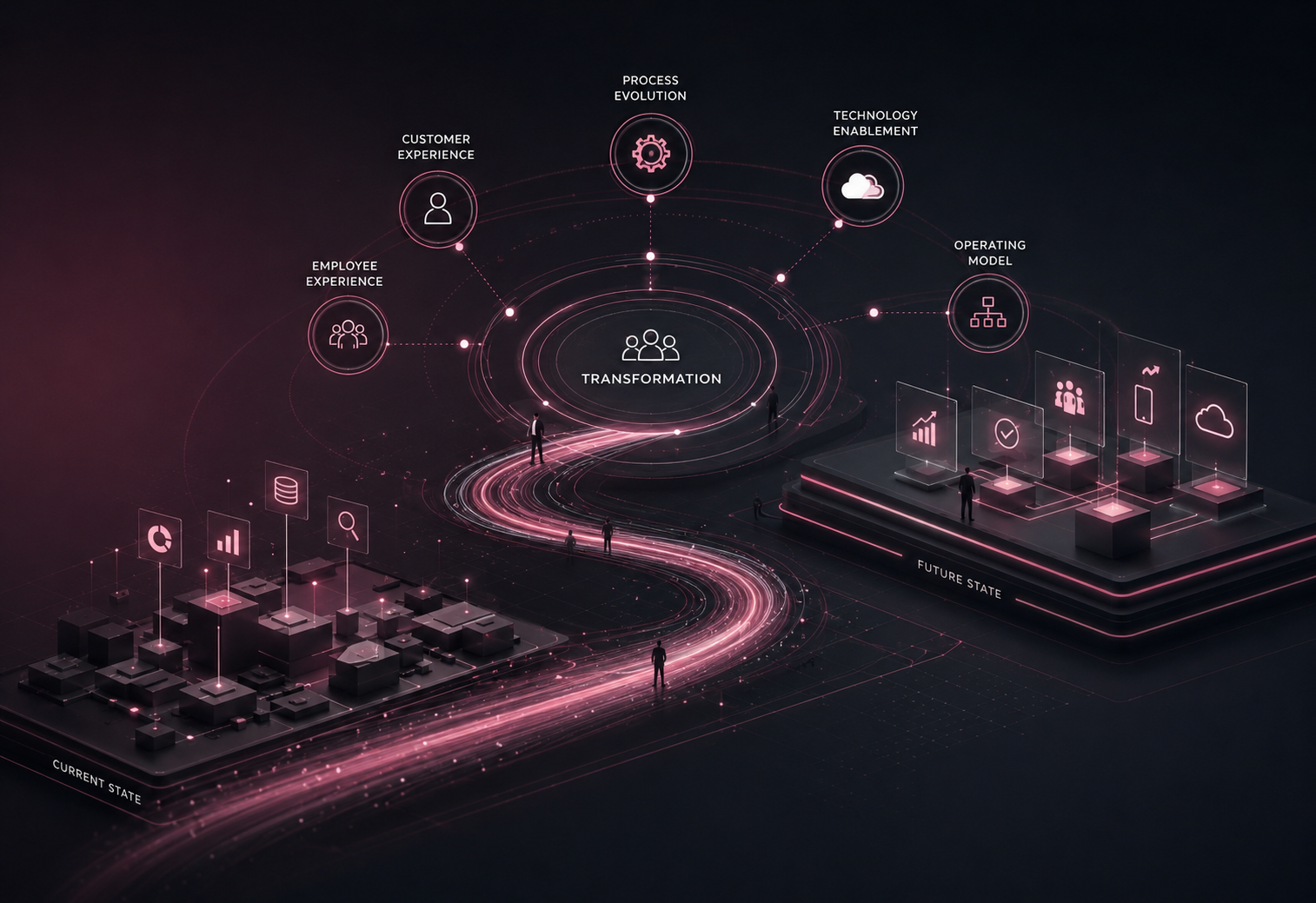
Transformation earns its name when process, experience and technology change together, not when one of them changes alone.
From Independent Initiatives to One Coordinated Sequence
Illustrative, not exhaustive: the point is that most of these pairs are already true somewhere in the organization at once.
Not a Technology Platform. A Business Consequence, Traced Through.
Digital transformation does not begin with a platform decision. It begins with what the business is trying to change, and a single objective usually requires coordinated movement across far more of the organization than any one team owns.
Business Outcomes
What the organization is actually trying to change or achieve.
Capability Gaps
What the organization can’t yet do well enough to reach that outcome.
Process Friction
Where work slows down, duplicates itself, or depends on a workaround.
Experience Problems
Where customers or employees feel that friction directly.
Technology Constraints
Where systems, data or integration limit what the process can become.
Transformation Opportunity
A specific, coordinated change worth prioritizing, not a generic initiative.
A Current-State Transformation Assessment, Before Any Target State
Before defining what should change, it helps to understand how the organization actually operates today, where friction exists, what causes it, and where technology quietly reinforces an inefficient process rather than a genuinely necessary one.
Business Capabilities & Customer Journeys
What the organization needs to be able to do, and how customers actually experience it end to end.
Employee Workflows & Manual Processes
Where work depends on manual effort, duplicated entry, or a workaround that has become permanent.
Applications, Platforms & Integrations
What each system supports, how they connect, and where handoffs between them create delay or risk.
Data, Cloud & Existing Automation
Where data actually lives, how workloads are hosted, and what automation or AI is already in place.
Not a Maturity Score
The goal isn’t a number. It’s a working understanding of where friction exists, what causes it, which capabilities constrain growth or service quality, and where coordinated change can create meaningful improvement.
Legacy Constraints & Technical Debt
Where aging systems or deferred decisions are quietly shaping what the business can and can’t do.
Skills, Governance & Existing Programmes
Whether the organization is structured to absorb change, and which transformation work already under way still earns its place.
Automating a Broken Process Just Makes It Faster
3Shadz doesn’t automate a process exactly as it exists. Before automation is even on the table, the process itself gets examined, what it’s for, what creates value, and what only exists because of a limitation somewhere else.
Some steps exist purely because of a system limitation from years ago. Separating value from inherited habit is the first useful finding.
Repeated approval or re-typed data usually signals that two systems, or two teams, were never properly connected.
These gaps are often where the most time is quietly lost, and where integration matters more than any single application change.
A process built around internal convenience can create real friction for the person on the other end of it.
A frequent “exception” is usually a sign that the standard path no longer matches how work actually happens.
Not every decision deserves the same level of discretion. Naming which ones do keeps automation focused where it belongs.
Six Honest Outcomes
Simplify
Remove steps that exist only out of habit or inherited limitation.
Redesign
Rebuild the process around how work should actually flow today.
Integrate
Connect the systems so information stops moving by hand.
Automate
Apply automation once the redesigned process deserves it.
Add AI Assistance
Support judgment-heavy steps where variability genuinely matters.
Remove Entirely
Retire steps that no longer serve a purpose worth keeping.
No Organization Transforms Everything at Once
Prioritization is structured decision-making, weighed across dimensions that rarely all point the same direction, not an arbitrary ranking or a fixed formula.
Business Consequence
What meaningful business problem or capability does this initiative actually address?
Customer or Employee Impact
Who experiences the improvement, and how directly do they feel it?
Dependency
What foundational work has to happen before this can realistically start?
Technology Readiness
Are the platforms, integrations and data foundations this depends on already in place?
Organizational Readiness
Can the teams involved actually absorb and adopt this change right now?
Risk
What happens if the organization changes, and what happens if it doesn’t?
Complexity
How many systems, teams and processes does this initiative genuinely touch?
Strategic Importance
How strongly does this support the direction the organization has already committed to?
A Coordination Mechanism, Not a Timeline of Projects
A useful roadmap shows how workstreams move together across horizons (which foundations come first, and what depends on them), rather than listing initiatives against dates and hoping they don’t collide.
Transformation Isn’t Finished When a System Goes Live
New technology layered onto an unchanged operating model tends to produce a more expensive version of the same problem. The goal is an organization that can operate, adopt, and keep improving the change, not just switch it on.
Roles, Ownership & Decision Rights
Who owns a process, a platform or a decision once the workshop ends: made explicit, not assumed.
Skills & Capability Building
What teams need to learn to operate the redesigned process or platform confidently.
Business & Technology Collaboration
New ways of working that keep business and technology decisions connected day to day, not just at launch.
Training & Enablement
Practical support for the people who have to work differently, sized to what actually changed.
Governance That Fits
Enough structure to keep decisions consistent, without adding process for its own sake.
Measurement & Continuous Improvement
A way to tell whether the change is working, and to keep adjusting it after go-live.
Considered Where They Serve a Specific Outcome, Not Everywhere
Data, automation and AI are enablers of transformation, not the definition of it. Each is connected to a specific business process, capability or experience, not applied because it’s available.
For deeper AI strategy and adoption planning, beyond where it fits inside a wider transformation, that work continues through AI Strategy Consulting.
Explore AI Strategy ConsultingTransformation That Changes How the Organization Works, Not Just What Technology It Owns
Processes Are Simpler
Digital tools support redesigned workflows rather than preserving unnecessary complexity.
Capabilities Connect
Applications, data, platforms and teams support the same business outcomes instead of evolving independently.
Modernization Has a Reason
Systems are changed because of business consequence, risk, capability or dependency, not simply because they are old.
Automation Removes Friction
Automation is applied where it genuinely reduces repetitive work, delays, errors or handoffs.
People Can Adopt the Change
Operating models, responsibilities and skills evolve alongside technology.
Dependencies Are Visible
Foundational work happens before dependent transformation initiatives are committed.
Progress Can Be Evaluated
Transformation is measured against defined business and operational outcomes, not the number of technologies implemented.
Transformation Can Continue
The organization develops the capabilities, governance and operating structures required to keep evolving after the initial programme.
Three Related Questions. Three Different Answers.
These practices are connected, and most engagements draw on more than one, but each answers a distinct question, and keeping that distinction clear keeps the work focused.
Where Should Technology Investment Go, and in What Order?
Sets direction and priority across the technology portfolio.
- Technology direction & investment priorities
- Portfolio decisions across applications and platforms
- Architecture principles and technology roadmaps
- Governance over technology decisions
What Needs to Change, and How Should the Change Be Sequenced?
Coordinates change across process, people, experience and technology.
- Business and process transformation
- Customer and employee experience change
- Coordinated modernization, automation and AI adoption
- Operating-model evolution and adoption
How Should a Specific System or Platform Actually Be Modernized?
Goes deep into modernizing a defined technology estate.
- Application and platform modernization pathways
- Architecture and technical-debt remediation
- Migration sequencing for a specific estate
- Often one workstream inside a wider transformation
One of Six Connected Technology Consulting Capabilities
Digital Transformation Consulting typically draws direction from IT Strategy Consulting and hands off to Technology Modernization Consulting, AI Strategy Consulting and Enterprise Architecture Consulting as specific workstreams take shape: all inside the wider Technology Consulting practice.
Digital Transformation Consulting: Frequently Asked Questions
No. The starting point is business outcomes, process friction and experience gaps, not a preference for newer technology. Some findings lead to replacement; many lead to redesigned processes, better integration, or targeted automation around systems that stay exactly where they are.
No. Many engagements begin with a general sense that digital initiatives feel disconnected, or that a modernization effort keeps stalling, without a fully worked-out plan. Assessing the current state (capabilities, processes, journeys, systems and constraints) is the starting point, not a prerequisite for it.
IT Strategy Consulting sets technology direction and investment priority. Digital Transformation Consulting goes further into what needs to change across processes, experiences, operating model and adoption, and how those changes are sequenced together with the technology work. Most engagements draw on both.
Technology Modernization Consulting goes deep into modernizing a specific application, platform or architecture. Digital Transformation Consulting is broader: modernization is often one workstream inside a wider transformation that also includes process redesign, experience change, data enablement, automation and operating-model adoption.
No. Automation and AI are considered once the underlying process has been examined, and applied where they measurably reduce friction, not by default. Some findings lead to simplifying or removing a step rather than automating it exactly as it exists today.
Digital Transformation Consulting sits alongside 3Shadz’s engineering, cloud, data, AI and design practices, so recommended sequencing is checked against what can realistically be built, integrated, migrated and adopted, not just what looks right on a roadmap slide.
Before the Next Initiative Gets Funded, Let’s Confirm It Moves With the Rest of the Business.
Whether digital initiatives feel disconnected, modernization keeps stalling, or nobody can quite say what should change first, the opening conversation is about clarifying that decision, not committing to a large engagement.