











Confidence Isn’t Declared. It’s Verified.
3Shadz designs and runs the validation layers that stand between a code change and a confident release (functional accuracy, integration behaviour, performance under load, and cross-device consistency), so releases are governed by evidence, not hope.
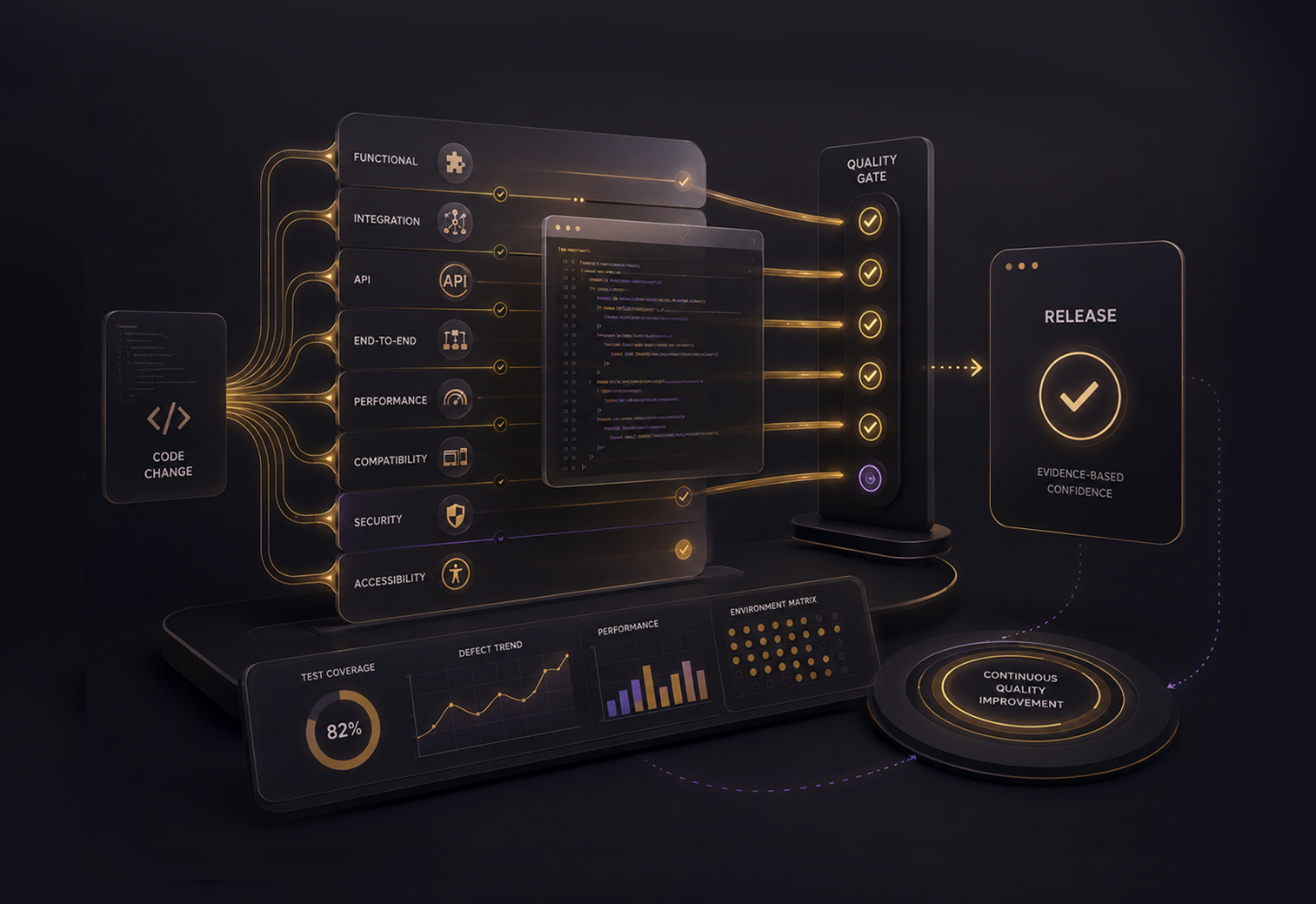
Quality Engineering, Not a Final Checklist
QA & Software Testing is the discipline of building evidence into a release before it ships, not a phase that starts once development is declared finished.
3Shadz assesses existing test coverage, tooling and bottlenecks, designs a test architecture that mirrors how your application is actually built, and validates it across functional, integration, API, end-to-end, performance and compatibility layers, automating what's worth automating and reading the results as one connected picture, not a stack of independent reports.
The goal isn't a defect-free promise: no honest testing practice can make one. It's shortening the distance between a change and the moment its consequences are understood, so releases are decided on evidence rather than optimism.
This Isn’t What Testing Looks Like Here
Most of what makes testing feel like a bottleneck isn’t testing itself: it’s where it sits in the process and how little strategy sits behind it.
Scoped to What Your Application Actually Needs
Every engagement draws from these seven areas, applied selectively, based on risk, not offered as a fixed bundle.
Strategy & Test Architecture
Where a quality effort starts, before a single test case is written.
Functional & Regression
Confirming the application still does what it’s supposed to, release after release.
Integration, API & End-to-End
Validating how components, services and journeys actually connect.
Web, Mobile & Cross-Platform
Confirming consistent behaviour across the environments your users are actually in.
Automation & Continuous Testing
Making repeatable checks part of every build, not a separate event.
Performance & Reliability
Understanding how the application behaves under real and extreme conditions.
Quality Operations
The connective work that turns testing into release confidence and continuous improvement.
Quality Is Decided Long Before a Test Runs
Effective QA looks at requirements, architecture, implementation, integrations, automated validation, release readiness and production behaviour as one continuous chain, not a screen to click through once the build is finished.
Structured QA doesn’t promise a defect-free release: it shortens the distance between introducing a problem and finding it. A defect caught during automated validation is normally a smaller, cheaper, better-understood fix than the same defect discovered after your users already have it.
No Single Layer Is Enough on Its Own
Application quality isn’t established by one kind of test. These layers compound: each one structurally catching what the others can’t.
Unit-Level Confidence
Owned primarily by engineering teams, validating isolated logic before it reaches any shared environment.
API & Integration Testing
Validating contracts, payloads, authentication, dependencies and error handling between services.
Functional Testing
Confirming that business features behave according to the requirements they were built against.
End-to-End Testing
Validating the journeys that connect several components the way a real user actually experiences them.
Regression Testing
Verifying that existing functionality keeps working as the application continues to change.
Performance & Reliability Testing
Validating behaviour under realistic and abnormal workloads, not just correctness.
Compatibility & Accessibility
Confirming the people the product is built for can actually use it, across supported environments.
Automation That Earns Its Place in the Pipeline
Not every test belongs in an automated suite. We identify what’s worth automating, then build a framework substantial enough to keep paying off as the application grows.
What We Choose to Automate
- Stable enough that the test itself won’t need constant rewriting
- Repeated often enough across releases to justify the investment
- High-value from a regression perspective, protecting business-critical paths
- Suitable for unattended execution inside CI/CD
- Relevant across multiple environments, browsers or device configurations
A useful automation framework is judged on how it behaves eighteen months in, not on day one. We design for maintainability and clear ownership from the start, so the suite keeps paying off as the application changes instead of becoming something nobody trusts enough to fix. Automation is how 3Shadz protects feedback speed as an application grows, not a way to remove people from testing.
Tested Against How the Application Is Actually Used
Performance testing means little without a realistic definition of load. We build workload scenarios from your actual usage patterns and business calendar, then push beyond them to see where things give way.
Feedback Placed Close to the Change That Caused It
Not every test belongs at every stage. We weight what runs where by execution time, risk, and how critical the release actually is, so the pipeline stays fast enough that teams don’t route around it.
Commit
Unit-level checks and static analysis
SecondsBuild
Fast smoke and sanity checks against the new build
MinutesAutomated Validation
Functional, API and regression suites run automatically
MinutesIntegration Validation
Cross-service and contract checks against connected systems
Tens of minutesDeployment Candidate
End-to-end and targeted performance checks on a release candidate
On demandRelease Checks
Business-critical journeys and agreed readiness criteria
Before go-liveThe goal is fast feedback, not maximum coverage at every stage. Slow, high-value checks are placed where they can run without blocking the changes that don’t need them.
A Defect List Isn’t the Same as Understanding Why
Executing tests is only half the discipline. What happens after something fails is what actually improves the system.
Symptom Reported
What failed, where, and how severe the business impact is
Reproduced
Confirmed reliably, with the versions and conditions it affects
Isolated
Narrowed to the component responsible, and whether related functionality is at risk
Root Cause Identified
Traced past the symptom to why it happened, not just where
Prevention Control Added
A test or engineering control put in place so it doesn’t resurface
Signals for a Decision, Not a Score
Release readiness isn’t a single number. It’s read from several signals together, weighed against the risk and criticality your team already agreed on.
Release readiness depends on context: what the application does, who it affects, and the acceptance criteria agreed before the cycle began. The same open item might block a payments release and be perfectly acceptable on an internal tool, which is exactly why 3Shadz doesn’t reduce it to one score.
Releases That Don’t Depend on Crossing Your Fingers
Quality becomes visible before software reaches production, not something you find out about from your users.
Failures Are Found Closer to the Change
Automated and targeted validation shortens the distance between introducing a defect and discovering it, so the person who can fix it fastest still remembers what changed.
Regression Becomes Repeatable
Important existing behaviour is checked the same way every time, instead of being manually reconstructed under pressure before each release.
Release Risk Is Visible
Known defects, validation results, coverage gaps and performance findings are surfaced before a go-live decision is made, not discovered after.
Production Teaches the Test Strategy
Incidents and escaped defects become inputs for improving what gets tested next time, instead of being treated as isolated, unrelated events.
QA & Software Testing Doesn’t Work in Isolation
Quality improves when testing, engineering, deployment and support read the same signals, not when they operate as disconnected stages handing off a ticket. The same 3Shadz team can reach into the disciplines your application actually touches.
Once your application is live, that same continuity carries into Application Support & Maintenance, or head back to Quality Assurance & Support to see how both capabilities work together.
Practical Tooling, Chosen to Fit Your Stack
We select automation, performance and defect-management tooling around your existing environment and team, rather than standardizing on one vendor.
Test Automation & Frameworks
- Selenium
- Playwright
- Cypress
- Appium
API & Contract Testing
- Postman
- REST Assured
- SoapUI
- Pact
Performance & Load
- Apache JMeter
- k6
- Gatling
- Locust
Test & Defect Management
- TestRail
- Xray
- Jira
- Azure DevOps
QA & Software Testing: Frequently Asked Questions
We weigh stability, repetition, and regression value together. Scenarios that repeat every release, behave consistently, and protect business-critical paths are strong automation candidates; exploratory checks, usability judgment calls, and rapidly changing screens usually stay manual until they settle down.
Yes. We start by reviewing what exists (coverage, stability, maintainability, and how it fits your pipeline) before deciding what to keep, refactor, or replace. Most engagements build on what’s already there rather than starting from zero.
We work from what’s known (current traffic patterns, business calendars, seasonal peaks, planned campaigns) and build realistic scenarios from that, rather than picking arbitrary concurrency numbers. Where data is thin, we test a defensible range and document the assumptions behind it.
Readiness is read from several signals together (regression results, known defect risk, integration stability, performance findings, and coverage of business-critical journeys) against criteria agreed before the cycle starts. That combination tells you more than one number ever could, and it’s specific to what your release actually carries.
Deterministic parts of the system (APIs, data handling, UI logic) are tested the way any application is. Non-deterministic outputs need additional validation around expected ranges, guardrails, and failure behaviour, which we scope alongside the rest of the test plan rather than treating as a separate discipline.
We design around your existing pipeline rather than asking you to change it: fast checks run close to the commit, deeper suites run at stages your pipeline already supports, and we work with whoever owns your CI/CD tooling, in-house or our own Cloud & DevOps team, to wire it in.
Let’s Build the Validation Layer Your Releases Actually Need.
Whether it’s a single testing engagement, an embedded QA function, or a full automation build-out, our QA & Software Testing team can scope it around your application and your risk.