



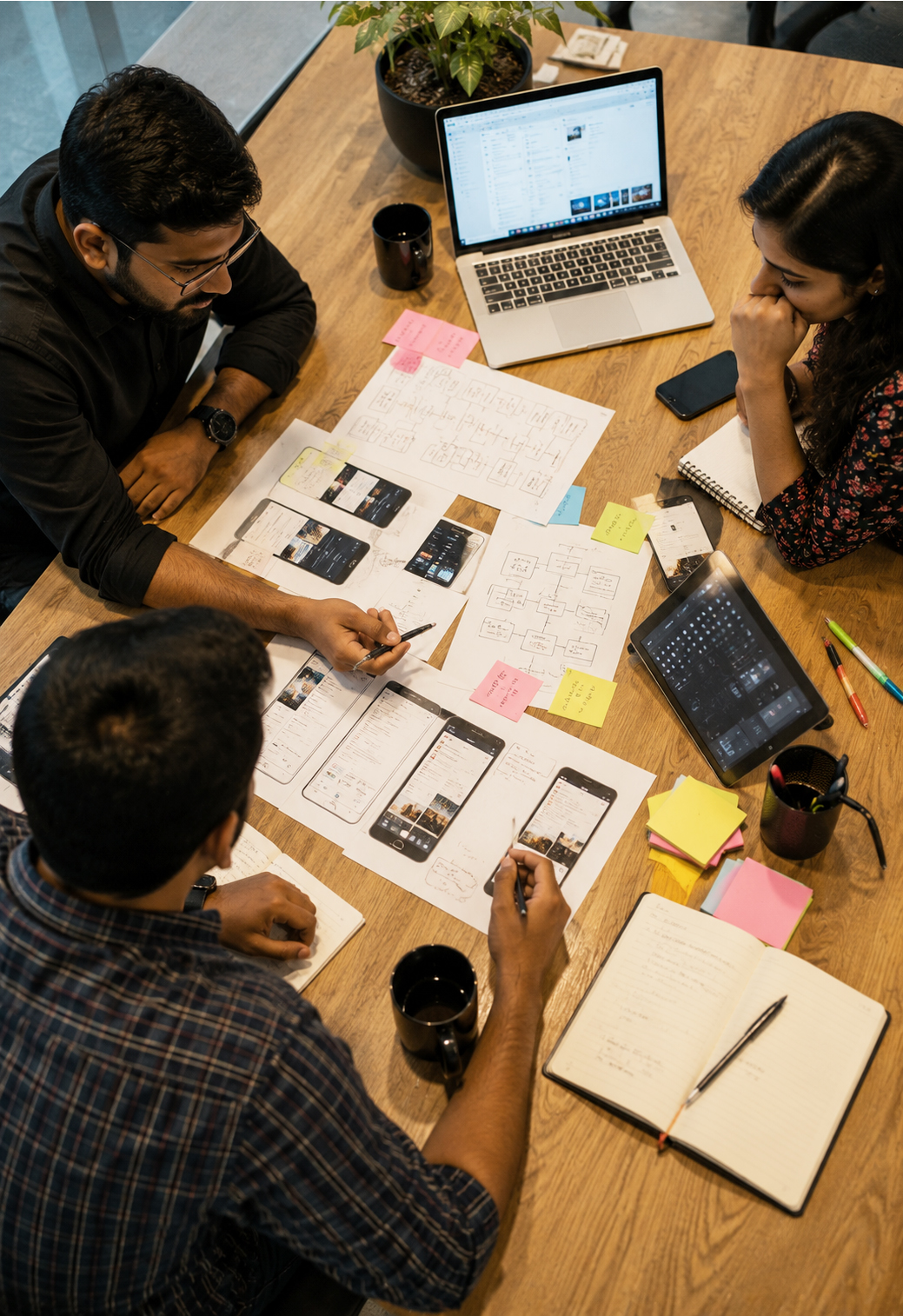







Every Great Product Was Once a Rough Sketch
We take a product from an open question to a launch-ready interface: one connected process, not a stack of disconnected deliverables handed between vendors.
3Shadz Product Design covers discovery sprints, 0-to-1 product design, redesigns of live products, and ongoing fractional design support, whichever stage your product is actually at right now.
Every engagement is scoped around what proves the idea first. We would rather ship a smaller, validated version of the right product than a complete version of the wrong one.
- 01 Concept to launch, one team throughout
- 02 Scoped to the MVP, not the whole vision
- 03 Every stage ends in something engineering can use
A Product Is a Series of Decisions, Not a Single Screen
The hardest part of building a product is rarely the interface. It is deciding what the product should actually do first.
Most product ideas do not fail because the screens looked wrong. They stall because the scope grew before anything was validated, or because the team designed the entire vision before testing whether the core idea held up at all.
Product design at 3Shadz starts by separating what proves the idea from what can reasonably wait. We design the smallest version that answers the real question, then use what we learn from it to decide what earns a place in the next release.
That discipline carries through every stage, from a rough concept sketch to a launch-ready screen your engineers can build without guessing.
Four Ways to Bring In Product Design
Pick the one that matches where your product actually is, not a fixed package that assumes every product starts from zero.
Discovery Sprint
A short, focused sprint that turns an open idea into a validated direction, before anyone commits budget to a full build.
- Problem framing & goal alignment
- Competitive & market scan
- Rapid concept sketches
- Stakeholder-tested direction
- Scoped recommendation for what comes next
0 → 1 Product Design
End-to-end design for a product that does not exist yet, from user flows through a launch-ready UI kit, staying involved through build.
- User flows & journey mapping
- Wireframes & information architecture
- MVP-scoped screen design
- High-fidelity UI design
- Interactive prototype
- Developer-ready handoff
Redesign & Iteration
Structured improvement of a live product, grounded in a usability review of what exists today, not a guess at what might look better.
- Heuristic & usability review
- Friction point prioritization
- Incremental or full redesign
- A/B-ready variant design
- Design QA during rollout
Fractional Product Design
An embedded product designer for teams that need ongoing design capacity without hiring a full in-house team.
- Weekly or sprint-based cadence
- Backlog-driven screen design
- Direct collaboration with engineering
- Design system upkeep
- Flexible scale up or down
Six Principles Behind Every Product We Design
Not a style guide: the working beliefs that settle arguments when a scope or design decision is not obvious.
Design for the MVP, Not the Vision Deck
Ambitious roadmaps are useful context, not a spec. We design what proves the idea now and leave clear seams for what comes later.
Validate Before You Build
A clickable prototype in front of a real user is worth more than another week of internal debate about a button.
Flows First, Screens Second
A beautiful screen in the wrong place in a flow is still a broken product. We settle the journey before we settle the pixel.
Every Screen Earns Its Complexity
If a simpler layout does the same job, it wins. Complexity is a cost, not a sign of effort.
Design Ends at Handoff, Not Before
A file that only lives in Figma has not shipped. We stay involved through build so the design and the product stay the same thing.
Ship, Then Iterate
Launch is a checkpoint, not a finish line. We treat real usage after launch as the next round of research.
From Early Concept to Launch-Ready Product
The same path every product takes through our process (idea and discovery, wireframing, design, development, and launch), laid out in one frame.
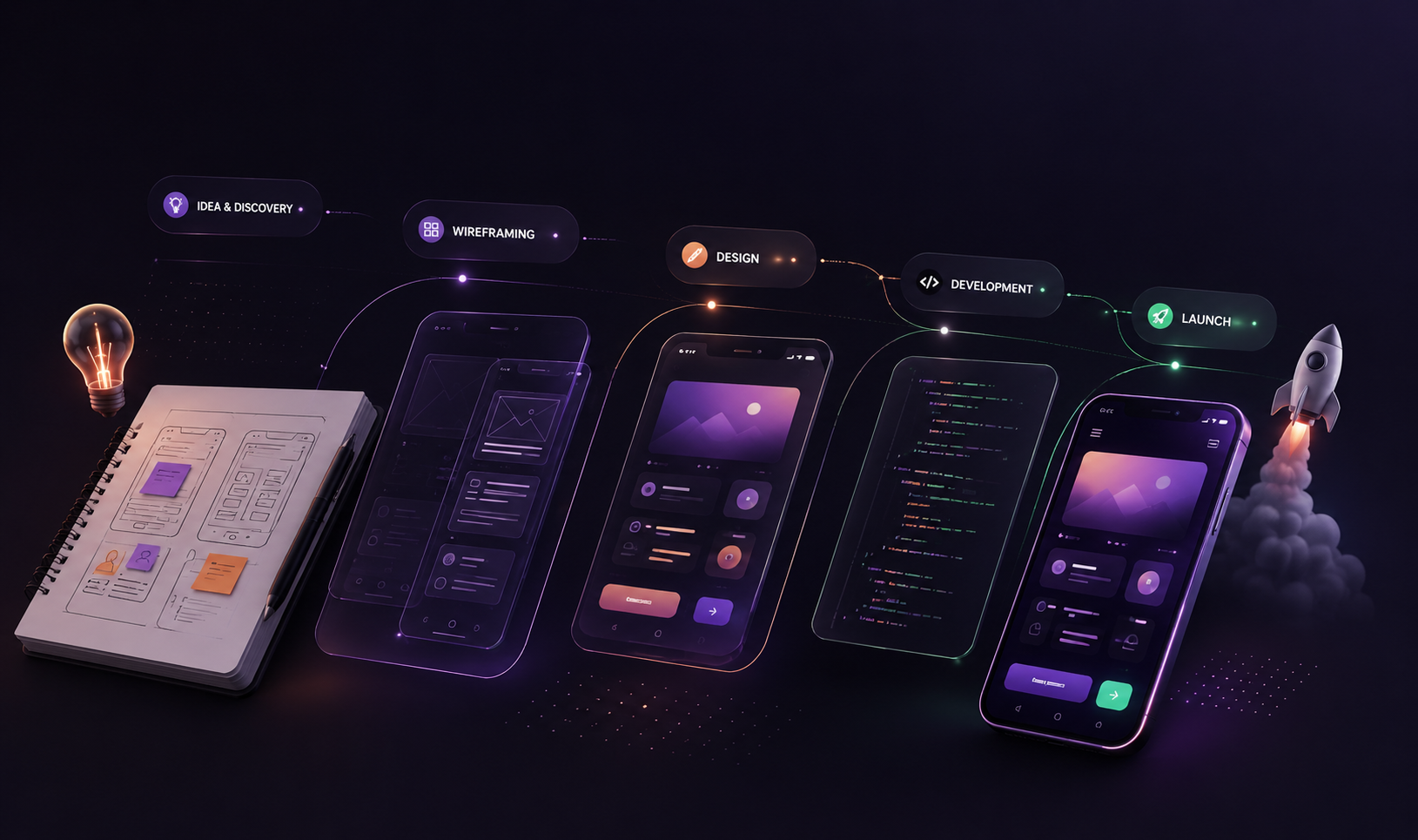
What typically changes along the way: validated user flows, a clear visual hierarchy, consistent spacing and components, higher-contrast text, and a scope trimmed down to what the product actually needs for launch.
From Open Question to a Product Engineering Can Build
The same six stages apply to a Discovery Sprint and a full 0-to-1 engagement, only the depth of each stage changes.
-
01
Discover
We learn the product, the users, and the constraint that actually matters before proposing a direction.
-
02
Scope the MVP
We separate what proves the idea from what can wait, so the first build stays achievable.
-
03
Concept & Flow
Rough concepts and user flows settle the structure before any screen is polished.
-
04
Prototype & Validate
Clickable prototypes go in front of real users, and findings get folded back before build.
-
05
Design & Polish
Wireframes become launch-ready, high-fidelity screens with documented states.
-
06
Handoff & Launch
Structured specs ship to engineering, and we stay involved through launch for design QA.
Deliverables From a Product Design Engagement
Exactly what is included is scoped up front: this is the typical set for a 0-to-1 or redesign engagement.
User Flows & Journey Maps
The paths real users take through the product, mapped before any screen is designed.
Wireframes & IA
Structure and information architecture that decide what happens on which screen.
Clickable Prototype
A testable, interactive version of the core flows, ready for real users to react to.
High-Fidelity UI Kit
Launch-ready screens with a consistent visual language across the whole product.
Design Tokens Starter
Color, type, and spacing tokens your team can extend into a full design system later.
Developer Handoff Specs
Structured redlines and component states delivered in a form engineers can build from.
Usability Test Notes
What real users did with the prototype, and what changed because of it.
Post-Launch Design Support
Design stays available after launch to refine flows as real usage reveals what to improve.
Chosen Around the Stage Your Product Is At
Figma is home base for almost every engagement. The rest is selected based on whether we are validating a concept or shipping a launch-ready product.
- Maze
- UserTesting
- Dovetail
- Miro
- Notion
- Google Forms
- Figma
- Adobe XD
- Sketch
- Framer
- Adobe Illustrator
- Adobe Photoshop
- Figma Dev Mode
- Zeroheight
- Storybook
- Zeplin
- Notion
- Confluence
- Hotjar
- Microsoft Clarity
- Google Analytics
- Lookback
- UsabilityHub
- Amplitude
Product Design Work Across Industries
The product changes with the industry. The discipline of scoping and validating it does not.
Healthcare
Patient-facing and clinical products designed for clarity under pressure.
Banking & Financial Services
Regulated products validated early, so compliance is a constraint, not an afterthought.
Retail & E-Commerce
Browsing, cart, and checkout products designed to reduce friction at every step.
Education & EdTech
Learning products scoped to a first release that proves engagement, not the entire curriculum.
Travel & Hospitality
Booking and guest products designed to feel effortless under time pressure.
Real Estate
Listing and portfolio products that make large amounts of imagery and data usable.
Marketplaces & Platforms
Multi-sided products designed and validated for buyers, sellers, and admins at once.
Startups
Lean, testable MVPs that help a first version earn its next round of funding or feedback.
One Product, One Team
Discovery, design, and handoff stay with the same people throughout, not split across vendors.
MVP-Minded by Default
We scope for what proves the idea first, not the full vision on day one.
Validated, Not Guessed
Prototypes get tested with real users before anything is finalized.
Built for Engineering
Every file is structured for handoff, because a design that cannot be built cleanly is not finished.
Systems-Aware
New screens are assembled from a growing, documented pattern set instead of a blank canvas each time.
You Own Everything
Figma files, prototypes, and documentation are handed over: you are never locked out.
A Product Design Partner Embedded in the Build
Great product thinking that lives only in a slide deck rarely survives contact with a sprint deadline. We stay close to engineering through build, review implemented screens against the design, and treat scope as something to defend, not just document.

Product Design Works Best Connected to Everything Around It
A product decision rarely stays isolated to one discipline: here is what it connects to.
Product Design + UI/UX Design
Take validated flows into a full, high-fidelity interface across your whole product.
Explore UI/UX DesignProduct Design + UX Research
Ground scope and prioritization decisions in real interviews, tests, and usage data.
Explore UX ResearchProduct Design + Design Systems
Turn the patterns that emerge from a 0-to-1 build into a documented, reusable system.
Explore Design SystemsProduct Design + Software Engineering
Hand off a design your engineers can build without re-interpreting it screen by screen.
Explore Software EngineeringProduct Design + Technology Consulting
Fold product and technical constraints into the same roadmap conversation.
Explore Technology ConsultingSee All Services
Review the full set of 3Shadz services and how product design fits into the wider picture.
Explore All ServicesProduct Design FAQs
Product design is the end-to-end shaping of a digital product, from the first rough concept and user flows through to a launch-ready interface, staying involved through build. UI/UX design is one part of that: the interface and interaction layer. Product design also covers problem framing, MVP scoping, and the decisions about what gets built first, which sit upstream of any specific screen.
Both. 0-to-1 engagements take a product from an open idea to a launch-ready interface, while redesign and iteration engagements start with a usability review of what already exists so changes target real, observed friction instead of guesswork.
A Discovery Sprint is a short, focused engagement that turns an open idea into a validated direction: problem framing, a competitive scan, rough concepts, and a scope recommendation. It is not required before every engagement, but it is worth it whenever the problem, the users, or the right first version are not yet settled.
We work through what the product needs to prove first, then group everything else into what can reasonably wait. In practice this looks like a prioritized scope (what is essential to test the core idea, what strengthens it once that is validated, and what is explicitly deferred), agreed with your team before design work starts.
Typically: user flows and information architecture, wireframes, a high-fidelity UI kit, an interactive prototype, and developer-ready handoff specs covering spacing, type, color, and interaction states. Exactly what is included is scoped up front around what your engineering team needs to build from it.
We work alongside your team by default. Product managers stay involved in scoping and prioritization, and engineers are looped in early so feasibility questions surface before a design is finalized rather than after handoff, when they are far more expensive to fix.
As involved as you want to be. Most engagements include regular review checkpoints where you see work in progress and give direction, rather than a single reveal at the end. Teams with limited bandwidth can lean on us for day-to-day decisions within an agreed scope and direction.
Fractional product design is an embedded designer working on a weekly or sprint-based cadence against your backlog, without you hiring a full-time in-house designer. It suits teams that need consistent design capacity but do not yet have enough ongoing work to justify a full-time hire.
Carefully. We start with a usability and heuristic review of the live product and, where possible, usage data or support feedback, so changes address proven friction rather than disrupting flows that are already working well for real users.
A Discovery Sprint typically runs one to two weeks. A 0-to-1 design engagement for a focused MVP usually spans several weeks to a few months depending on scope, while fractional engagements run on an ongoing basis. We scope in phases so usable screens reach your engineers early instead of arriving all at once at the end.
Wherever the timeline allows. Clickable prototypes are tested with real users or stakeholders before a flow is finalized, so decisions are backed by observed behavior. Deeper research (interviews, usability testing, surveys) can also run as a standalone engagement through our UX Research team.
Share the product idea or the product you already have, who it is for, and what stage it is at: a concept that needs validating, an MVP that needs designing, or a live product that needs to work better. We will recommend where to start, whether that is a Discovery Sprint, a full 0-to-1 engagement, or a focused redesign.
Tell Us the Idea. We’ll Help You Find the Version Worth Building.
You do not need a finished spec to start a conversation. Tell us about the product you want to build, the one that is not converting the way it should, or the backlog you need extra design capacity to work through. We will help you decide what to validate, what to design first, and how to hand it to engineering in a form that actually ships.