










Plenty of Technology Options. Rarely a Clear Way to Choose.
3Shadz Technology Consulting connects business priorities, architecture, investment and governance into one coherent set of decisions, so technology change happens in the right order, for the right reasons, at a pace the organization can actually sustain.
Direction Before Investment, Not Instead Of It
Technology Consulting is the 3Shadz practice that connects business direction to technology decisions, before those decisions harden into expensive constraints.
It is not a slide deck of recommendations, a nudge toward the newest platform, or a generic framework applied regardless of context. It is the discipline of helping organizations decide what to invest in, what to modernize, what to leave alone for now, and in what order, in a way that is commercially relevant, technically realistic, and connected to measurable business priorities.
Consulting on its own can produce a confident-sounding plan that nobody can execute. That is why every recommendation is checked against your architecture, your teams, your budget, and your existing commitments, not just against best practice.
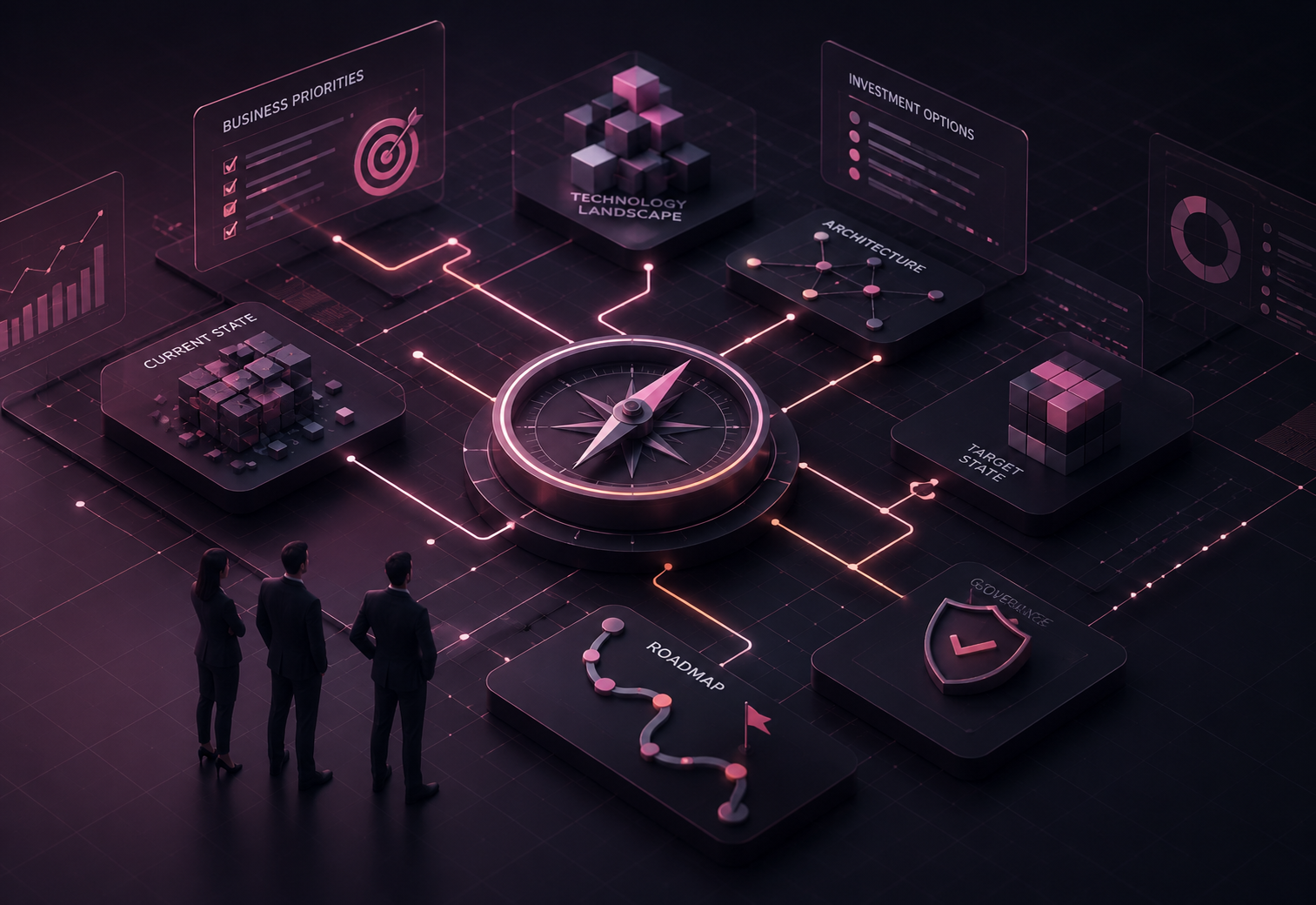
Strategy should survive contact with the systems, teams, budgets, dependencies and constraints that have to execute it.
The Situations That Usually Start the Conversation
There is rarely a single trigger. Engagements tend to begin wherever the friction is currently greatest, and grow into the connected capabilities from there.
Investment & Overlap
Legacy & Technical Debt
Architecture & Governance
AI & Transformation
Leadership
Before Any Target State, a Landscape Worth Trusting
Technology Consulting does not begin with a future-state architecture. It begins with making the current landscape legible, what exists, why it was introduced, what depends on it, and where the real constraints sit.
The questions below shape that view. Expand any of them to see what we’re actually looking for.
Systems often outlive the decision that created them. Understanding the original intent clarifies whether a constraint is still relevant or simply inherited.
A platform that looks minor on an architecture diagram can sit underneath a capability the business cannot operate without. Dependencies, not diagrams, determine risk.
Overlap usually accumulates quietly, one reasonable decision at a time. Naming it is the first step toward a consolidation decision that is actually worth making.
When a roadmap keeps quietly avoiding a certain system, that is usually a signal worth investigating rather than working around indefinitely.
Not every system deserves the same level of investment or caution. Distinguishing importance from inertia changes where attention goes next.
Concentration risk is a technology risk even when the system itself is stable. It shapes how urgently certain decisions need to move.
Momentum is not the same as value. Some initiatives deserve acceleration; others deserve a deliberate, honest close-out.
Effort and outcome do not automatically track together. Separating the two is often the single most useful early finding.
Decisions made in good faith at the leadership level sometimes conflict with a dependency nobody surfaced. Making these visible is what lets prioritization hold up under pressure.
The Trade-Offs Behind Almost Every Recommendation
None of these has one universally correct answer. The right choice depends on business priorities, economics, architecture, timing, organizational readiness, technical risk, and the cost of change, not a fixed rule applied everywhere.
Depends on whether the cost of waiting is rising faster than the cost of acting.
Depends on whether the capability is a genuine differentiator or a solved problem elsewhere.
Depends on how much of the existing system’s value is in logic worth preserving.
Depends on how much local autonomy is worth the coordination cost it creates.
Depends on whether variation is serving a real need or just accumulated exceptions.
Depends on whether overlap is causing real friction or is simply cosmetic duplication.
Depends on whether the task rewards judgment and variability, or needs to be exactly repeatable.
Depends on whether the organization can absorb the change without destabilizing what already works.
One Practice, Working as a Connected System
These capabilities are not six unrelated offerings filed under one menu heading. Each hands something to the next (direction into transformation, transformation into architecture, architecture into modernization) with leadership judgment running across all of it.
IT Strategy Consulting
Establishes where technology investment should support the business, and where it currently doesn’t.
Explore IT Strategy ConsultingDigital Transformation Consulting
Connects that direction to operating models, processes, and the experiences customers and employees actually have.
Explore Digital Transformation ConsultingAI Strategy Consulting
Determines where AI belongs inside that wider strategy, and just as importantly, where it doesn’t yet.
Explore AI Strategy ConsultingEnterprise Architecture Consulting
Translates strategic intent into coherent technology structures, boundaries, and decision principles.
Explore Enterprise Architecture ConsultingTechnology Modernization Consulting
Determines how existing systems need to evolve toward the target capabilities, and in what order.
Explore Technology Modernization ConsultingCTO as a Service
Ongoing technology leadership and judgment across strategy, transformation, AI, architecture and modernization, for organizations that need it before, or instead of, hiring a permanent executive.
A Living Decision System, Not a Document Filed Away
Technology strategy is treated as something revisited as conditions change, rather than a report reviewed once and left on a shelf.
Understand the Landscape
Map business priorities, systems, architecture, investments, constraints, teams and existing transformation initiatives.
Make the Trade-Offs Visible
Surface duplication, dependencies, technical debt, risks and capability gaps, and the decisions that can’t all be optimized at once.
Define the Direction
Establish principles, target capabilities, architecture direction, investment priorities and decision criteria.
Sequence the Change
Turn ambition into initiatives that can realistically be funded, governed, staffed and delivered.
Govern the Decisions
Put mechanisms in place that keep technology decisions aligned as conditions change.
Revisit the Strategy
Treat the strategy as a living decision system, checked and adjusted rather than reviewed only once every few years.
Sequencing, Not a Fixed Timeline
Not every decision belongs at the same distance. Separating what needs attention now from what depends on groundwork not yet in place is part of what makes a roadmap usable.
Immediate constraints and high-confidence improvements
- Critical risks that cannot wait
- Decisions currently blocking other decisions
- Well-understood improvements with limited downside
Architecture and capability changes already in motion
- Platform and consolidation decisions
- Modernization programs and operating-model changes
- Capability development that supports the next stage of growth
Larger shifts that depend on groundwork already in place
- Emerging technology adoption, including further AI capability
- Larger architectural shifts across the portfolio
- Strategic capabilities that only become viable once earlier decisions have settled
What a Useful Technology Roadmap Actually Connects
A roadmap that only lists projects and dates rarely survives contact with a changed budget or a new priority. A useful one connects what changes, why it changes, what depends on it, and what decision becomes possible once it’s done.
Coherent Structure Is a Business Decision Before It’s a Technical One
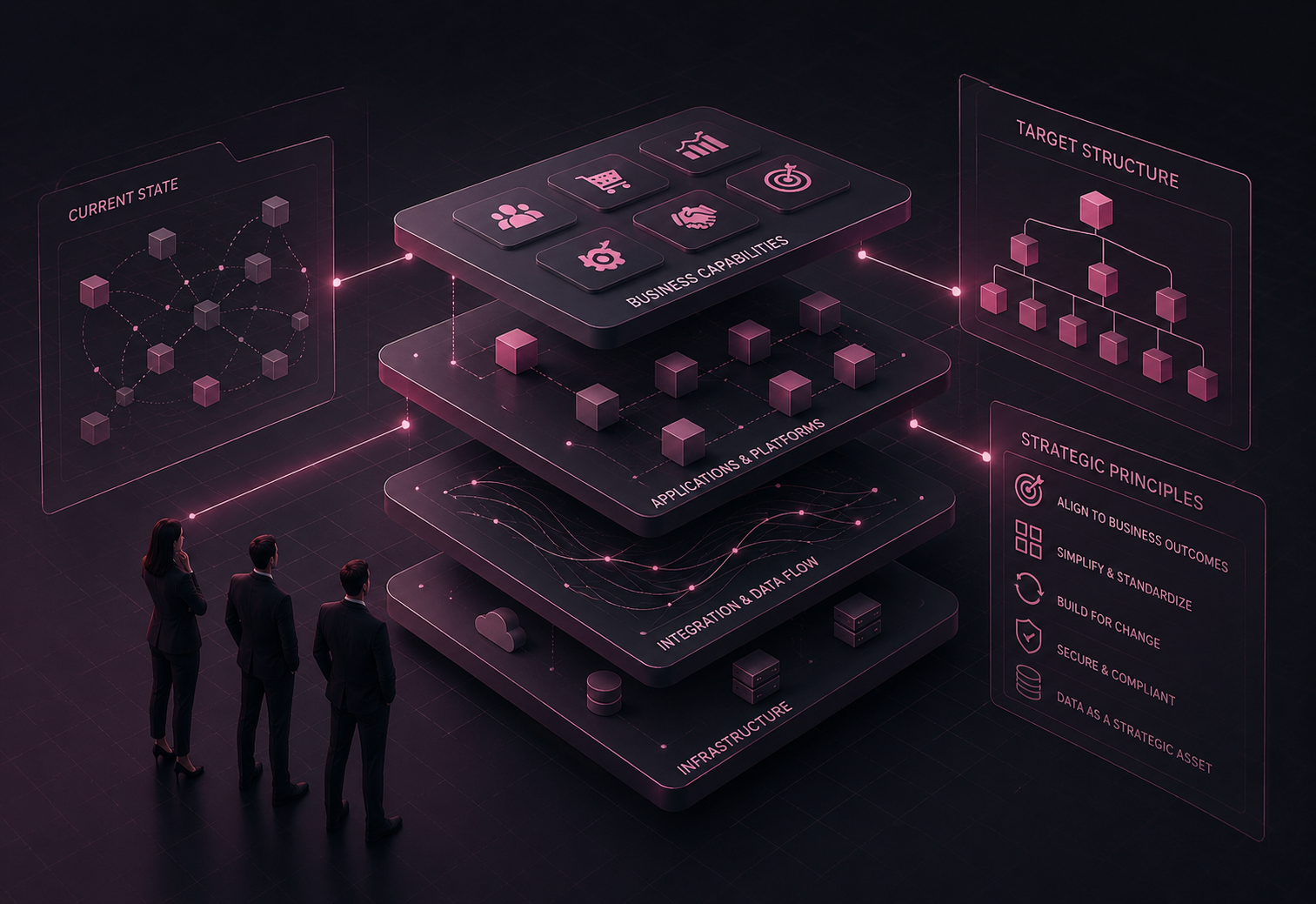
Enterprise Architecture Consulting is one of the connected capabilities, so architectural thinking runs through this practice, but at the level a CIO, COO or product leader needs, not a build-level engineering discussion.
That means business capabilities mapped to the platforms that support them, overlapping systems made visible, integration dependencies traced, and a target structure defined in terms of principles, not a specific technology stack chosen in advance.
For architecture at the implementation level (system design, APIs, application modernization work) that continues through Software Engineering and Enterprise Architecture Consulting.
The right choice rarely comes from a framework applied the same way everywhere. It comes from weighing economics, architecture, timing, organizational readiness, and the cost of change, for this organization, at this point in its history.
Often, the most useful outcome of a consulting engagement is a clear, well-reasoned decision to leave something alone for now.
Recommendations Shaped by People Who Also Build the Systems
Technology Consulting sits alongside 3Shadz’s delivery practices, not apart from them. That proximity is what keeps a roadmap grounded in what a team can actually staff, fund and deliver, not just what sounds right in a workshop.
Not a Score. A Set of Things Made Clear
Business Alignment
Technology priorities linked to business priorities, not maintained as a separate roadmap.
Decision Clarity
Trade-offs and dependencies made visible before major commitments are made.
Architecture Direction
Current constraints connected to a practical, achievable target state.
Execution Readiness
Strategy translated into initiatives that can actually be funded, staffed and owned.
Governance
Technology decisions revisited as conditions change, not filed away after one workshop.
Technology Consulting: Frequently Asked Questions
No. The output is a set of decisions and a sequence for acting on them (what changes, in what order, and why), checked against your architecture, teams, and budget. A document can summarize that, but the document isn’t the point.
No. Many engagements start with an organization that knows something isn’t working (rising technology spend, stalled modernization, fragmented transformation work) without yet knowing what to do about it. Understanding the current landscape is the first stage of the work, not a prerequisite for it.
Technology Consulting is the practice; IT Strategy Consulting, Digital Transformation Consulting, AI Strategy Consulting, Enterprise Architecture Consulting, Technology Modernization Consulting, and CTO as a Service are its connected capabilities. Most engagements draw on more than one at once, since direction, architecture, and modernization decisions rarely stay separate for long.
Yes, through CTO as a Service: senior technology judgment made available on an ongoing basis for organizations that need it before, or instead of, hiring a permanent executive.
No. A meaningful part of the work is determining what should be left alone for now, because the cost of changing it exceeds the benefit at this point in time. Recommendations follow the assessment, not the other way around.
Technology Consulting sits alongside AI & Intelligent Solutions, Software Engineering, Cloud & DevOps, Data & Analytics, Design & Experience, and Quality Assurance & Support. Recommendations are shaped by people who also build, migrate, and operate systems, so direction stays connected to what can realistically be delivered.
Before the Next Platform Decision Gets Made, Let’s Make Sure the Direction Is Clear.
Whether a roadmap needs rebuilding, modernization has stalled, AI investment needs clearer direction, or your team needs CTO-level judgment on the table, the first conversation is about clarifying the decision in front of you, not committing to a large engagement.