











The Digital Layer Where Content, Commerce and Customer Experience Connect
A CMS or commerce platform is rarely just a website tool. It's the system a business relies on to publish content, run digital storefronts, manage customer journeys, and stay connected to the backend systems that keep everything running.
We work across content management systems (WordPress, Contentful, Strapi, Sanity, Drupal, and Umbraco) and commerce platforms (Shopify, WooCommerce, Magento, and BigCommerce), choosing the platform, or combination of platforms, that fits how a business actually publishes, sells, and scales. As part of the same connected technology stack we bring to frontend, backend, cloud, and data engineering, CMS and commerce decisions are made to support APIs, integrations, and omnichannel delivery from day one.
- WordPress
- Shopify
- Contentful
- Magento
- Strapi
- BigCommerce
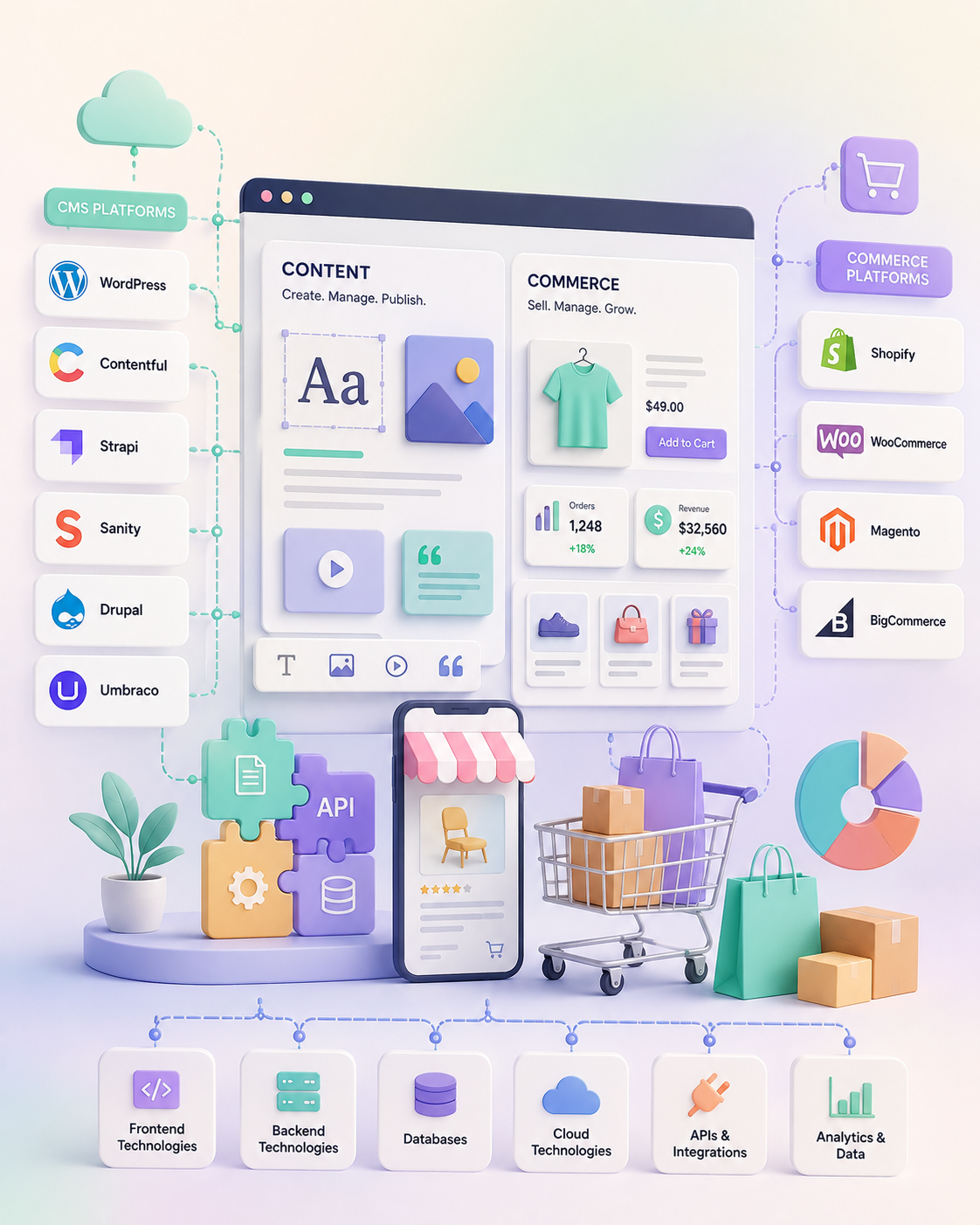
Where Content, Commerce and Business Systems Meet
A CMS or commerce platform doesn't operate in isolation. It sits between the content a business creates, the experiences customers interact with, the transactions that generate revenue, and the internal systems that keep everything running.
Content
Articles, product data, media, and structured information a business creates and maintains.
Experience
The pages, storefronts, and interfaces built on that content, what a visitor actually sees and uses.
Commerce
Catalog, cart, checkout, and payment flows where browsing turns into a transaction.
Customer
The person moving through that experience, across devices, sessions, and channels.
Business
The ERP, CRM, fulfillment, and analytics systems that content and commerce ultimately feed.
The CMS & Commerce Technology Landscape
Ten platforms, two conceptual groups: content management systems that publish and structure information, and commerce platforms that turn a catalog into a transaction. Open any row for what it's actually built for.
Content Management
WordPressContent-Driven Websites
The most widely deployed CMS, built around flexible page and post structures, a mature plugin ecosystem, and a publishing workflow non-technical teams can run independently. It extends into commerce through WooCommerce when a built-in store fits the plan.
Best for: corporate and marketing websites, content-heavy publishing platforms, and teams that want editorial independence.ContentfulHeadless CMS
A headless CMS that stores and structures content independently of any single frontend, delivering it through APIs to whatever experience consumes it: a website, an app, or several channels at once.
Best for: multi-channel content delivery and teams building custom frontends around structured content.StrapiOpen-Source Headless CMS
An open-source, self-hosted headless CMS that gives engineering teams full control over content models, hosting, and API behavior, suited to products where customizing the CMS itself is part of the requirement.
Best for: API-first products and teams that want to own and customize their CMS infrastructure.SanityStructured Content Platform
A content platform built around structured, queryable content and a real-time editing environment, designed for teams building composable experiences that draw the same content into multiple applications.
Best for: structured content at scale and composable, multi-application content architectures.DrupalEnterprise Content Management
An enterprise-grade CMS built for complex content models, multi-site management, and granular permissions and workflows, suited to organizations whose content requirements are too complex for a simpler CMS to model cleanly.
Best for: large or multi-site organizations with complex content governance and workflow needs.Umbraco.NET Content Management
A flexible, open-source CMS built on .NET, giving organizations already standardized on Microsoft infrastructure a content platform that integrates naturally with their existing backend and hosting environment.
Best for: .NET-based organizations that want a CMS aligned with their existing technology stack.Digital Commerce
ShopifyHosted Commerce Platform
A fully hosted commerce platform that handles storefronts, product management, payments, and infrastructure as a managed service, letting a business focus on the product instead of operating commerce infrastructure.
Best for: direct-to-consumer brands and businesses that want scalable commerce without managing infrastructure.WooCommerceWordPress Commerce Extension
A commerce layer built directly into WordPress, turning an existing content site into a fully functional store without introducing a separate platform.
Best for: WordPress-based businesses that need commerce added to an existing content site.MagentoAdvanced / Customizable Commerce
An open, highly customizable commerce platform built for complex catalog structures, advanced pricing and customer logic, and commerce requirements that outgrow simpler platforms.
Best for: complex catalogs, advanced business rules, and commerce requirements needing deep customization.BigCommerceAPI-Driven Commerce
A hosted commerce platform built with an API-first architecture, well suited to composable commerce setups where the storefront is decoupled from the commerce backend and built independently.
Best for: composable commerce architectures and teams building a custom frontend on a hosted commerce backend.The Right Platform Depends on the Product
No CMS or commerce platform is universally better than the rest: each was built with different trade-offs. Before we recommend one, we work through what the product and the business actually need.
- Content Complexity
- Commerce Requirements
- Scalability
- Customization
- Integration Needs
- Editorial Workflows
- API Requirements
- Omnichannel Delivery
- Performance
- Security
- Long-Term Maintainability
A content-heavy site with an active editorial team
WordPress or DrupalA large organization with complex, multi-site governance
DrupalA direct-to-consumer store that needs to launch quickly
ShopifyAn existing WordPress site that now needs to sell
WooCommerceA complex catalog with advanced pricing and customer logic
MagentoA custom frontend built around structured, API-delivered content
Contentful, Strapi, or SanityA composable setup with a decoupled storefront
BigCommerceAn organization standardized on .NET infrastructure
UmbracoThese are common patterns we see across projects, not fixed rules. The right platform, or combination of platforms, always depends on the specifics of your content, catalog, and team.
When Content and Commerce Stop Dictating the Frontend
In a composable setup, content and commerce data don't decide what the frontend looks like: they feed it. Contentful, Strapi, and Sanity manage content as structured data delivered through APIs, while commerce platforms expose products, pricing, and checkout through their own APIs. A frontend, built with whatever technology fits the product, pulls from both to assemble the actual customer experience.
Headless CMS
- Contentful
- Strapi
- Sanity
Commerce APIs
- Shopify
- BigCommerce
- Magento
API Layer
Where content and commerce data become callable, structured endpoints.
Frontend / Experience Layer
Built with whatever frontend technology fits the product.
Customer Experience
The website, app, or channel the customer actually experiences.
This separation keeps content, commerce, and presentation independent enough to evolve on separate timelines, without forcing a single platform to do everything.
CMS & Digital Commerce Capabilities
Nine areas of CMS and commerce engineering we bring to a project, applied based on what the platform and the business actually need.
Corporate & Content Platforms
Websites and content platforms built around how an organization actually publishes and maintains information.
Headless CMS Implementations
Content architecture and delivery built around Contentful, Strapi, or Sanity for teams building custom frontends.
Ecommerce Storefronts
Storefronts built on Shopify, WooCommerce, Magento, or BigCommerce, matched to catalog size and commerce complexity.
Custom Commerce Experiences
Commerce flows, catalog logic, and checkout experiences built beyond what an out-of-the-box theme supports.
Content Migration & CMS Modernization
Moving content and structure between platforms without losing history, SEO value, or editorial continuity.
Commerce & Third-Party Integrations
Connecting CMS and commerce platforms to payment providers, ERPs, CRMs, and fulfillment systems.
API-Driven Digital Experiences
Frontend experiences assembled from content and commerce APIs rather than a single monolithic platform.
Platform Performance & Optimization
Identifying what's actually slowing down a content or commerce platform under real traffic.
Ongoing Maintenance & Evolution
Keeping a CMS or commerce platform secure, current, and able to absorb new requirements over time.
CMS & Commerce Inside the Wider Technology Ecosystem
A CMS or commerce platform rarely stands alone. It draws on the same frontend, backend, data, and cloud technologies we bring to every engagement.
Engineering Principles Behind Every CMS & Commerce Build
Five principles that guide how we approach content and commerce platforms, regardless of which technology ends up being the right fit.
Content-First
Content structures should support future experiences, not just the page they were written for.
Integration-Ready
CMS and commerce platforms should connect cleanly with the systems already running around them.
Scalable by Design
Architecture should support growing traffic, products, content, and users without a rebuild.
Experience-Focused
Technology decisions should ultimately improve the digital experience a customer actually has.
Maintainable
Solutions should stay understandable and adaptable as requirements evolve over time.
Let’s Talk About Your Content, Commerce and Digital Experience.
Whether you're planning a CMS modernization, an ecommerce transformation, a move to headless architecture, or a new digital experience platform, 3Shadz can help think through the technology behind it.