









Operational Chaos, Modelled Into Analytical Order.
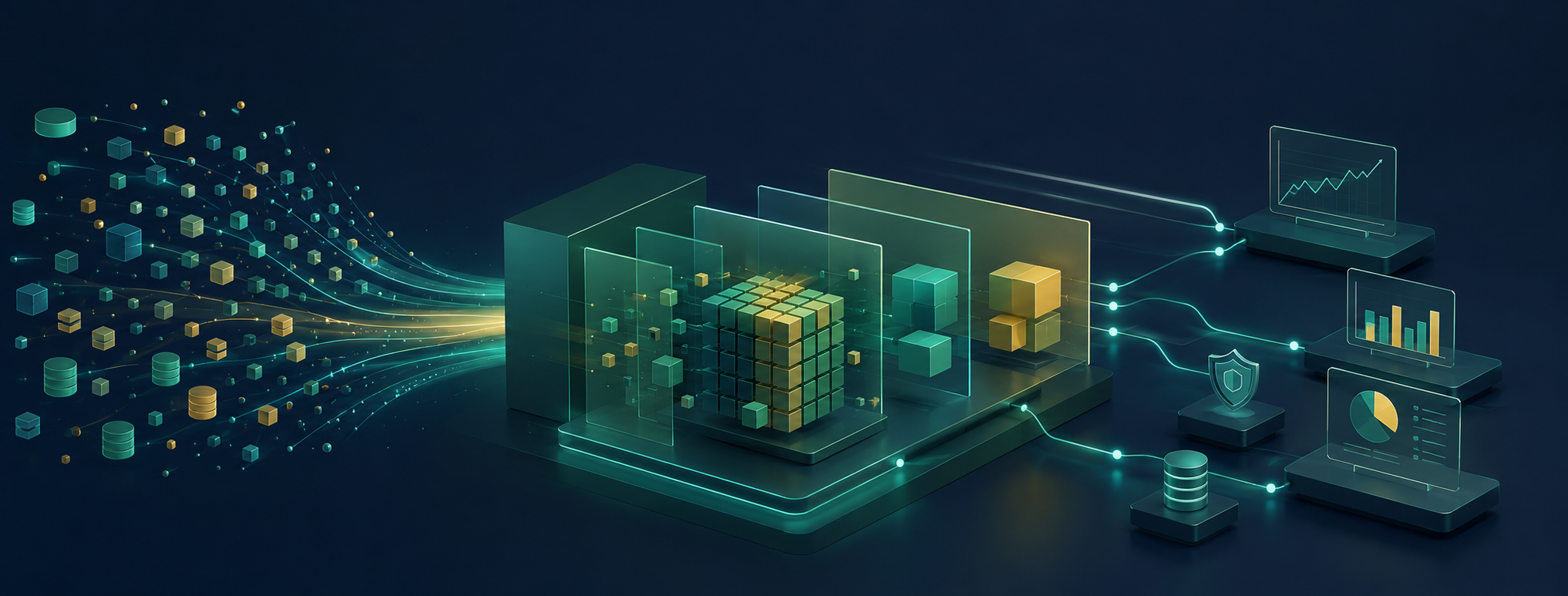
3Shadz architects, models, and builds the warehouse layer that sits between your operational systems and the reports your business runs on: structured, historized, and governed, so the numbers hold up the tenth time someone checks them, not just the first.
A bigger, faster database in the cloud is not a data warehouse.
It’s the deliberate architecture, modelling, and governance work that turns operational data into a structured, historized, query-ready foundation your business can rely on for years, not just a faster place to store the same mess.
Moving tables into Snowflake, BigQuery, or Redshift doesn’t make them a warehouse. Without a defined grain, conformed dimensions, and a governed integration layer, you’ve just relocated the inconsistency, and paid cloud compute rates for the privilege.
3Shadz designs the zones, models the facts and dimensions, and builds the pipelines that turn scattered operational data into something your BI tools, analysts, and applications can query with confidence, including how it looked last quarter, not just how it looks today.
Signs Your Reporting Still Runs on Fragmented Data
None of these are BI problems. They’re symptoms of not having a warehouse layer doing the modelling and governance work in the first place.
Duplicate “Final” Extracts
Every quarter starts with a fresh spreadsheet export that quietly redefines what last quarter’s numbers were.
Numbers That Don’t Agree
Finance and Sales report different revenue for the same month, and nobody’s certain which one is right.
No Real History
Source systems overwrite yesterday’s values, so trend and cohort analysis gets rebuilt by hand, if it happens at all.
Dashboards That Time Out
Reports query production databases directly, so the report and the application slow down together.
Manually Assembled Reporting
Someone still stitches together three exports and a lookup table before a Monday meeting can happen.
No Clear Owner for a Metric
“Active customer” means something different in every team’s spreadsheet, and no one owns the definition.
Inside a 3Shadz Data Warehouse
Five zones, each with a distinct job. Select one to see what actually happens there.
Landing Zone
Zone 01 · RawData lands exactly as the source system produced it: no reshaping, no business logic, no assumptions. This is the audit trail: if a downstream number is ever questioned, this is where you prove what actually arrived, and when.
- Schema captured as-is, unmodified
- Load timestamps & source metadata retained
- No business logic applied yet
- Immutable copy, kept for traceability
Staging & Integration
Zone 02 · ConformedData from every source system is cleaned, standardized, and reconciled into a common structure, before it ever reaches the model. This is where “customer ID” in the CRM finally means the same thing as “account number” in the ERP.
- Type casting, deduplication, null handling
- Key matching across source systems
- Business rules validated, not finalized
- Rejected records logged, never silently dropped
Dimensional Core
Zone 03 · ModelledThe modelled heart of the warehouse: fact tables built to an agreed grain, connected to conformed dimensions shared across subject areas. This is what makes “revenue by region by quarter” a fast, consistent query instead of a custom project.
- Fact tables built to a defined grain
- Conformed, reusable dimensions
- Slowly changing dimensions preserve history
- Surrogate keys decouple source system churn
Governed Marts
Zone 04 · Domain-readyDomain-specific, access-controlled views built on top of the dimensional core, shaped for how Finance, Sales, or Operations actually query, without duplicating the modelling work behind each one.
- Purpose-built per business domain
- Row & column-level access control
- Consistent metric definitions across marts
- Query performance tuned per workload
Consumption Layer
Zone 05 · GovernedThe governed, query-ready surface that BI tools, applications, and analysts actually connect to: documented, versioned, and monitored, so what changes here is a managed release, not a surprise.
- One semantic layer feeding every tool
- Lineage traceable back to source
- Usage & performance monitored
- Changes managed like a software release
Dimensional Modelling
This is what actually separates a warehouse from a copy of your source database: a fact table at a defined grain, connected to the dimensions your business measures it by.
The one sentence every fact table must satisfy: what does a single row mean? Get the grain wrong and every downstream number is quietly ambiguous.
The same “Customer” or “Product” dimension is reused across every fact table, so figures from different subject areas can be compared without reconciliation.
Slowly changing dimensions capture what a customer’s segment or a product’s category was at the time of the transaction, not just what it is today.
Governed Data Marts
Purpose-built, access-controlled slices of the warehouse for the teams that use them most, sharing one set of definitions instead of reinventing them per department.
Finance & Revenue
Recognized revenue, margin, and cost centers reconciled to one general ledger view.
Sales & Pipeline
Bookings, pipeline stage, and quota attainment on a consistent close-date definition.
Operations & Supply Chain
Fulfilment, inventory turns, and on-time delivery, traced to the order that drove them.
Customer 360
Every interaction, transaction, and support ticket resolved to a single customer record.
People & Workforce
Headcount, attrition, and org-level cost data, sensitive fields access-controlled by role.
From Fragmented Sources to a Warehouse in Production
The same five stages carry every engagement, whether it’s a first warehouse or a migration off a legacy platform.
Assess & Profile
Understand source systems, data volume, quality, and the specific business questions the warehouse needs to answer.
Architect & Model
Define zones, grain, conformed dimensions, and the target platform before a single pipeline is built.
Build & Migrate
Stand up ingestion, transformation, and the dimensional core; migrate historical data alongside it, not as an afterthought.
Validate & Cut Over
Reconcile numbers against existing reports line by line, then cut reporting over on a schedule your teams control.
Optimize & Govern
Tune query performance, document lineage, and hand over a warehouse your team can extend with confidence.
Built to Be Queried in Five Years, Not Just Today
Warehouses fail quietly, long after launch, when the model doesn’t hold up to new questions. Here’s what keeps ours holding up.
Modelled Before It’s Migrated
We design the target schema and grain before moving a single table, so the warehouse reflects how your business asks questions, not how source systems happen to store data.
History You Can Actually Query
Slowly changing dimensions and point-in-time snapshots are built in from day one, so trend and cohort analysis works without reconstructing the past.
Tuned for the Queries You Run
Partitioning, clustering, and materialization strategies are chosen around your actual workloads, not generic defaults.
Governance Built Into the Model
Access control and metric ownership are part of the schema design, not a permissions layer bolted on afterward.
Platform-Agnostic by Design
We architect for Snowflake, BigQuery, Redshift, Synapse, Fabric, or Databricks based on your constraints, not a preferred vendor.
One Team Across the Stack
The same team that models your warehouse builds the pipelines feeding it and the dashboards drawing from it.
Platform-Agnostic, By Design
We choose the warehouse platform, transformation tooling, and orchestration layer that fit your constraints and existing stack, not the other way around.
Cloud Warehouse Platforms
- Snowflake
- Google BigQuery
- Amazon Redshift
- Azure Synapse Analytics
- Microsoft Fabric
- Databricks SQL
Modelling & Transformation
- dbt
- Data Vault & dimensional patterns
- Coalesce
- Version-controlled schema migrations
Ingestion & Orchestration
- Fivetran
- Airbyte
- Matillion
- Apache Airflow
Consumption & Governance
- Power BI, Tableau & Looker
- Unity Catalog & Microsoft Purview
- Role-based access control
- Query & cost monitoring
Data Warehousing: Frequently Asked Questions
Data & Analytics, under Services, is the umbrella practice covering engineering, warehousing, scale, insight, and governance. Data Warehousing is the specific discipline underneath it: the architecture, modelling, and storage work that turns data already being moved into a structured, historized, query-ready foundation.
Data Engineering moves data reliably from source systems into the platform. Data Warehousing is what happens once it arrives, modelling it into facts, dimensions, and governed marts. Business Intelligence sits on top of that, building the dashboards and semantic layer people actually use. Most engagements involve two or all three, often as one continuous build.
Both. We design new cloud warehouses on platforms like Snowflake, BigQuery, Redshift, Synapse, or Fabric, and we also modernize or migrate existing SQL Server, Oracle, or Teradata warehouses, assessing what to lift, remodel, or retire rather than moving every table as-is.
Dimensional modelling organizes data into fact tables (the events or transactions you measure) and dimension tables (the context you measure them by: customer, product, date, region). It’s what lets a query answer “revenue by region by quarter” quickly and consistently. Most organizations need at least a lightweight version of it once more than one team is reporting from the same data.
Through slowly changing dimension patterns and point-in-time snapshots, so you can see what a customer’s segment, price tier, or territory was at the moment a transaction happened, not just what it is today. This is designed into the model up front, not added after someone asks why last year’s numbers changed.
A focused warehouse build for a handful of source systems typically runs eight to twelve weeks. Larger migrations or multi-domain platforms usually run three to six months, phased by business domain so reporting value lands before the entire migration is complete.
Let’s Turn Fragmented Systems Into a Governed Foundation.
Whether you need a first warehouse, a migration off a legacy platform, or a remodel of one that’s stopped keeping up, our Data Warehousing team can help you get there.