










Technology Decisions, Converging Into Clear Executive Direction
Most organizations don’t lack technology expertise. Business leaders, product teams, engineers, architects, and specialists in cloud, data, AI and security are all making real decisions, usually without one senior technology perspective connecting them to each other or to the business. CTO as a Service supplies that perspective.
Senior Technology Leadership, Sized to the Decisions in Front of You
CTO as a Service places experienced technology leadership inside an organization that needs senior judgment on its major technology decisions, without requiring a permanent, full-time executive hire to get it.
It is not a developer added to a team, a project manager tracking a delivery plan, or an architect reasoning about one system in isolation. It is not a generic consultant who hands over a recommendation and moves on, an outsourced IT department, or a temporary title with no operating responsibility. CTO as a Service is embedded senior technology leadership: accountable for how business priorities, architecture, delivery, risk and investment decisions connect, for as long as the organization needs that perspective in the room.
In practice, that means assessing the technology landscape, clarifying priorities, challenging assumptions that haven’t been tested, reviewing architecture and delivery decisions, evaluating vendors and platforms, sequencing investment, governing technical debt, and communicating trade-offs in terms a founder, executive team or board can actually act on.
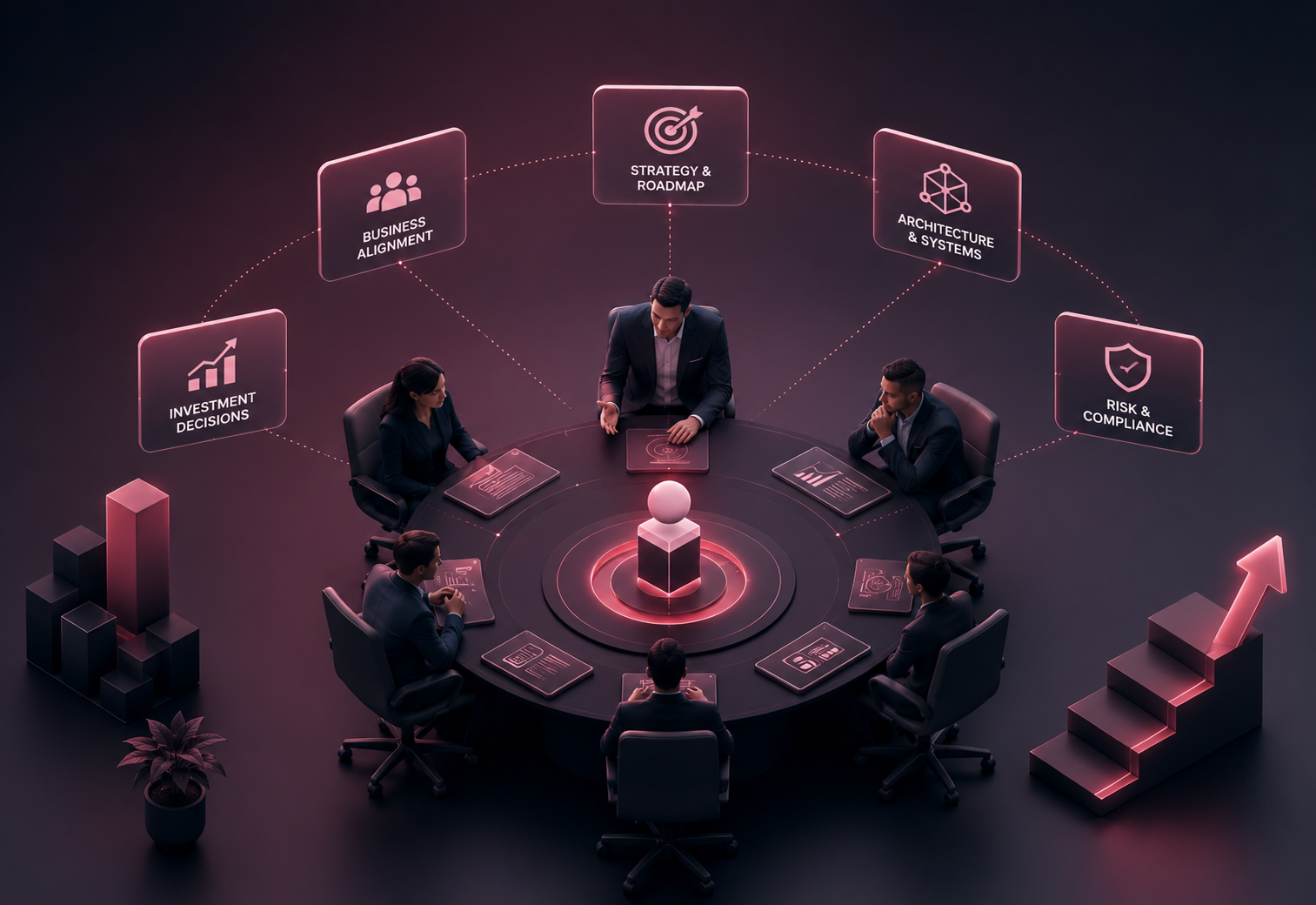
The right technology leadership model depends on an organization’s stage, complexity and decisions, not on an org-chart template.
You May Not Need a Full-Time CTO Yet
CTO as a Service is not an argument that every organization should immediately hire a CTO. It is a way to bring senior technology leadership to the decisions that need it now, while the organization works out what kind of leadership it needs permanently, and when.
Growth Outpacing Leadership
Transition Moments
Decisions Approaching
Delivery & Spend Signals
The right leadership model depends on the organization’s stage, complexity and the decisions ahead of it, not on an org-chart template. CTO as a Service is one possible model, not a default answer.
Leadership Patterns, Not Rigid Packages
CTO as a Service takes different shapes depending on what an organization actually needs. These are useful operating patterns, not categories every engagement has to fit.
Fractional CTO
Ongoing senior technology leadership for an organization that doesn’t require, or can’t yet justify, a permanent full-time CTO.
Interim CTO
Temporary executive ownership during a leadership gap, a transition, a recruitment period, or a critical programme that can’t wait for a permanent hire.
Advisory CTO
Senior technology guidance where internal leadership already exists, but benefits from independent executive-level challenge or specialist perspective.
Most engagements start closer to one pattern and shift as the organization’s needs change: the model is expected to evolve, not stay fixed.
What the CTO Function Actually Connects
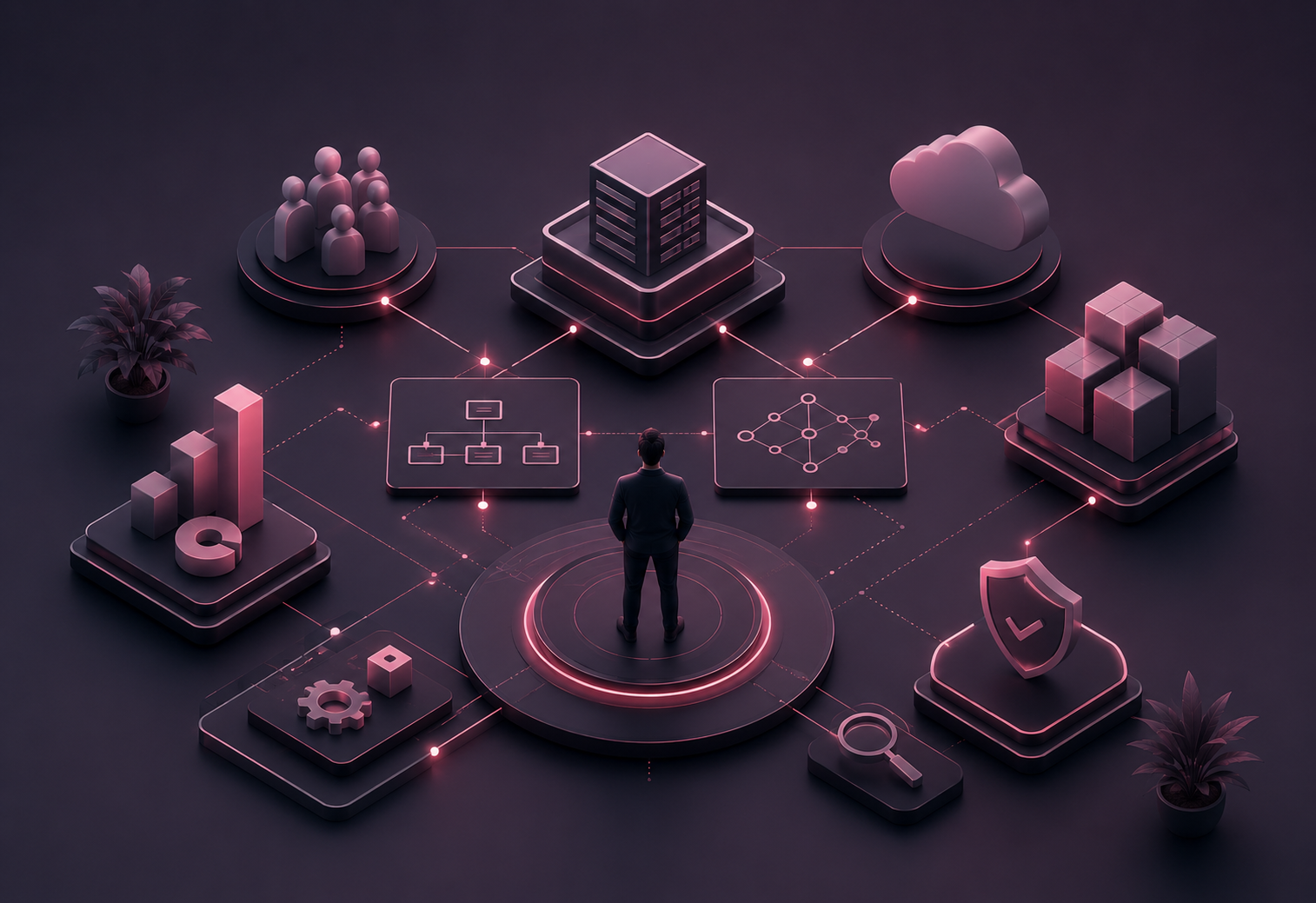
Technology leadership isn’t one more specialism sitting alongside architecture, engineering and data. It is the function responsible for how those domains, and the business priorities behind them, relate to each other.
Technology leadership is not another technology silo. It is the function that connects the technology silos to each other and to the business.
Who Actually Decides?
Many organizations have talented people and still lack clear ownership for their most consequential technology decisions. CTO as a Service is built to close that gap, establishing who decides what, and when a decision needs to escalate.
The questions below are the kind that surface quickly once ownership is unclear. Expand any of them to see what clearer ownership actually resolves.
Not every platform deserves the same commitment. This decision determines what the organization is prepared to build its future around, and what it isn’t.
Without a clear owner, architecture changes tend to get approved by whoever raised them most recently, rather than by anyone accountable for the consequences.
Debt that nobody owns tends to stay invisible until it blocks something urgent. Ownership turns it into a decision made on purpose, on a timeline that makes sense.
Commitments made without technical challenge tend to look confident right up until they slip. Someone senior enough needs the standing to ask the uncomfortable question early.
This decision shapes what the organization owns for years. It deserves more than whichever team happens to be under the most pressure to ship.
Vendor evaluation done only by procurement or the loudest advocate misses the architectural and operational consequences that show up later.
Risk that never reaches the executive table doesn’t stop existing: it just stays invisible until it becomes an incident.
These are three different answers to the same complaint. Confusing them is one of the more expensive mistakes a growing organization can make.
Translating Direction Into Consequences, Before They Become Surprises
Business decisions rarely stay business decisions for long. CTO as a Service is partly about naming the technology consequences of a business decision while there is still time to plan for them.
Entering a New Market
Launching a New Digital Product
Acquisition or Merger
AI Investment
A CTO translates business direction into technology consequences before those consequences become surprises.
Direction Needs Continuous Leadership, Not Just a Plan
Technology strategy can define where investment should go. It cannot, on its own, keep making the decisions that follow, challenging priorities as conditions change, adjusting the roadmap, or escalating what needs executive attention.
IT Strategy defines direction. CTO as a Service helps continuously lead the decisions required to keep technology aligned with that direction.
Explore IT Strategy ConsultingWhat Investment Decisions Actually Weigh
Where Technology Budgets Compete
What technology investment genuinely deserves priority, and what can wait?
The CTO Doesn’t Design Every System. The CTO Makes Sure Architecture Has Direction.
Enterprise Architecture Consulting goes deep into structure, boundaries and target states. CTO as a Service consumes and governs that direction as part of a wider leadership remit, asking whether architecture is still serving the business, and where it needs executive attention.
- Is architecture supporting the business direction?
- Which decisions require executive technology attention?
- Where is unnecessary complexity growing?
- Which platforms should become strategic?
- What architecture decisions are difficult to reverse?
- Which architecture risks require deeper specialist analysis?
Detailed architecture and target-state work continues through Enterprise Architecture Consulting.
The CTO does not personally design every system. The CTO ensures the important architecture decisions have direction, ownership and consequences that are understood.
Where Product, Engineering and Delivery Need an Executive View
Product urgency and engineering sustainability pull in different directions more often than either side intends. CTO as a Service is meant to improve the dialogue between them, not to simply hand engineering more control.
Where Product and Engineering Pull Apart
Engineering Leadership, Without Becoming Staff Augmentation
- Engineering structure and technical leadership
- Delivery practices and ownership
- Team boundaries and capability gaps
- Hiring priorities and release discipline
- Architecture ownership and quality expectations
- Platform responsibility
- An engineering manager replacement
- Scrum management
- Project coordination or ticket tracking
- Coding capacity
- Daily development supervision
Making Delivery Commitments Challengeable
Executive technology leadership should make delivery commitments more informed, transparent and challengeable, not perfectly predictable.
Trade-Offs That Deserve a Named Decision-Maker
Technical Debt Is a Leadership Decision, Not Just a Cleanup Task
Understood, bounded, and accepted for a reason: a conscious trade-off, revisited on purpose.
Consequences are no longer understood, hidden inside systems few people can safely change, and quietly shaping what the roadmap avoids.
Not all technical debt is equally urgent. The CTO function helps determine which debt matters, what it blocks, and whether it should be resolved now, contained, or genuinely left alone. Deeper modernization work continues through Technology Modernization Consulting.
Build, Buy, or Something Between
The right answer depends on what capability the business needs and what it genuinely needs to own, not on cost alone.
Vendor & Platform Decisions
What decision are we actually making when we choose this platform?
Keeping Fast-Moving Decisions Connected to the Wider Picture
AI Technology Direction
Keeping AI decisions coherent with the wider technology environment, reviewing architecture impact, data readiness, security and governance implications, integration requirements, cost, and the internal capability an initiative will actually need.
Explore AI Strategy ConsultingCloud Direction
Challenging cloud decisions at the level that matters, why a workload is moving, what should stay where it is, whether skills and architecture are ready, and how cost and resilience assumptions will be governed.
Explore Cloud ConsultingTechnology Risk
Not every technical concern belongs in the boardroom. This function helps separate routine operational detail from the risks (unsupported platforms, key-person dependency, fragile architecture, vendor lock-in) that genuinely require executive attention.
Security as a Leadership Concern
Not a substitute for specialist security leadership. It ensures security implications are visible inside technology decisions (architecture, vendor selection, identity direction) and that specialist ownership is properly funded and clear.
Technology Problems Aren’t Always Solved by Hiring More Engineers
CTO as a Service looks at capability before it looks at headcount, which skills are genuinely missing, where leadership itself is missing, what should stay internal, and where key-person dependency is quietly creating risk.
None of these is a default answer. Each depends on what capability the organization actually needs next, and what it can realistically build, buy or borrow.
Toward a Permanent CTO, When That’s the Right Next Step
CTO as a Service isn’t designed to remain in place forever inside every organization. Sometimes the right outcome is that the organization becomes ready to hire, brief and onboard its own permanent CTO, with far stronger conditions in place than if that hire had happened on day one.
A successful CTO as a Service engagement may ultimately make the engagement itself unnecessary. That should feel like the plan working, not a threat to it.
Decision Rights, a Working Cadence, and a Board That Can Follow the Trade-Offs
Technology governance isn’t committees and approval forms. It is clarity about which decisions require it, who owns them, and what principles guide them: platform choices, architecture standards, exceptions, investment priorities, risk ownership, vendor decisions, security responsibilities and technical debt among them.
A Cadence Set by the Decisions, Not the Calendar
How often technology leadership shows up depends on the engagement, not a fixed weekly or monthly rhythm. What matters is presence at the moments that count:
Technology leadership should be present when important decisions are made, not delivered as an occasional presentation.
Good technology leadership makes technically complex decisions understandable, without removing the consequences that matter.
Executives don’t need implementation detail. They need to know what decision is required, why it matters, what it costs, and what happens if nothing changes.
What a Technology Roadmap Needs to Answer Next
A roadmap that only lists projects and dates rarely survives a changed budget or a new priority. A useful one connects business priorities, product direction, architecture, engineering capacity, modernization, platforms, technical debt, capability and risk, and makes the dependencies between them visible.
Not every engagement follows this exact sequence. The point is naming what has to be true before the next stage of the business becomes realistic.
Technical Due Diligence, at Executive Level
For investment, acquisition, partnership or a major platform commitment, CTO as a Service brings technology leadership insight to the decision. This supports the business decision; it isn’t a substitute for formal financial, legal or cybersecurity assurance.
What the CTO Function Should Not Become
The CTO function should improve the organization’s ability to make technology decisions, not centralize every decision around one individual.
Technology Leadership Becomes Clearer Than the Noise Around It
Technology Has Direction
Major technology decisions connect back to business priorities.
Decision Ownership Is Clear
People know who decides what, and when to escalate.
Architecture Has Leadership
Structural choices are deliberate, not accidental.
Investment Has Priorities
Spending reflects value, risk and dependency, not the loudest request.
Delivery Is Challengeable
Leadership can see commitments, assumptions and capacity clearly.
Technical Debt Has Context
Engineering concerns translate into business consequences and priorities.
Platforms Have Intent
Cloud, data, AI and software choices fit the technology direction on purpose.
Technology Risk Is Visible
Executive leadership can tell material risk from routine detail.
CTO as a Service Doesn’t Operate Alone
Technology leadership stays grounded when it sits next to the practices doing the deeper strategy, architecture and delivery work, not apart from them.
CTO as a Service: Frequently Asked Questions
No. It provides senior technology leadership on a fractional, interim or advisory basis, sized to what the organization needs right now, and it can help prepare the organization to hire a permanent CTO later, rather than replacing that decision.
No. CTO as a Service operates at the level of direction, architecture oversight, investment priorities, risk and major decisions, not day-to-day coding, ticket management or engineering management duties.
IT Strategy Consulting defines where technology investment should go and why. CTO as a Service provides the ongoing leadership that keeps making and adjusting the decisions required to stay aligned with that direction after the strategy work is finished.
No. It works alongside existing leadership, providing executive-level challenge, alignment and decision ownership, not a replacement for the people running engineering or product day to day.
Yes. Establishing stronger technology direction, architecture context, a clear risk picture and team structure is often exactly what makes a later permanent hire more successful.
Fractional support is ongoing leadership for an organization that doesn’t yet need a full-time CTO. Interim support covers a defined leadership gap or transition. Advisory support adds independent executive-level challenge where internal leadership already exists. Most engagements lean toward one and shift as needs change.
Give Important Technology Decisions Clear Ownership
Whether the organization is between CTOs, scaling past founder-led technology decisions, facing a major platform or AI investment, or simply needs an independent, senior technology perspective in the room, the first conversation is about clarifying the decisions ahead, not committing to a large engagement.