







Not Every Legacy System Needs Replacing. The Ones That Do Need the Right Path.
3Shadz Technology Modernization Consulting assesses the technology estate against real business importance and operational risk, then chooses the modernization pathway, sequencing and transition plan each part actually needs, instead of one uniform migration.
Seven components, plotted by business fit and operational risk, not by how old they are.
The Discipline of Deciding What Actually Needs to Change
Technology Modernization Consulting is the 3Shadz practice that works out which parts of an organization’s technology estate genuinely need to change, which modernization path fits each one, and in what order that change can happen without disrupting the business running on top of it.
It isn’t a proposal to replace everything old, move every workload to the cloud, or rewrite every application in a newer framework. Age on its own is not a reason to change something. The starting question is always what problem the existing technology actually creates, for the business, for operations, or for the ability to change something else later.
That’s why the work begins with assessment rather than a shopping list of platforms. What gets retained looks different from what gets replaced, and what modernizes this year looks different from what modernizes in three years, because the estate, not a template, decides the sequence.
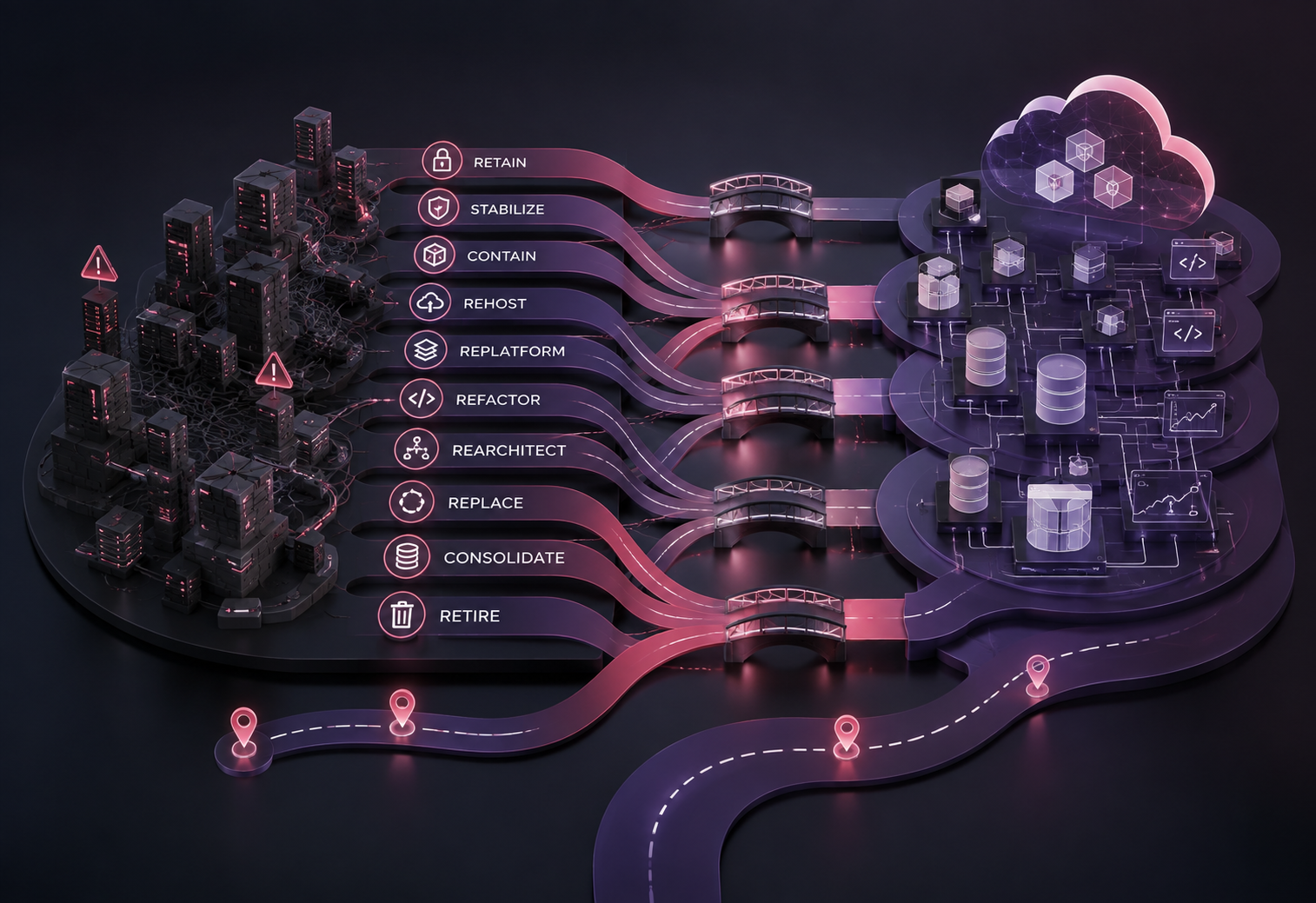
Modernization is not one migration. It’s a set of decisions, each one earned by what the technology is actually doing to the business.
Not “Which Cloud?”: “What Problem Are We Actually Solving?”
Modernization conversations often start with a platform already in mind. That usually means the harder, more useful questions get skipped.
Age alone is not a modernization strategy. An older system that remains reliable, secure and fit for purpose can be less urgent than a newer platform quietly creating architectural or operational constraints.
A Modernization Assessment Is Not a Technology Inventory
Before recommending any change, the estate that actually exists, not the one described in outdated documentation, has to be understood across a consistent set of areas.
Applications & Platforms
Infrastructure & Data
Operations & Ownership
Dependencies & Risk
- What exists
- Versions and license counts
- Where things are hosted
- Which systems actually matter
- Where risk concentrates
- Which modernization decisions are worth making
Not Everything Old Needs Replacing
Modernization isn’t a mandate to replace every legacy system. Every component in the estate deserves a deliberate outcome, not the same outcome.
These outcomes aren’t assigned by a scoring formula. Each is a judgment call, weighed against business importance, operational risk, dependency and the realistic cost of change.
Different Problems Need Different Responses
These aren’t mandatory categories every system has to pass through. Modernization strategy should match the actual problem, not force every component through the same migration pattern.
Preserve
Because it still works, and changing it wouldn’t create enough value yet
Transition
Because the environment, structure or boundaries need to change, not the capability
Renew
Because rebuilding or replacing genuinely creates more value than evolving what’s there
Simplify
Because reducing the estate is sometimes worth more than upgrading it
Where the Estate Actually Constrains the Business
Before any implementation work begins, these strategic questions shape which applications and platforms deserve attention first.
Where these questions point to implementation-level work, that continues through Application Modernization and broader Software Engineering.
Technical Debt, Without Treating All of It as Bad
Technical debt shows up across more than application code, and not all of it needs to be paid down immediately.
- A known shortcut, taken deliberately
- Documented and revisited on a schedule
- Isolated away from critical paths
- Nobody quite remembers why it’s there
- Blocking a change nobody’s tried yet
- Quietly shaping releases, reliability or security
Technology Modernization Consulting helps determine which debt actually matters, what it blocks, and when resolving it creates enough value to justify the investment, not a mandate to eliminate all of it.
A System That Looks Replaceable Rarely Stands Alone
Select a legacy component below to see what it usually turns out to be connected to.
Modernizing the Connections, Not Just the Systems
Modernization isn’t only an application or infrastructure problem. Fragile, undocumented integrations are often what makes an otherwise straightforward change feel risky.
Often the most valuable early move isn’t replacing what’s behind a legacy system: it’s introducing a clear boundary around it, so the rest of the estate stops depending on its internals. Deeper integration implementation continues through API Development & Integration.
Modernization is not automatically cloud migration. Cloud is one possible mechanism among several, not the definition of modernization.
Moving an unchanged problem to another hosting environment rarely resolves:
Cloud decisions should follow modernization requirements. Implementation continues through Cloud & DevOps.
Many Modernization Programmes Become Data Transition Programmes Too
This is the modernization lens on data: deeper implementation continues through Data & Analytics.
Modernization Has to Work While the Business Is Still Running
Organizations rarely move directly from a legacy state to a finished modern one. Business operations continue throughout, which means the coexistence in between matters as much as either end.
A target state is useful. What determines whether modernization is actually executable is the path between where you are and where you’re going.
What Has to Change First So the Next Change Becomes Possible?
Sequencing depends on the actual technology estate, not a universal rule, but some dependencies show up often enough to be worth naming.
Modernization Planning Has to Account for Production Reality
Existing technology often supports active customers, employees, transactions and operations throughout a modernization programme, not just before it starts and after it ends.
Security Belongs Inside the Decision, Not After It
Security consequences are considered as part of each modernization decision, rather than treated as a final check once migration is already underway.
Coherence, Without Feeling Like Bureaucracy
Governance exists to keep modernization decisions coherent as the estate evolves, not to slow delivery down for its own sake.
Who decides what modernizes, against what criteria, and how are exceptions or temporary states managed?
A Sequence With Reasons, Not a Gantt Chart
A useful modernization roadmap connects business priorities, technology risk, application importance, technical debt, architecture and data dependencies, platform decisions, transition states, operational constraints and delivery capacity, and explains why one action has to happen before another.
Understand
See what actually exists and why it matters
Stabilize
Improve reliability before anything deeper changes
Establish Foundations
Put shared standards in place
Decouple
Give legacy technology clear boundaries
Transition
Move deliberately through coexistence states
Consolidate
Bring duplicated systems onto one platform
Retire
Remove what no longer earns its place
Evolve
Treat modernization as an ongoing capability
The Technology Estate Becomes Easier to Operate, Change and Continue Evolving
Modernization Has a Reason
Technology changes are connected to specific business, operational, lifecycle or architectural needs.
Legacy Has a Decision
Older systems are deliberately retained, contained, modernized, replaced or retired.
Dependencies Are Visible
Teams understand what else is affected before changing important systems.
Technical Debt Has Priorities
The organization knows which debt genuinely constrains reliability, security or change.
Transition Is Designed
Modernization programmes have credible intermediate states.
Platforms Have Direction
Strategic platforms are clearer and unnecessary overlap keeps shrinking.
Operations Remain Viable
Modernization accounts for the production environment throughout transition.
The Estate Can Keep Evolving
Modernization is sequenced so foundational changes happen before what depends on them, and it creates stronger foundations for future change instead of producing another generation of difficult-to-change technology.
Related to Several Practices. Interchangeable With None of Them.
Technology Modernization Consulting is one of six connected capabilities inside Technology Consulting. Here’s where it stops and each neighboring practice begins.
IT Strategy Consulting
They answer: where should technology investment go, and what happens first?
We go deeper into: how aging or constrained technology should evolve, and in what sequence.
Digital Transformation Consulting
They answer: how do process, experience and operating models change together?
We go deeper into: the applications, platforms and technical debt that need to evolve underneath that change.
Enterprise Architecture Consulting
They answer: how should capabilities, applications, data and platforms fit together?
We go deeper into: how the technology that exists today can practically move toward that structure.
Application Modernization
They answer: how should this specific application be modernized and implemented?
We go deeper into: what across the whole estate should modernize, why, and in what order.
Cloud Migration
They answer: how do we move suitable workloads into a cloud environment?
We go deeper into: what should actually change, cloud is one possible mechanism, not the definition.
Software Engineering
They answer: how does an individual system get designed, built and deployed?
We go deeper into: which systems across the estate need to change at all, and how sequencing keeps the business running.
One of Six Connected Technology Consulting Capabilities
Technology Modernization Consulting usually sequences a path toward direction set by IT Strategy Consulting and structure defined by Enterprise Architecture Consulting, then hands decisions to delivery teams to execute.
Sometimes the Right Modernization Decision Is to Wait
Modernization isn’t replacing everything old, moving everything to cloud, converting everything to microservices, rewriting every application, chasing the newest technology, eliminating all technical debt, or running one enormous big-bang migration. Often the correct call is one of these instead:
Technology Modernization Consulting: Frequently Asked Questions
No. A meaningful part of the work is deciding what should be retained, stabilized or contained rather than replaced. Replacement is one possible outcome among several, chosen when it genuinely creates more value than the alternatives.
No. Understanding what currently exists, including where it differs from what’s documented, is the first stage of the assessment, not a prerequisite for it.
No. Cloud is one possible modernization mechanism among several. Moving an unchanged problem to another hosting environment rarely resolves poor architecture, tight coupling or unclear ownership on its own.
Enterprise Architecture Consulting defines how business capabilities, applications, data and platforms should fit together going forward. Technology Modernization Consulting focuses on how the technology that exists today can practically evolve toward that structure: the pathways, dependencies and sequencing involved.
It shouldn’t, if the transition is planned properly. Most of the work goes into defining viable intermediate states (coexistence, temporary bridges, progressive migration), so the business keeps running throughout, not just at the end.
It’s one of six connected capabilities inside Technology Consulting, and it hands decisions to delivery teams working through Application Modernization, Software Engineering and Cloud & DevOps. Enterprise Architecture Consulting typically supplies the target structure this practice sequences a path toward.
Modernize What Matters, Without Replacing What Still Works.
Before a migration programme, a platform replacement or a large modernization investment becomes an expensive commitment, let’s assess what in your technology estate genuinely needs to change, which pathway fits it, and how the sequence should work, so modernization solves real problems instead of creating new ones.