Site Logo

Get in touch

Database Technologies

Data Foundations Built for Performance, Scale and Reliability

Every application is only as dependable as the data layer underneath it. We work across relational, document, cloud-managed, in-memory, and search database technologies to build the data foundation a product actually needs.

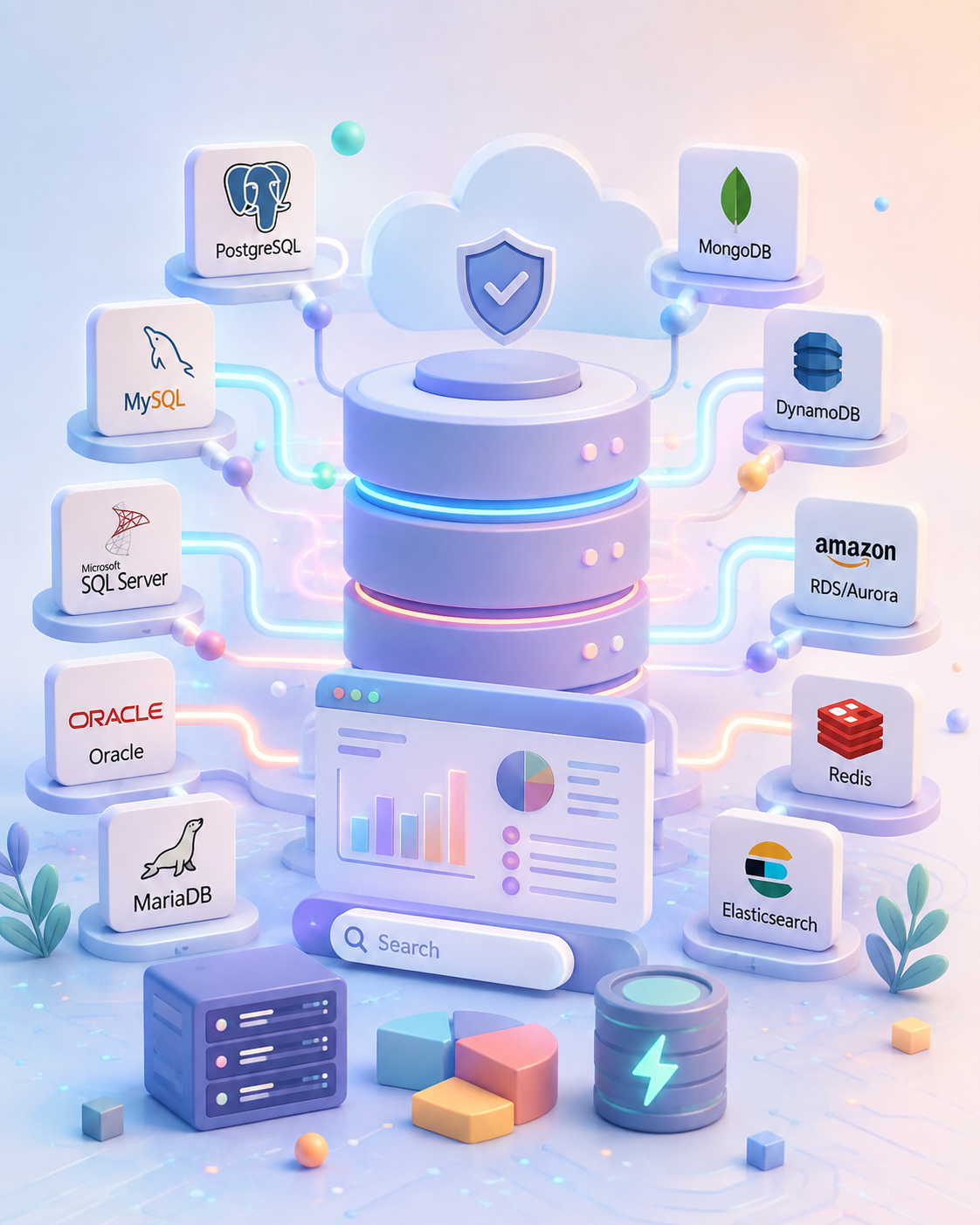
At 3Shadz, choosing a database isn't a default setting: it's an engineering decision shaped by how data is structured, how it's read and written, how far it needs to scale, and how much the rest of the application depends on it staying correct. We work with PostgreSQL, MySQL, Microsoft SQL Server, Oracle, and MariaDB for relational workloads, MongoDB and Amazon DynamoDB for flexible and distributed data, Amazon RDS and Aurora for managed cloud infrastructure, Redis for low-latency access, and Elasticsearch for search and discovery, as part of the same connected technology stack we bring to frontend, backend, and cloud engineering.

The result is a data layer that holds up under real traffic, stays consistent under concurrent access, and gives the rest of the application something dependable to build on.

  • PostgreSQL
  • MongoDB
  • Redis
  • Amazon Aurora
  • Elasticsearch
  • MySQL
3Shadz database technology stack connecting PostgreSQL, MySQL, Microsoft SQL Server, Oracle, MariaDB, MongoDB, DynamoDB, Amazon RDS and Aurora, Redis, and Elasticsearch around a central secured data store
Consistent Under Load ACID-compliant transactions
Sub-Millisecond Access Caching & real-time reads
Transactional Integrity Schema Flexibility Horizontal Scalability Low-Latency Caching Full-Text Search Cloud-Managed Infrastructure High Availability Query Optimization
How We Organize the Data Layer

Five Ways Data Behaves, Five Kinds of Database

Not every application stores data the same way, and it shouldn't use the same database either. We group the technologies we build with by how data actually behaves (structured or flexible, local or distributed, persistent or momentary), so the reasoning behind a technology choice stays visible instead of hidden inside a logo grid.

01
Relational Data

Structured Records & Transactions

Data where relationships between tables and consistency guarantees matter more than raw flexibility: orders, accounts, ledgers, and business records that need to reconcile correctly every time.

  • PostgreSQL
  • MySQL
  • Microsoft SQL Server
  • Oracle
  • MariaDB
02
Document & NoSQL Data

Flexible, Evolving Structures

Data whose shape changes as the product evolves, modeled as documents or key-value pairs instead of fixed schemas: catalogs, profiles, and content that don't fit neatly into rows and columns.

  • MongoDB
  • Amazon DynamoDB
03
Distributed & Cloud Data

Managed Relational Infrastructure

Relational engines run as managed cloud services, trading manual patching and failover work for infrastructure that scales and recovers on its own.

  • Amazon RDS
  • Amazon Aurora
04
Caching & Real-Time Data

Data Kept Close to the Application

Frequently accessed data held in memory, for the request paths where every millisecond is visible to the person waiting on the other end.

  • Redis
05
Search & Discovery

Findable at Scale

Large volumes of content and records made searchable, filterable, and rankable: the kind of lookups a relational index wasn't built to handle well.

  • Elasticsearch
The Technologies We Build With

Database Technologies, One by One

The engines and services that make up our database stack, grouped by the same five categories above, what each one is, where it fits, and why it would be the right call for a given application.

Relational Data

PostgreSQL

Relational Database

An open-source relational engine built around strict standards compliance and dependable transactional behavior, for systems that can't tolerate silent data drift.

Best suited for
  • Complex relational schemas
  • Regulated or financial systems
  • Analytics-heavy applications
  • ACID Compliance
  • Extensible Data Types
  • Strong Concurrency

MySQL

Relational Database

A widely deployed relational database with a large ecosystem, well matched to web and content-driven applications with conventional read and write patterns.

Best suited for
  • Content management systems
  • E-commerce platforms
  • SaaS products
  • Fast Indexed Reads
  • Broad Tooling Support
  • Predictable Replication

Microsoft SQL Server

Relational Database

An enterprise relational database tightly integrated with the Microsoft stack, built for structured business systems running on .NET infrastructure.

Best suited for
  • Enterprise line-of-business apps
  • .NET-based systems
  • Microsoft-standardized environments
  • .NET & Azure Integration
  • Built-In Reporting
  • Enterprise Security Model

Oracle

Relational Database

A high-end relational database engineered for large-scale, mission-critical transaction processing where uptime and auditability carry real operational weight.

Best suited for
  • Large enterprise systems
  • Banking & insurance platforms
  • Strict compliance workloads
  • Advanced Clustering
  • Large-Scale Partitioning
  • Long Support Lifecycle

MariaDB

Relational Database

A community-driven fork of MySQL that keeps the same relational foundation while adding storage-engine flexibility and open governance.

Best suited for
  • MySQL-compatible migrations
  • Storage-engine flexibility needs
  • Open-source-first teams
  • Drop-In MySQL Compatibility
  • Pluggable Storage Engines
  • Active Open Development

Document & NoSQL Data

MongoDB

Document Database

A document-oriented database that stores data in flexible, JSON-like structures instead of fixed rows and columns.

Best suited for
  • Rapidly evolving product schemas
  • Catalog & profile data
  • Document-shaped APIs
  • Schema Flexibility
  • Horizontal Sharding
  • Nested Data Support

Amazon DynamoDB

Key-Value / NoSQL Database

A fully managed, serverless key-value and document database built for predictable low-latency access at very large scale.

Best suited for
  • High-throughput serverless apps
  • Session & state stores
  • Simple, well-defined access patterns
  • Single-Digit ms Latency
  • Automatic Scaling
  • Zero Server Management

Distributed & Cloud Data

Amazon RDS

Managed Cloud Database

A managed relational database service that runs engines like PostgreSQL, MySQL, and SQL Server without manual patching, backups, or failover handling.

Best suited for
  • Cloud-first relational workloads
  • Teams avoiding infrastructure overhead
  • Automated backup requirements
  • Automated Maintenance
  • Multi-AZ Failover
  • Familiar Relational Engines

Amazon Aurora

Managed Cloud Database

A cloud-native relational database compatible with PostgreSQL and MySQL, built for higher throughput and faster replication than standard managed offerings.

Best suited for
  • High-traffic applications
  • Systems needing fast read replicas
  • Availability-critical workloads
  • Higher Throughput
  • Auto-Scaling Storage
  • Fast Cross-AZ Failover

Caching & Real-Time Data

Redis

In-Memory Data Store

An in-memory data store used to hold frequently accessed data close to the application, cutting response times on the paths a product depends on most.

Best suited for
  • Session storage & caching
  • Rate limiting
  • Real-time counters & leaderboards
  • Sub-Millisecond Access
  • Rich Data Structures
  • Pub/Sub Messaging

Search & Discovery

Elasticsearch

Search & Analytics Engine

A distributed search and analytics engine built for full-text search, filtering, and aggregating large volumes of data.

Best suited for
  • Product & content search
  • Log and event analytics
  • Faceted filtering at scale
  • Fast Full-Text Search
  • Horizontal Scalability
  • Flexible Aggregations
How We Decide

The Right Database Starts With the Right Questions

There isn't a single database that fits every application. Before we recommend a technology, we work through how the data behaves, how the application needs to reach it, and what happens to that answer once real traffic and real data volume show up.

01

How is the data structured?

Fixed relationships vs. flexible, evolving shapes.

02

What do transactions require?

Strict consistency vs. eventual consistency.

03

What are the read/write patterns?

Read-heavy, write-heavy, or a mix of both.

04

How far does this need to scale?

Thousands of records, or hundreds of millions.

05

How available does it need to be?

Tolerance for downtime and failover expectations.

06

How much latency can it tolerate?

Sub-millisecond reads vs. batch-style processing.

07

Does it need rich search?

Full-text, faceted, or fuzzy lookups at scale.

08

Where would caching help?

Data that's read far more often than it changes.

09

What's the cloud architecture?

Managed services vs. self-operated infrastructure.

10

How much operational complexity fits?

What the team can realistically maintain long-term.

These questions come before the technology name, not after it. A confident answer to each one is usually what separates a database choice that lasts from one the team is renegotiating in a year.

How It Fits Together

Where Each Database Fits in the Stack

A request rarely stops at just one kind of data store. It moves from the application through an API layer and a data access layer, which routes it to whichever store fits what's being asked for: a relational engine for a transaction, a cache for a fast read, a search index for a query across content.

Application
API / Backend
Data Access Layer
Relational
  • PostgreSQL
  • MySQL
  • SQL Server
Document / NoSQL
  • MongoDB
  • DynamoDB
Managed Cloud
  • Amazon RDS
  • Amazon Aurora
Cache
  • Redis
Search
  • Elasticsearch

This shows how these technologies can connect, not a checklist every project uses. Most applications lean on two or three of these paths: the ones that match what the product actually needs to do with its data.

Outcomes

What We Solve With Database Engineering

Database decisions eventually surface as real product outcomes: an application that stays fast under load, or one that starts timing out as the data grows. These are the outcomes we're engineering toward.

Reliable Transactional Data

Financial, order, and account data that stays accurate under concurrent access.

High-Performance Queries

Indexing and query design tuned to how the application actually reads data.

Large-Scale Data Storage

Storage architecture that keeps working as record counts climb into the millions.

Flexible Data Models

Document structures that change as the product does, without a migration project each time.

Real-Time Caching

Sub-millisecond access to the data a product depends on most.

Search & Discovery

Fast, relevant search across catalogs, content, and logs.

Cloud Database Deployment

Managed database infrastructure that doesn't need a full-time DBA to keep running.

Availability & Resilience

Replication and failover planned before an outage, not scrambled together after one.

Database Optimization

Finding the query, index, or schema decision that's quietly slowing everything down.

Scalable Architecture

A data layer that can grow from first users to production scale without a rebuild.

What We Do

Database Engineering Capabilities

Seven areas of database engineering we bring to a project, applied based on what the application actually needs, not handed over as a fixed package.

Database Design

We model schemas and data structures around how the application actually queries and writes, not just how the data looks on a whiteboard.

Database Integration

We connect applications and services to the right data stores, wiring authentication, pooling, and access patterns correctly from the start.

Performance Optimization

We trace slow queries back to their root cause (missing indexes, inefficient joins, or architecture decisions), rather than treating symptoms.

Cloud Database Engineering

We build and operate database infrastructure on managed cloud services, so scaling and maintenance don't fall on your team.

Data Migration

We move data between systems and versions while keeping it consistent, available, and verifiable throughout the process.

Scalability & Reliability

We design database architecture that can absorb growth in traffic, data volume, and complexity without a ground-up rebuild.

Search & Caching

We bring in Elasticsearch or Redis specifically where search relevance or response latency is the actual bottleneck, not by default.

From Requirement to Technology

The Technology Follows the Requirement

Once we understand what an application needs from its data layer, the shortlist of suitable technologies narrows quickly. These are the patterns we see most often, not fixed rules.

Relational transactionsStrong consistency and mature SQL tooling for data that has to reconcile correctly, every time.
PostgreSQLMySQLSQL ServerOracleMariaDB
Document-oriented dataSchemas that evolve with the product without a migration for every change.
MongoDB
Managed cloud relational databaseThe same relational engines, without carrying the operational overhead.
Amazon RDSAmazon Aurora
Key-value / serverless NoSQLPredictable performance at scale without provisioning servers.
Amazon DynamoDB
Low-latency cachingKeeping the data a product touches most, closest to where it's used.
Redis
Search & discoveryFast, faceted search across data volumes a relational index wasn't built for.
Elasticsearch
Working Through a Data or Database Challenge?

Let’s Talk About the Data Foundation Your Application Needs.

Whether you're choosing a database for a new product, untangling performance issues in an existing one, or planning a migration to managed cloud infrastructure, 3Shadz can help think through the architecture behind it.