










The Automation Layer Behind Every Reliable Release
DevOps is the discipline that connects how software is written to how it runs in production: the automated path from a commit to a working system, and the feedback loop that tells a team whether it actually worked.
At 3Shadz, DevOps & Automation means engineering the pipelines, infrastructure, and operational tooling that let a team ship changes safely and often. We build with Docker, Kubernetes, Terraform, Jenkins, GitHub Actions, Azure DevOps, Ansible, Argo CD, Prometheus, and Grafana as part of the same connected technology stack we bring to frontend, backend, and cloud engineering.
The result is a delivery process that stays consistent as a team and its infrastructure grow: repeatable deployments, environments that behave the same way twice, and visibility into what's actually happening in production.
- Docker
- Kubernetes
- Terraform
- CI/CD
- Argo CD
- Observability
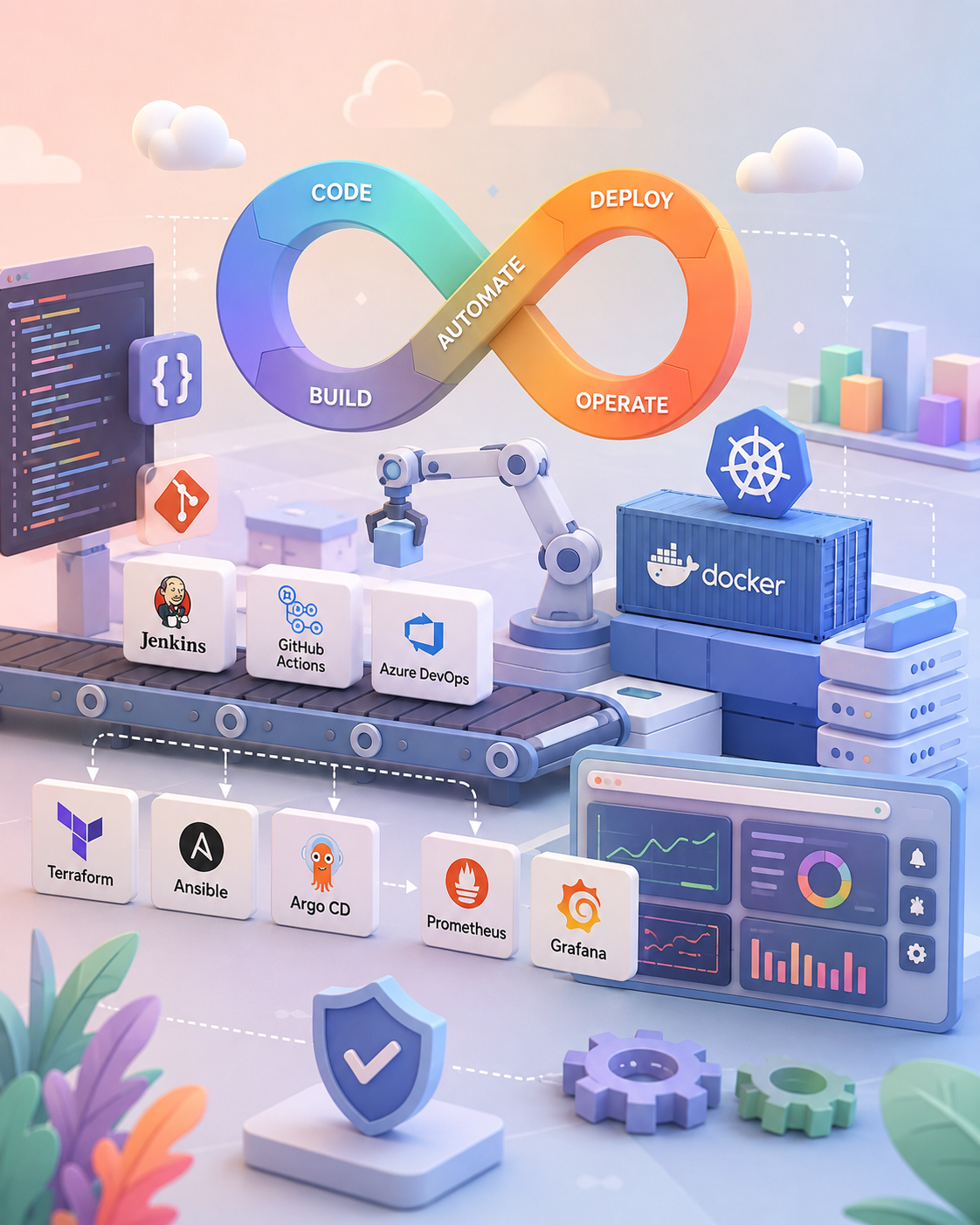
Automation Beyond Deployment
It's easy to reduce DevOps to a pipeline that runs tests and pushes code to a server. In practice, it's a wider system: one that connects how software is written, how infrastructure is provisioned, how releases reach production, and how a team learns from what happens once they're live. Each part feeds the next: code that's easy to test, infrastructure that's easy to reproduce, deployments that are easy to reverse, and monitoring that's easy to act on.
Develop
Code, review, and merge with automated checks built in.
Deliver
Build, package, and ship through an automated pipeline.
Operate
Run on infrastructure that behaves the same way twice.
Learn
Observe production and feed what's learned back into the next change.
The loop closes back into Develop: DevOps is this cycle running continuously, not a single hand-off.
One Flow, Nine Stages, No Manual Hand-Offs
A change moves through the same automated sequence every time it ships, from an engineer's commit to a monitored service in production, reducing the manual steps that usually cause deployment failures.
Plan
Code
Build
Test
Package
Provision
Deploy
Observe
Improve
Ten Technologies, Four Jobs to Do
We group our DevOps stack by the job each technology does, not just its name, because a container platform, an infrastructure tool, and a CI system solve fundamentally different problems.
Docker
Packages an application and everything it needs to run into a portable container image, so it behaves the same on a laptop, in staging, and in production.
Kubernetes
Orchestrates containers across a cluster, scheduling workloads, restarting failed containers, scaling services, and rolling out changes without downtime.
Infrastructure Automation
Terraform
Defines cloud infrastructure as versioned, declarative code, so environments can be created, changed, and torn down predictably instead of by hand.
Ansible
Automates configuration and repetitive operational tasks across servers using human-readable playbooks instead of manual scripts.
CI/CD Pipelines
Jenkins
A flexible, self-hosted automation server for building custom CI/CD pipelines with fine-grained control over build and release logic.
GitHub Actions
Runs CI/CD workflows directly from a GitHub repository, triggering builds, tests, and deployments on every push or pull request.
Azure DevOps
Combines pipelines, repos, and release management in one platform, well suited to teams already working within the Microsoft ecosystem.
GitOps & Observability
Argo CD
A GitOps continuous delivery tool that keeps a Kubernetes cluster's actual state continuously synchronized with what's declared in Git.
Prometheus
Collects and stores time-series metrics from applications and infrastructure, powering alerts on the conditions that matter.
Grafana
Turns Prometheus and other data sources into dashboards that make service health and performance visible at a glance.
Infrastructure That Repeats Reliably
Manually configured servers drift. Someone changes a setting to fix an incident, forgets to document it, and months later no one can reproduce the environment that's actually running production. Infrastructure as Code replaces that with a definition of the environment itself: written once, reviewed like any other code change, and applied consistently every time.
With Terraform provisioning cloud resources and Ansible handling configuration and repetitive operational tasks, an environment becomes something a team can recreate on demand, not institutional knowledge that lives in one engineer's head.
resource "kubernetes_cluster" "production" {
  node_count = 3
  region     = "ap-south-1"
  auto_scale = true
}
// applied the same way, every environmentFrom Commit to Production
A single code change touches more systems than it seems. Here's what typically happens between a developer pressing commit and that change running safely in front of users.
Source Control
A commit lands in a shared repository, triggering the pipeline automatically.
CI Pipeline
Jenkins, GitHub Actions, or Azure DevOps picks up the change and starts the build.
Automated Testing
Unit, integration, and build checks run before anything moves forward.
Container Build
The application is packaged into a Docker image tagged to that exact commit.
Infrastructure Provisioning
Terraform and Ansible confirm the target environment matches what's declared.
Deployment
Kubernetes and Argo CD roll the new version out, typically with zero downtime.
Production Monitoring
Prometheus and Grafana confirm the release is healthy, or flag it before users notice.
Running Applications the Same Way, Everywhere
Containers solve the "it worked on my machine" problem by packaging an application with everything it depends on. Kubernetes solves the next problem: running many containers, across many machines, without someone watching them manually.
We use Kubernetes to handle scheduling, scaling, service discovery, configuration, and self-healing, restarting a failed container, rebalancing workloads across nodes, and scaling a service up or down as demand changes, without manual intervention.
- Scheduling & Scaling
- Service Discovery
- Configuration Management
- Self-Healing Workloads
- Rolling Updates
- Resource Isolation
Git as the Single Source of Truth
In a GitOps model, the desired state of a system lives in a Git repository, not in someone's memory or a series of manual commands. Argo CD continuously compares what's declared in Git against what's actually running in the cluster, and reconciles the two automatically.
Git Repository
Declares the desired state of the system.
Argo CD
Watches Git and reconciles differences continuously.
Kubernetes Cluster
Reflects exactly what's declared, nothing more, nothing drifted.
That gives every deployment a clear audit trail, makes rollbacks as simple as reverting a commit, and removes the drift that creeps in when infrastructure gets changed by hand under time pressure.
Seeing Problems Before They Become Incidents
Automation makes deployments fast. Observability is what makes them safe: the ability to see, in real time, whether a system is actually behaving the way it's supposed to.
Prometheus collects metrics from applications and infrastructure and evaluates them against alerting rules. Grafana turns that data into dashboards that make latency, error rates, resource usage, and service health visible at a glance, so a team can catch a problem during a gradual rollout instead of during a page in the middle of the night.
DevOps & Automation Capabilities, in Practice
Ten capabilities we apply in whatever combination a product's delivery process actually needs.
CI/CD Pipeline Engineering
Automated build, test, and release pipelines with Jenkins, GitHub Actions, or Azure DevOps.
Infrastructure as Code
Cloud environments defined, versioned, and provisioned through Terraform.
Containerization
Applications packaged into Docker images built for consistency across environments.
Kubernetes Implementation
Cluster design, workload orchestration, and scaling built on Kubernetes.
Cloud Automation
Repeatable provisioning and configuration across AWS, Azure, and Google Cloud.
Configuration Management
Server and environment configuration automated with Ansible.
GitOps
Git-driven deployment workflows managed through Argo CD.
Release Automation
Deployment strategies designed to ship changes safely and roll them back quickly.
Monitoring & Observability
Metrics, dashboards, and alerting built with Prometheus and Grafana.
DevOps Platform Engineering
Internal tooling and workflows that make automation something every team can use, not just DevOps engineers.
Build an Engineering Delivery System That Scales With Your Product.
Whether you're standing up a first CI/CD pipeline, migrating workloads to Kubernetes, or building observability into a system that's outgrown manual monitoring, 3Shadz can help design the automation layer behind it.