









Go-Live Isn’t the Finish Line. It’s Where We Start Watching.
3Shadz Managed Cloud Services keeps applications, infrastructure, databases, and platforms monitored, secured, optimized, and continuously improved across AWS, Microsoft Azure, Google Cloud, hybrid, and multi-cloud environments, so the team that got you to production doesn’t disappear the day it launches.
Cloud Infrastructure Does Not Manage Itself
Managed Cloud Services is the fourth capability inside 3Shadz Cloud & DevOps: the ongoing discipline of keeping an environment monitored, secure, cost-efficient, and reliable once it’s live, whether 3Shadz built that environment or someone else did.
AWS, Microsoft Azure, and Google Cloud manage the data centers, the hardware, and the underlying platform. They do not manage your specific architecture, your patch cadence, your access policies, your backup schedule, or what happens when a monthly bill quietly grows past what anyone budgeted for. That responsibility stays with whoever operates the account, and after go-live, it often lands on a team that is already stretched across other priorities.
3Shadz Managed Cloud Services takes on that responsibility directly: continuous monitoring across infrastructure, applications, data, and security; a defined cadence for patching, backups, and cost review; and an incident response path that doesn’t depend on whoever happens to be online when something breaks.
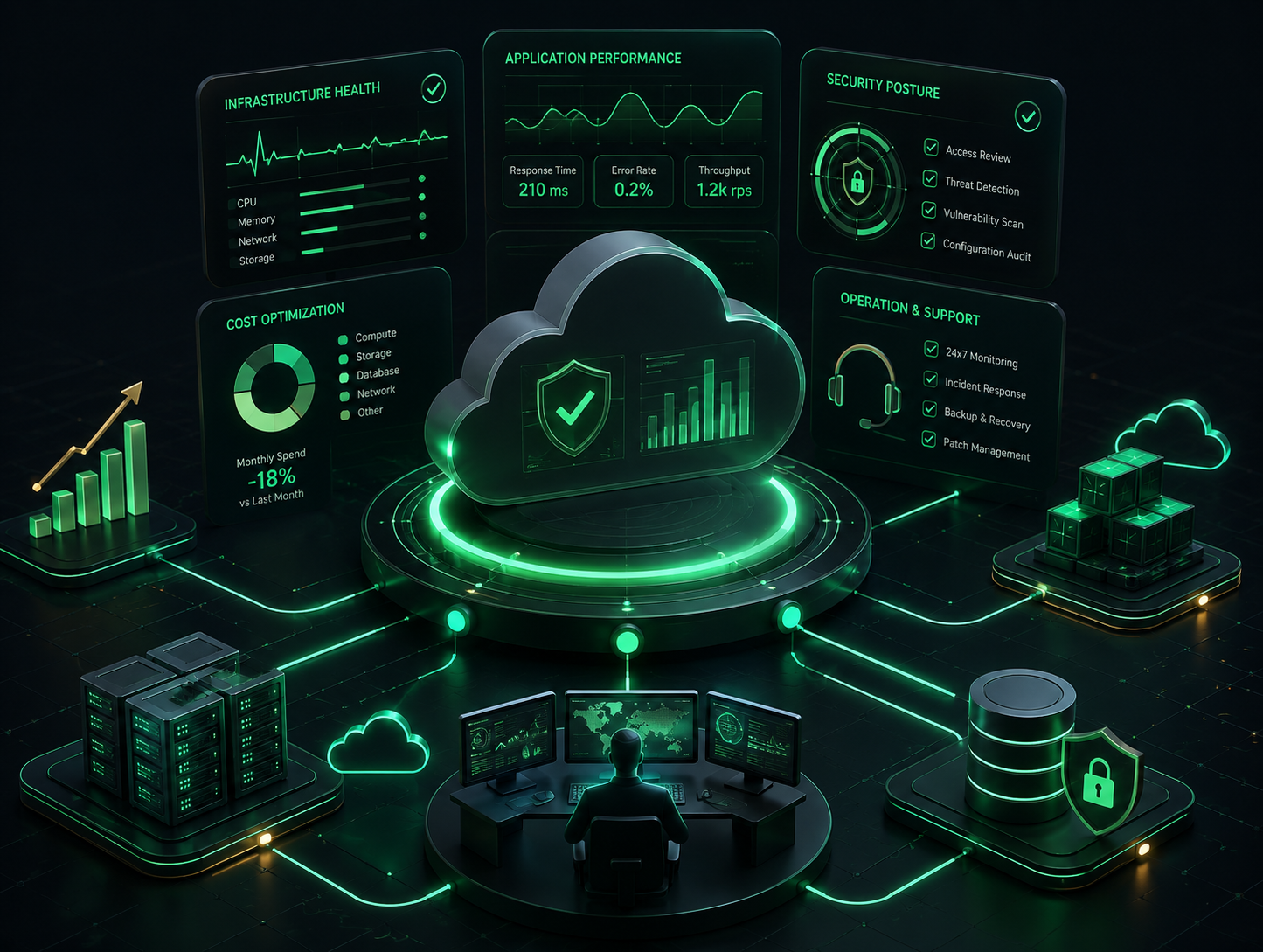
Every managed environment is reviewed against a documented baseline, not a general impression of “normal.”
From Go-Live to Continuous Cloud Operations
A deployment or migration project has a defined end date. Running a cloud environment well does not. This is usually where an engagement quietly hands back to an internal team, and where 3Shadz Managed Cloud Services picks up instead.
Managed Cloud Capabilities
An environment isn’t one thing to manage: it’s several layers that each drift differently over time. We operate all of them, plus the cost and governance concerns that cut across every one.
Application & Delivery Layer
We track how applications actually behave in production (response times, error rates, release health, and dependency changes), so a slow endpoint or a failing integration is caught before it becomes a support ticket.
Data & Storage Layer
Backups are scheduled, verified, and periodically tested for restore, not just configured and forgotten, while storage tiers and retention policies are tuned as data volumes and access patterns change.
Compute, Containers & Platform Layer
Patch cycles, platform upgrades, and autoscaling policies run on a defined cadence, so capacity keeps pace with demand and known vulnerabilities don’t sit unpatched because no one owns the task.
Network & Security Layer
Access is reviewed against who actually needs it, configurations are audited against a baseline, and incidents are detected and triaged through a defined path rather than discovered after the fact.
Cost & Governance
Continuous across every layer above: spend, policy compliance, and reporting reviewed on a standing rhythm, not a quarterly exercise.
The Signals We Watch, Every Day the Environment Runs
Managed doesn’t mean staring at a dashboard. It means specific signals, across specific layers, reviewed against a baseline that’s actually documented.
Infrastructure Health
CPU, memory, storage, and network signals across every environment, watched for the gradual drift that precedes an outage, not just the outage itself.
Application Performance
Latency, error rates, and throughput at the service level, so a regression is visible before customers report it.
Security Posture
Access anomalies, configuration drift, and vulnerability signals reviewed against a defined baseline, rather than left for the next audit.
Cost & Usage
Spend trends and resource utilization tracked continuously, so a cost anomaly is caught while it’s still small.
From Reactive Firefighting to Managed Operations
This is the difference most organizations feel within the first few months of handing operations to a team that treats it as a standing responsibility, not a side task.
Without Managed Cloud Services
- Problems are usually found by users first, not by monitoring.
- Patching happens in bursts, whenever someone finds the time.
- No one owns the monthly cloud bill until it becomes a conversation.
- Backups exist, but restores have never actually been tested.
- Security reviews happen occasionally, if a deadline forces one.
- Operational knowledge lives with whoever set the environment up.
With 3Shadz Managed Cloud Services
- Monitoring surfaces issues before they reach your users.
- Patch and upgrade cycles run on a defined, predictable cadence.
- Cost and utilization are reviewed on a standing rhythm, not a surprise.
- Backups are scheduled, verified, and periodically tested for restore.
- Security posture is reviewed continuously against a defined baseline.
- Operational knowledge is documented and shared with your team.
A Loop That Doesn’t Stop at “Resolved”
Every managed environment runs through the same operating loop, not a project plan with an end date, but a cycle that keeps running for as long as we’re responsible for what’s live.
Environment
Monitor
Telemetry flows in continuously from infrastructure, applications, and security tooling.
Detect
Deviations from baseline are flagged before they escalate into user-facing problems.
Diagnose
Root cause is identified against documented architecture, not guessed at under pressure.
Resolve
Fixes are applied through the same reviewed change process as any other release.
Optimize
Cost, performance, and capacity are tuned based on how the environment is actually used.
Improve
What’s learned feeds back into monitoring thresholds, runbooks, and architecture.
Continuity Without Losing Control
Handing over ongoing operation of an environment is a trust decision, not just a technical one. Here’s what we hold onto so that trust holds up over time.
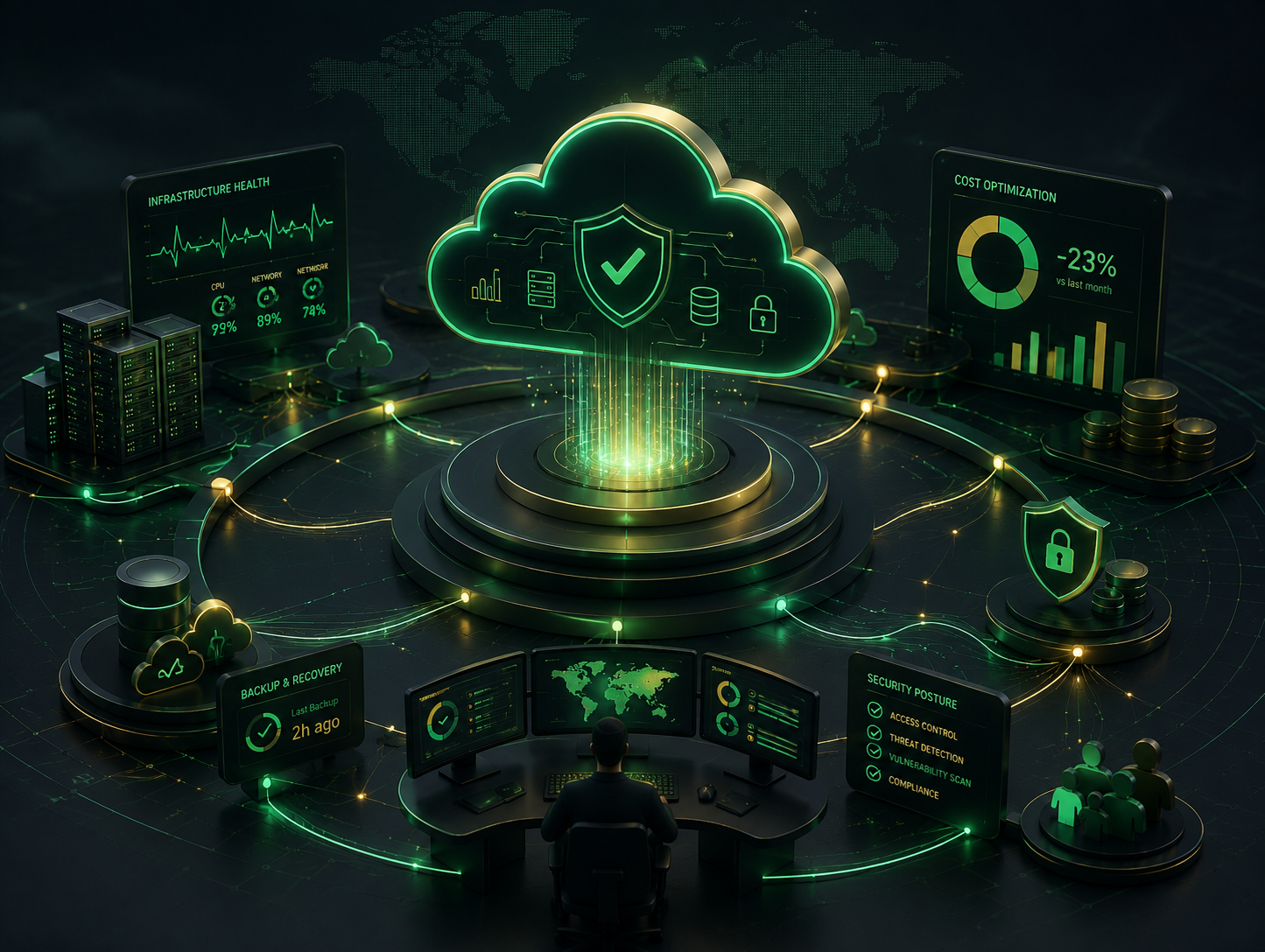
Operational reviews are calendared, not incident-driven.
One Team Across the Lifecycle
Whether we designed your architecture, ran your migration, or built your pipelines, the same team can carry into ongoing management: no re-briefing a new provider on decisions already made.
Comfortable Operating What We Didn’t Build
Most Managed Cloud Services engagements start with an environment someone else built. We assess what’s already there before changing anything, and work with the architecture we’re handed rather than insisting on a rebuild.
Cost Visibility as a Standing Practice
Spend and utilization are reviewed on a regular rhythm, not discovered at the end of the month, so cost creep gets caught while it’s still small.
Security Reviewed on a Rhythm, Not an Anniversary
Access, configuration, and vulnerability posture are checked continuously against a defined baseline, instead of waiting for the next scheduled audit to find out what changed.
Documented So Nothing Depends on One Person
Runbooks, access records, and operational decisions are written down and shared with your team, so continuity doesn’t rest on a single engineer’s memory.
Platform and Tool Agnostic, By Design
We operate the monitoring, automation, and security tooling already in place wherever it’s sound, and recommend a change only when it genuinely closes a gap.
Cloud Platforms
Monitoring & Observability
Automation & Infrastructure as Code
Security & Backup
Managed Cloud Services: Frequently Asked Questions
Cloud & DevOps is the full practice: Cloud Consulting, Cloud Migration, DevOps & Automation, and Managed Cloud Services. This page covers Managed Cloud Services specifically: the ongoing monitoring, operation, security, and optimization of a cloud environment after it’s live.
Yes. Most Managed Cloud Services engagements start with an environment someone else built. We assess what’s already running (architecture, access, monitoring, backups) before changing anything, then take on ongoing operation from there.
Monitoring and alerting are configured per environment before the engagement starts, with escalation paths defined by severity rather than left to whoever happens to notice first. Exact coverage windows and response commitments are agreed and documented as part of each engagement, not assumed.
Rightsizing, scheduling, and storage-tiering decisions are made against agreed performance and reliability baselines, not against cost in isolation, so a saving that would compromise resilience isn’t treated as a saving.
No. Managed Cloud Services is built to extend an internal team’s capacity, not replace it: we can own an environment end-to-end, work alongside your team on shared responsibilities, or focus on a specific layer such as security or backups, depending on what’s actually needed.
It’s typically ongoing rather than fixed-term, since the value comes from continuity, monitoring, patching, and optimization rather than a one-time project. Scope and coverage are reviewed periodically and adjusted as the environment and business needs change.
Let’s Keep Your Cloud Environment Running Well, Not Just Running.
Whether we built your environment or someone else did, our Managed Cloud Services team can take on monitoring, security, cost optimization, and day-to-day operations, so production stays reliable without pulling your team into infrastructure work.