










The Systems Behind Every Digital Experience
Backend engineering is the layer people never see and always rely on: the systems that process requests, enforce business rules, move data, and keep an application working the way it's supposed to.
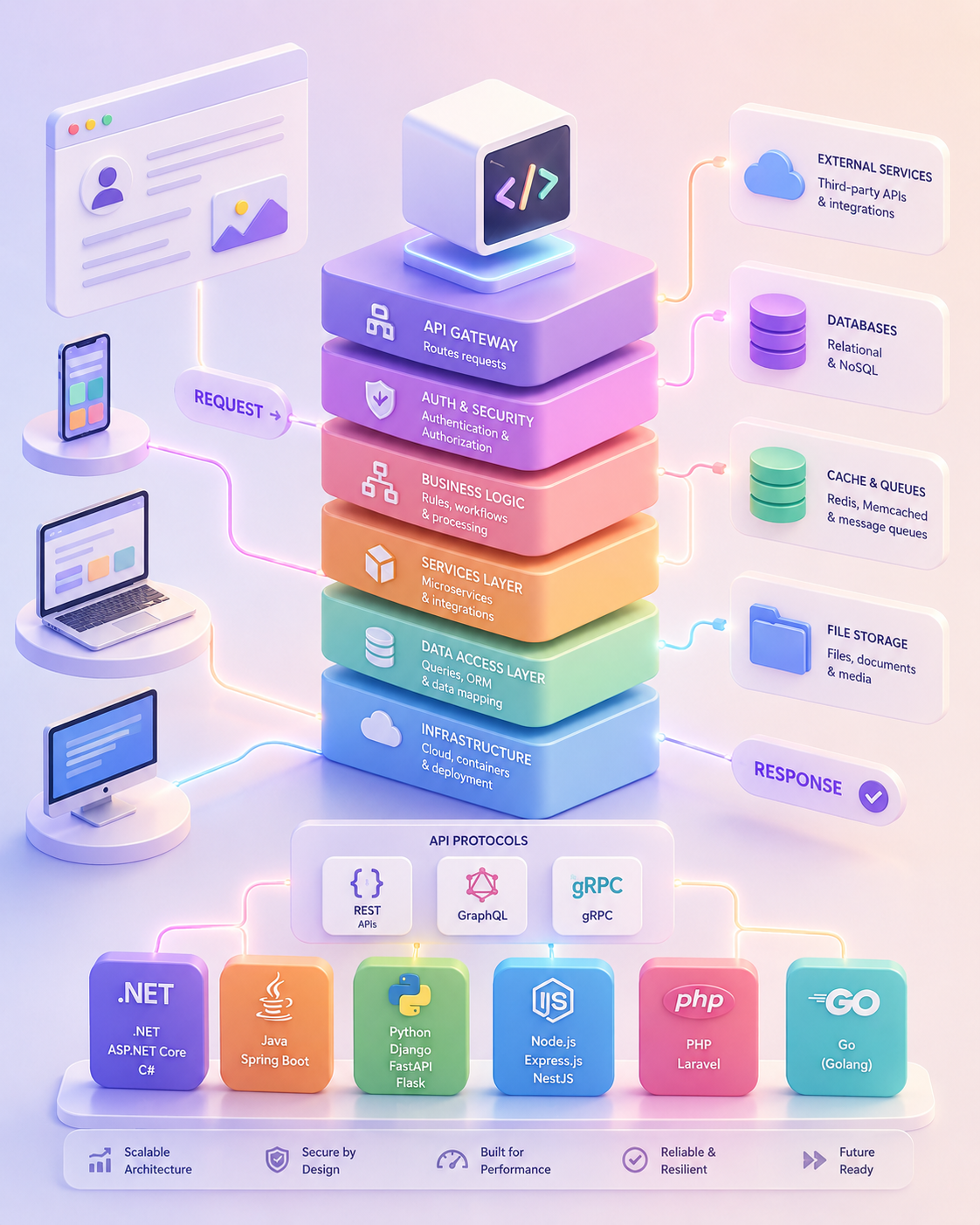
At 3Shadz, backend development means designing services, APIs, and data flows around what a product actually needs to do, not around one favorite language. We build with .NET, Java, Python, Node.js, PHP, and Go, connecting them through REST, GraphQL, and gRPC as part of the same connected technology stack we bring to frontend, cloud, and data engineering.
The result is a backend that stays reliable under real traffic, secure by design, and structured enough for a team to keep building on for years.
- .NET
- Java
- Python
- Node.js
- Go
- REST · GraphQL · gRPC
Where Digital Products Become Systems
Every interface eventually depends on something happening behind it. When someone submits a form, opens a dashboard, or checks out of a cart, a request leaves the browser and enters a system built to make sense of it, validating input, applying business logic, checking permissions, reading or writing data, and coordinating with other services before anything comes back.
3Shadz builds that system as an engineering discipline in its own right, not an afterthought to the interface. We design backend foundations meant to hold up under real usage: predictable under load, secure by default, and structured so a new feature doesn't mean re-learning how the rest of the product works.
Request
Where a user action or client call begins.
API Layer
Receives, validates, and routes the call.
Business Logic
Applies the rules that define the product.
Services
Coordinates work across modules or microservices.
Data
Reads, writes, and persists what the request needs.
Response
Returns a result the interface can use.
Built for the Work Behind the Interface
Every screen a user interacts with is backed by work happening somewhere else. These are the capabilities we build into a backend system, in whatever combination the product actually needs.
Business Logic
Reliable application logic that turns product requirements into working workflows: the rules that decide what happens next.
APIs & Integrations
Secure APIs that let applications, internal services, and external systems exchange data and stay in sync.
Data Services
Backend services designed to manage, process, and move application data efficiently and consistently.
Scalability
Architectures designed to support increasing traffic, workloads, and product complexity as the business grows.
Security
Backend foundations built with appropriate authentication, authorization, and secure communication patterns.
Performance
Efficient service design focused on response times, resource use, and dependable day-to-day operation.
Backend Technologies, Grouped by Where They Fit
We work across several backend ecosystems rather than one default stack, choosing the languages, frameworks, and communication protocols that match a product's requirements, existing systems, and team. None of these is presented as universally better: each fits a different kind of problem.
.NET Engineering
.NET, ASP.NET Core, and C# power structured, enterprise-grade services: a strong fit for organizations invested in the Microsoft ecosystem or building large, long-lived business applications.
- .NET
- ASP.NET Core
- C#
Java Engineering
Java and Spring Boot remain a dependable foundation for large-scale, high-throughput systems where stability, tooling maturity, and long-term support matter most.
- Java
- Spring Boot
Python Engineering
Python's readability and ecosystem make it well suited to data-driven backends and fast-moving APIs, spanning full-featured frameworks and lightweight microservice tooling.
- Python
- Django
- FastAPI
- Flask
Node.js Engineering
A JavaScript-based runtime built for event-driven, non-blocking workloads: useful where frontend and backend share language and tooling, or real-time communication matters.
- Node.js
- Express.js
- NestJS
PHP Engineering
PHP and Laravel continue to power a large share of the web's content-driven and transactional applications, backed by a mature and well-documented ecosystem.
- PHP
- Laravel
High-Performance Services
Go's simplicity and performance make it a strong choice for latency-sensitive services, concurrent workloads, and infrastructure-level tooling.
- Go (Golang)
API & Service Communication
The protocols that let applications, services, and external systems exchange data reliably, each suited to a different kind of integration.
- REST APIs
- GraphQL
- gRPC
Choose the Right Backend for the Problem
There's no universally "correct" backend stack, only the one that fits a product's requirements, existing architecture, and the team maintaining it long after launch.
- Product Requirements
- Existing Architecture
- Team Expertise
- Performance Needs
- Integration Requirements
- Scalability Expectations
- Development Speed
- Long-Term Maintainability
This is the sequence of decisions we work through with clients, not a fixed formula. The right combination always depends on the product, the team, and where it's headed.
APIs That Connect the Pieces
An API is the contract between a client, a service, and everything behind it. We choose the API model based on how a system will be consumed and by whom.
REST APIs
A resource-oriented, widely understood approach to conventional application communication: well suited to public APIs and standard client-server interactions.
GraphQL
A flexible query model that lets clients request exactly the data they need, useful where different consumers need different shapes of the same data.
gRPC
A high-performance, contract-based protocol suited to efficient communication between internal services in distributed systems.
From Application Logic to Distributed Systems
Not every product needs the same architecture. We add structure (like microservices, message queues, or a dedicated integration layer) where the product's complexity calls for it, not by default.
API Layer
Where requests enter the system, routing, validation, and the first line of authentication.
Business Logic
The rules and workflows that define how the product behaves, kept separate from how data is stored or delivered.
Service Layer / Microservices
Modular services that each handle a specific responsibility: built as microservices where system complexity and team structure make that separation worthwhile.
Data Access Layer
A consistent way for the rest of the system to read and write data, independent of which database sits behind it.
Integrations & Background Processing
Communication with external systems, plus the queues and background jobs that keep long-running work off the main request path.
Principles Behind Every Backend System
Six principles that shape backend decisions on every engagement, regardless of the specific language or framework in use.
Maintainability
Build backend systems that remain understandable as products evolve.
Scalability
Prepare services for changing workloads and growing product requirements.
Reliability
Design for predictable behavior and resilient day-to-day operation.
Security
Build security considerations into APIs, services, and application architecture.
Performance
Keep backend processing efficient, responsive, and resource-conscious.
Integration
Connect products to internal services and external platforms through well-designed interfaces.
Technology Is Only Part of the Equation
Choosing a language or framework is one decision. Knowing how to combine it with the right architecture, engineering practices, and understanding of the product is what makes a backend actually work for the business behind it.
We approach backend development with consideration for the context around the code, not just the code itself:
- Business Requirements
- User Workflows
- Existing Systems
- Integration Points
- Future Growth
- Operational Requirements
- Maintainability
Build the Systems That Power What Comes Next.
Whether you're modernizing an existing backend, building new APIs, or architecting a platform meant to scale, 3Shadz can help shape the engineering approach behind it.