









From Disconnected Handoffs to One Continuous System.
3Shadz DevOps & Automation connects development, testing, security, infrastructure, and operations into a single automated delivery path, so releases stop depending on manual handoffs, tribal knowledge, or one engineer being available at the right moment.
Not a Toolchain. A Way of Shipping.
DevOps & Automation is one of the four capabilities inside 3Shadz Cloud & DevOps: the discipline that decides whether a release is a routine event your team barely notices, or a stressful one that needs a war room.
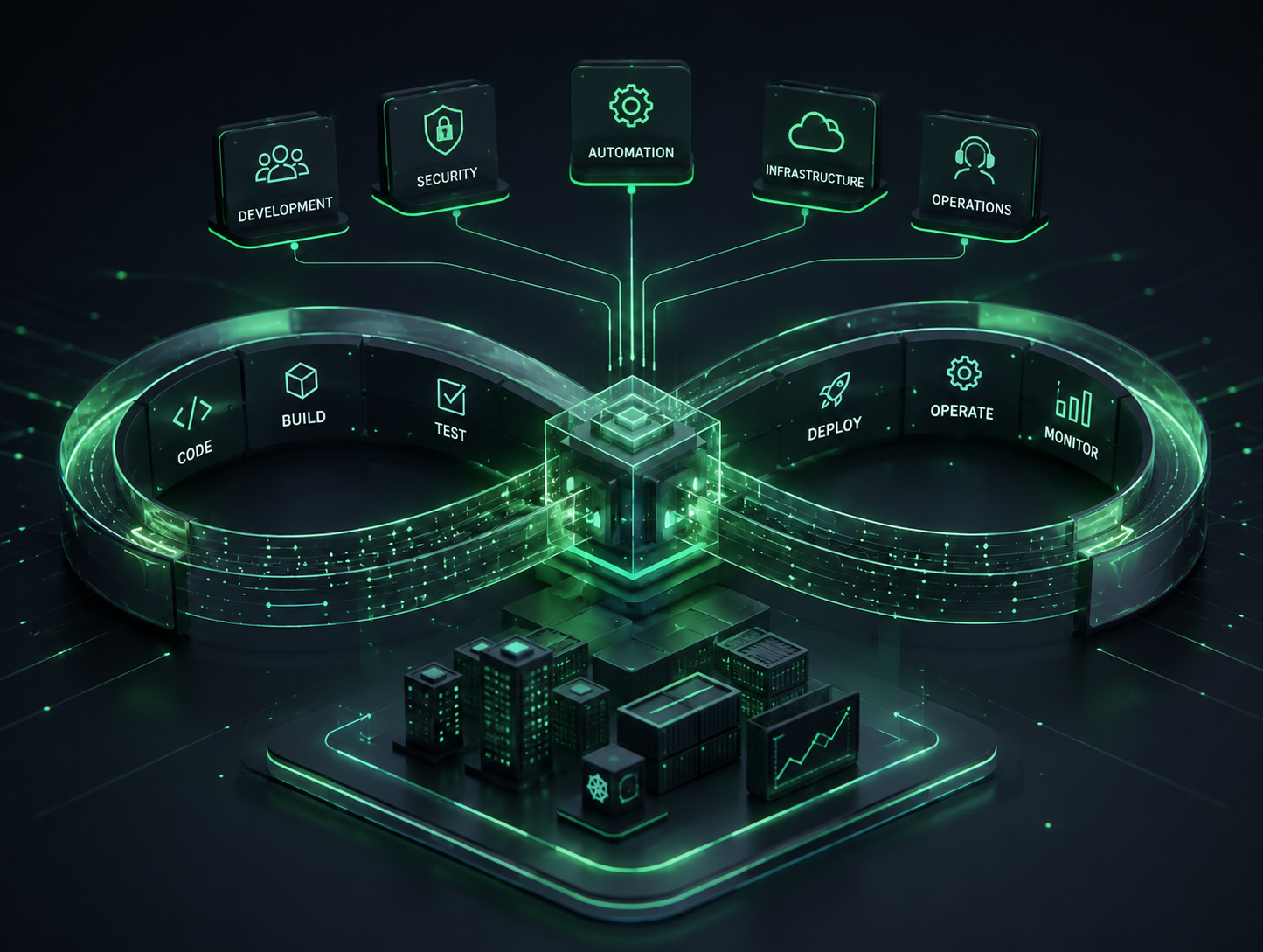
Installing a CI/CD tool doesn’t make a team “doing DevOps.” What matters is whether development, security, infrastructure, and operations are working from the same pipeline, the same definitions, and the same signals, or whether each team is still automating its own corner and hoping the handoffs line up.
We build the CI/CD pipelines, Infrastructure as Code, container platforms, and observability that connect those disciplines into one system, then hand it over documented well enough that your team can run it without staying dependent on us.
DevOps & Automation Capabilities
Each capability below can stand alone or connect into the next: most engagements combine several, built around whichever part of your delivery path is costing the most time today.
CI/CD Pipeline Engineering
We design build, test, and release pipelines around how your team actually ships, not a generic template, so every commit moves through the same verified path before it reaches production.
Infrastructure as Code
Environments are defined in version-controlled code instead of manual console changes, so every environment can be reviewed, replicated, and rebuilt on demand rather than reverse-engineered from memory.
Containerization & Kubernetes Orchestration
Services are packaged into containers and orchestrated so they behave the same way in staging as they do in production, regardless of which cloud or cluster they run on.
Release & Deployment Automation
Progressive rollout patterns, automated health checks, and rollback paths replace manual release-day scripts, so a bad deploy is caught and reversed in minutes instead of escalated at 2 a.m.
Observability & Monitoring
Metrics, logs, and traces are wired into the same tools engineers already work in, so production signal reaches the people who can act on it instead of sitting in a dashboard nobody watches.
DevSecOps & Compliance Automation
Security scanning, secrets management, and policy checks run inside the pipeline itself, so vulnerabilities and misconfigurations are caught before release, not after an audit.
Platform Engineering & Developer Experience
We build the internal tooling and self-service paths that let product teams provision environments and ship changes without waiting on a ticket queue.
Where Delivery Sits Today, and Where It Can Go
Most teams we meet recognise themselves somewhere along this line, not because they did anything wrong, but because delivery tends to grow faster than the automation around it. This isn’t a checklist to complete; it’s the general direction we help teams move.
Manual
Releases depend on a person running commands by hand, and knowledge lives in their head.
Fragmented
Teams automate their own corner (a script here, a build job there) with no shared standard between them.
Standardized
Pipelines, environments, and access follow the same reviewed pattern across teams.
Automated
Code moves from commit to production through a tested, repeatable pipeline with no manual gate left in place by accident.
Observable
Metrics, logs, and traces make production behaviour visible before a customer has to report it.
Continuously Improving
Incidents and performance data feed back into the pipeline itself, so the system gets steadier over time.
What Commonly Changes Once Delivery Is Automated
These are the patterns we see most often once a pipeline goes from ad hoc to automated: directional, not a guaranteed benchmark for every team.
Deployment Frequency
Higher is betterWeekly or ad hoc releases give way to small, frequent ones.
Lead Time for Changes
Lower is betterDays or weeks to ship a change come down to hours.
Change Failure Rate
Lower is betterIssues get caught by tests and checks before release, not after.
Recovery Time
Lower is betterManual triage gives way to automated rollback and alerting.
A Running Loop, Not a One-Time Project
Every engagement follows the same shape, whether it starts with one pipeline or a full platform rebuild, and it doesn’t stop at step five.
Baseline & Assess
Map the current delivery path, tools, and failure points before changing anything.
Standardize & Template
Turn one-off scripts and tribal knowledge into repeatable, version-controlled patterns.
Automate the Pipeline
Build CI/CD and infrastructure-as-code so releases stop depending on any one person.
Instrument & Observe
Wire metrics, logs, and traces into the same workflow engineers already use.
Improve Continuously
Feed incidents and performance data back into the pipeline design itself, on a running cadence.
Automation That Your Team Can Still Explain
A pipeline nobody understands is just a different kind of fragile. Here’s what we hold onto so automation makes your team more capable, not more dependent on us.
Automation Without Losing Control
Automating a pipeline doesn’t mean losing visibility into it. Every environment change and release stays reviewable, auditable, and reversible.
Security Embedded, Not Bolted On
Scanning, secrets handling, and access policy run inside the pipeline from day one, instead of arriving as a separate audit exercise months later.
Built On What You Already Have
We extend the tools and pipelines already in place wherever they’re sound, instead of replacing working systems to standardize on our own preferences.
One Team From Pipeline to Production
The engineers who build your automation can carry it into ongoing operations through our Managed Cloud Services team, with no re-briefing required.
Designed to Be Handed Over
Documentation, ownership, and runbooks are part of the deliverable, so your team can operate what we build without staying dependent on us to do it.
Platform and Tool Agnostic, By Design
We choose the CI/CD, IaC, and orchestration tooling that fit your team’s constraints and existing investments, not the vendor relationship that’s easiest for us.
CI/CD Platforms
Infrastructure as Code
Containers & Orchestration
Observability & Monitoring
Security & Policy Automation
DevOps & Automation: Frequently Asked Questions
Cloud & DevOps is the full practice: Cloud Consulting, Cloud Migration, DevOps & Automation, and Managed Cloud Services. DevOps & Automation is the specific capability covered here: CI/CD, Infrastructure as Code, containerization, release automation, observability, and DevSecOps.
We assess what’s already in place and extend it wherever it’s sound. Replacing a working pipeline or tool is a deliberate decision made with your team, never a default.
No. Containers and orchestration are one part of the practice, not a prerequisite. We automate around whatever runtime genuinely fits the workload, including environments that aren’t containerized.
Security scanning, secrets management, and policy checks are designed into the pipeline itself as part of the DevSecOps practice, not added as a separate step after release.
DevOps & Automation builds the pipelines, infrastructure code, and release automation. Managed Cloud Services keeps the resulting environment monitored, patched, and optimized day to day. Many engagements use both, but neither requires the other.
A first CI/CD pipeline or Infrastructure as Code baseline is usually delivered in a few weeks. Broader platform, observability, and DevSecOps automation is typically an ongoing engagement that expands as usage grows.
Let’s Turn Releases Into Routine, Not Risk.
Whether you need a first CI/CD pipeline, Infrastructure as Code for a growing environment, or a full DevSecOps rebuild, our DevOps & Automation team can help you get there without losing control of what you already have.