









Every Design Decision Deserves a Witness
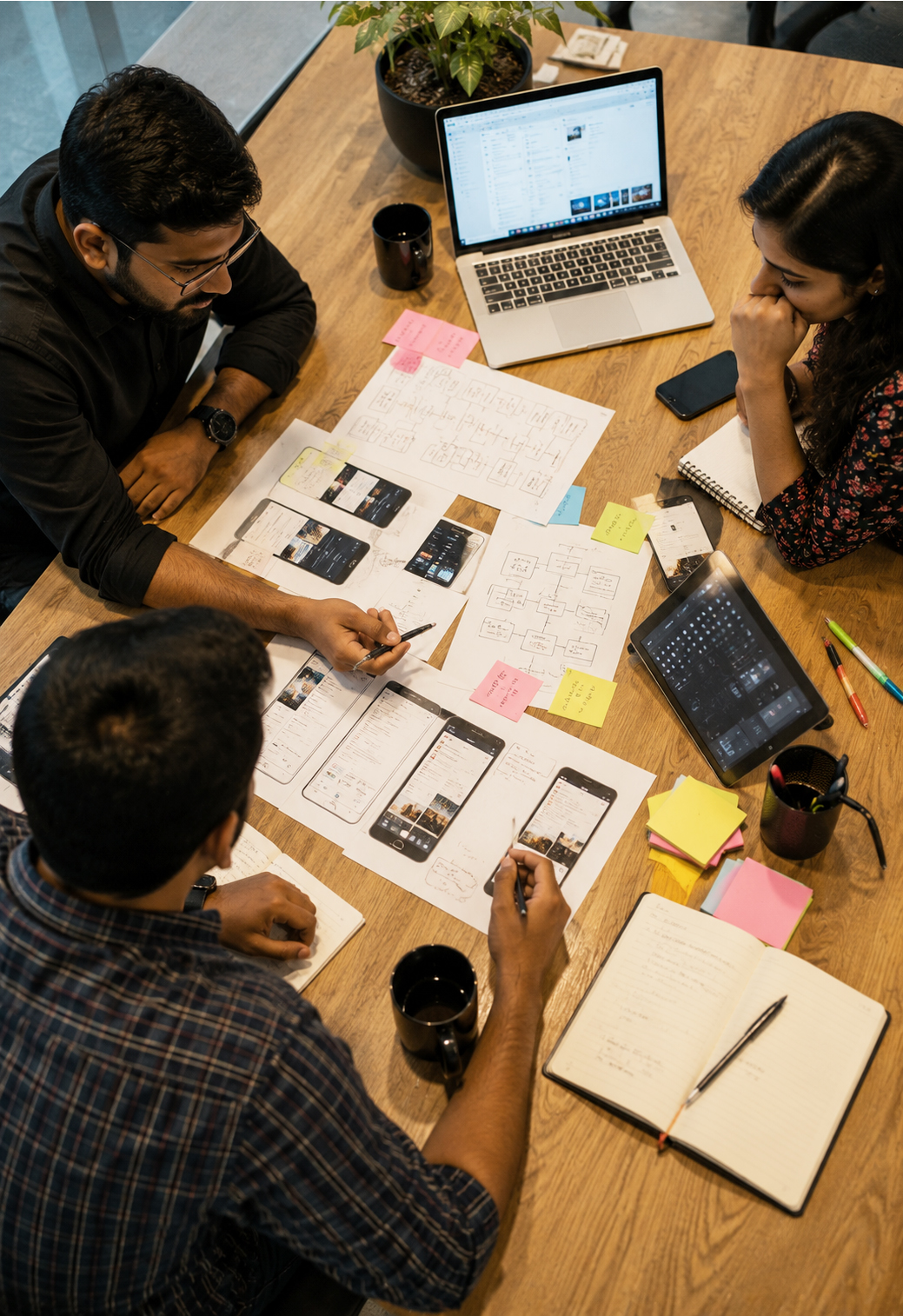
We watch how people actually use your product, then hand your team evidence to design the next version around, not another opinion in the room.
3Shadz UX Research runs user interviews, usability testing, card sorting, journey mapping, and behavioral analysis, and turns raw sessions into findings your design, product, and engineering teams can act on without a translation layer.
Research here is not a one-time study filed away after launch. It runs before a redesign to find what to fix, alongside design as a fast validation loop, and after launch to check whether the fix actually worked.
- Evidence-first Every recommendation traces to an observed session
- 6+ methods Matched to the decision, not a default template
- Fast synthesis Findings delivered in days, not buried in a deck
The Fastest Way to Be Wrong Is to Design Without Watching Anyone Use It
Every roadmap has assumptions buried in it, about what users want, what confuses them, and what they will never notice. Research is how those assumptions get tested before they become an expensive rebuild.
Teams that skip research do not usually skip it on purpose. A deadline moves up, a senior stakeholder is confident enough, and a decision ships on a guess that felt obvious in the room. Weeks later, the support queue or the drop-off chart tells a different story.
Our approach starts by naming the decision the research needs to inform, then picking the smallest method that answers it honestly: a handful of interviews, a moderated usability test, or a structured survey. We would rather tell you a plan will not work before you build it than after.
Findings are logged into a shared repository your team can search later, so the next person asking “didn’t we test this already?” gets an answer instead of a repeat study.
Four Ways We Turn Behavior Into Evidence
Each method answers a different kind of question, and each one gets sharper when paired with the others.
Discovery & Generative Research
Before a solution is designed, we find out what problem is actually worth solving: straight from the people who would use it.
- One-on-one user interviews
- Contextual inquiry & field visits
- Diary studies over time
- Stakeholder & expert interviews
- Competitive & heuristic review
- Problem framing workshops
Usability & Evaluative Testing
We put a live product or a clickable prototype in front of real users and watch, rather than ask, whether the design holds up.
- Moderated usability testing
- Unmoderated remote testing
- Heuristic & expert evaluation
- Accessibility walkthroughs
- Prototype & A/B concept testing
- System Usability Scale (SUS) scoring
Structural & IA Research
We test the structure underneath a product: the labels, categories, and navigation users rely on to find their way without reading a manual.
- Open & closed card sorting
- Tree testing (reverse card sort)
- First-click testing
- Journey & experience mapping
- Persona development
- Navigation & labeling audits
Behavioral & Survey Research
Qualitative sessions tell you why. Behavioral and survey research tell you how often, and at what scale, so a pattern from eight interviews can be checked against thousands of sessions.
- Quantitative & attitudinal surveys
- Product analytics & funnel review
- Session recording & heatmap analysis
- A/B & multivariate test synthesis
- NPS & satisfaction tracking
- Sentiment analysis on open-text feedback
Six Principles Behind Every Study We Run
Not a methodology poster: the working beliefs that settle arguments when a research decision is not obvious.
Talk to Users, Not About Them
A room debating what users probably think is not a substitute for five minutes of watching one actually try the thing.
Small Samples, Real Signal
Qualitative research does not need a huge panel. A handful of the right sessions surfaces most of the usability problems worth fixing.
Neutral Questions, Honest Answers
A leading question gets you the answer you wanted to hear. Every discussion guide is checked for bias before a single session runs.
Evidence Before Opinion
Every recommendation in a findings report traces back to an observed behavior or a direct quote, not a hunch dressed up as a conclusion.
Research Is Never “Done”
One big study before launch misses everything that happens after. We favor small, continuous research over a single annual report.
Findings Travel, Not Just Reports
Insights are logged to a shared repository the whole team can search, so nobody re-asks a question we already answered.
From an Untested Assumption to a Defensible Decision
The same design question, before and after five sessions of usability testing.
“Users will find the new dashboard intuitive because it mirrors the old one.”
Based on: internal opinion, three days before launch.
“6 of 8 participants missed the primary action after it moved below the fold. Task success dropped from 91% to 64%.”
Based on: 8 moderated usability sessions, coded and cross-checked.
What typically changes: a specific, measured failure point instead of a vague hunch, a number the team can track after the fix ships, and a recommendation everyone in the room can act on without relitigating the original opinion.
From an Open Question to a Findings Report You Can Act On
The same six stages apply to a single usability test and a multi-segment discovery study, only the depth of each stage changes.
-
01
Frame the Question
We name the exact decision this research needs to inform before choosing a method.
-
02
Recruit & Screen
Participants are screened against your target user profile, not whoever answered first.
-
03
Run Sessions
Interviews or usability tests are moderated and recorded under a clear consent protocol.
-
04
Synthesize
Sessions are coded and affinity-mapped so isolated quotes turn into visible patterns.
-
05
Report Findings
A prioritized report ties each recommendation back to what was actually observed.
-
06
Feed the Repository
Findings are logged centrally, so the next question starts from what we already know.
Deliverables From a UX Research Engagement
Exactly what is included is scoped up front: this is the typical set for a usability study or a discovery engagement.
Research Plan & Discussion Guide
The questions we will ask and why, agreed with your team before a single session runs.
Participant Recruitment
Screened participants matched to your target user profile, sourced from your users or ours.
Session Recordings & Transcripts
Full recordings and transcripts of every session, stored securely and shared with your team.
Affinity-Mapped Findings
Raw observations grouped into patterns, so isolated comments read as a trend.
Personas & Journey Maps
A shared picture of who your users are and the path they actually take through your product.
Usability & SUS Scoring
Task success rates and a System Usability Scale score you can track across future rounds.
Prioritized Recommendations
Findings ranked by impact and effort, so your team knows what to fix first.
Insight Repository
A growing, searchable archive of findings your team can reuse instead of re-asking.
Chosen Around the Question, Not a Fixed Toolkit
The right tool depends on the method, the fidelity of what is being tested, and how your team already works.
- User Interviews
- Respondent.io
- Calendly
- Google Forms
- Typeform
- Zoom
- UserTesting
- Lookback
- Maze
- Loom
- Dovetail
- Miro
- Notion
- Optimal Workshop
- Condens
- Hotjar
- Microsoft Clarity
- Google Analytics
- Amplitude
- UsabilityHub
Research Across Industries With Different Stakes
The questions we ask change with the industry. The rigor behind how we answer them does not.
Healthcare
Usability testing on clinical and patient-facing tools where mistakes carry real cost.
Banking & Financial Services
Research into trust, comprehension, and friction in high-stakes financial flows.
Retail & E-Commerce
Journey mapping and testing across browsing, cart, and checkout drop-off points.
Education & EdTech
Interviews and testing across learners, instructors, and administrators alike.
Travel & Hospitality
Research into booking and guest flows under real-world time pressure.
Real Estate
Card sorting and IA testing for listing, search, and portfolio-heavy interfaces.
Marketplaces & Platforms
Research run across buyers, sellers, and admins, whose needs rarely line up.
Startups
Fast, lean research that validates a direction before it is fully built.
Evidence-Led, Not Opinion-Led
Every recommendation traces back to an observed session or a coded quote, not a hunch.
Neutral Facilitation
We are not attached to a design we designed, so findings are not shaped to protect one.
Fast Synthesis Turnaround
Findings arrive as a prioritized report in days, not buried in a deck three weeks later.
Method Matched to the Question
The right method for the decision at hand, not a default template run every time.
Consent & Privacy by Default
Every participant is recruited and consented under a clear research protocol.
Insights You Can Reuse
A growing, searchable repository instead of a one-off PDF nobody reopens.
A Research Partner That Reports What It Finds
Research only earns its keep when the findings actually change a decision. We stay close to your design and product teams through synthesis, present findings in the language they already use, and log every study into a repository so the next roadmap conversation starts from evidence instead of memory.

Research Works Best Connected to What Happens Next
Findings only move a product forward when they land directly in design, product, and engineering decisions.
Research + UI/UX Design
Usability findings feed directly into the next round of interface and interaction decisions.
Explore UI/UX DesignResearch + Product Design
Discovery interviews shape concepts before the first screen is designed, not after.
Explore Product DesignResearch + Design Systems
Component-level usability findings tell you which patterns in the system actually work.
Explore Design SystemsResearch + Data & Analytics
Qualitative findings are checked against product analytics so patterns hold up at scale.
Explore Data & AnalyticsResearch + Design & Experience
See how UX research fits alongside UI/UX design, product design, and design systems.
Explore Design & ExperienceSee All Services
Review the full set of 3Shadz services and how research fits into the wider delivery picture.
Explore All ServicesUX Research FAQs
UX research is the structured study of how real people use a product (through interviews, usability testing, surveys, and behavioral data), so design and product decisions are grounded in observed behavior instead of internal opinion. It matters because the cost of being wrong compounds: a confusing flow shipped without research becomes a support ticket, a churned user, or a rebuild six months later.
We match the method to the question. Generative research (interviews, contextual inquiry, diary studies) uncovers needs before a solution exists. Evaluative research (usability testing, heuristic evaluation) checks whether a design works. Structural research (card sorting, tree testing) validates navigation and information architecture. Behavioral research (analytics review, surveys) adds scale to what smaller qualitative studies find.
For qualitative usability testing, five to eight participants per user segment typically surfaces the majority of usability problems, adding more participants mostly repeats the same findings. Quantitative or behavioral studies, such as surveys or analytics-based research, need larger samples because they are measuring rates, not patterns.
Both. Most usability testing and interviews run as moderated remote sessions over video call, which also makes recruiting a broader, more representative set of participants easier. In-person or contextual research is used when the environment itself matters: a clinical setting, a retail floor, or a warehouse, for example.
Either. We can recruit participants from your existing user base or, for research on a product still being validated, screen and recruit external participants who match your target audience through a structured screener.
Research is not limited to the start of a project. It runs before a redesign to identify what to fix, during design as a small-batch validation loop on early concepts, and after launch to measure whether a shipped change actually solved the problem it was meant to solve.
Market research generally asks whether people want a product and how large the opportunity is. UX research asks how people actually use a product or prototype, what confuses them, what they do without thinking, and where a specific flow breaks down. The two are complementary, not interchangeable.
A structured findings report tied to your original research questions, with prioritized, actionable recommendations, not just a transcript dump. Depending on the engagement, this can include session recordings, an affinity-mapped insight board, personas, journey maps, or a usability score such as SUS.
A focused usability test on an existing prototype can run one to two weeks end to end, including recruiting. A larger discovery study with interviews across multiple user segments typically runs three to five weeks. We scope timelines up front against the decision the research needs to inform.
Participants are recruited and consented under a clear research protocol before any session starts, recordings are stored securely and shared only with your team, and personally identifiable information is stripped from findings reports and the insight repository.
Both. Confirmatory research validates a decision already in motion, checking whether it will work before full investment, and is just as valuable as generative research that shapes a decision from scratch. Either way, findings are reported honestly, including when they contradict the original plan.
Share the decision you are trying to make: a redesign, a new feature, a flow with a high drop-off rate, or a product you are about to build without ever talking to a user. We will recommend the method that answers that question fastest and scope a plan around it.
Stop Guessing What Users Want. Ask Them.
You do not need a finished prototype or a huge user base to start. Tell us about the flow users abandon, the feature you are not sure anyone wants, or the redesign you are about to ship on assumptions alone. We will recommend the fastest method to get you a real answer.