











Intelligence That Turns Complexity Into Possibility
AI isn't a feature you bolt onto a product: it's a system of decisions about data, context, retrieval and orchestration that determines whether intelligence actually works once real users depend on it.
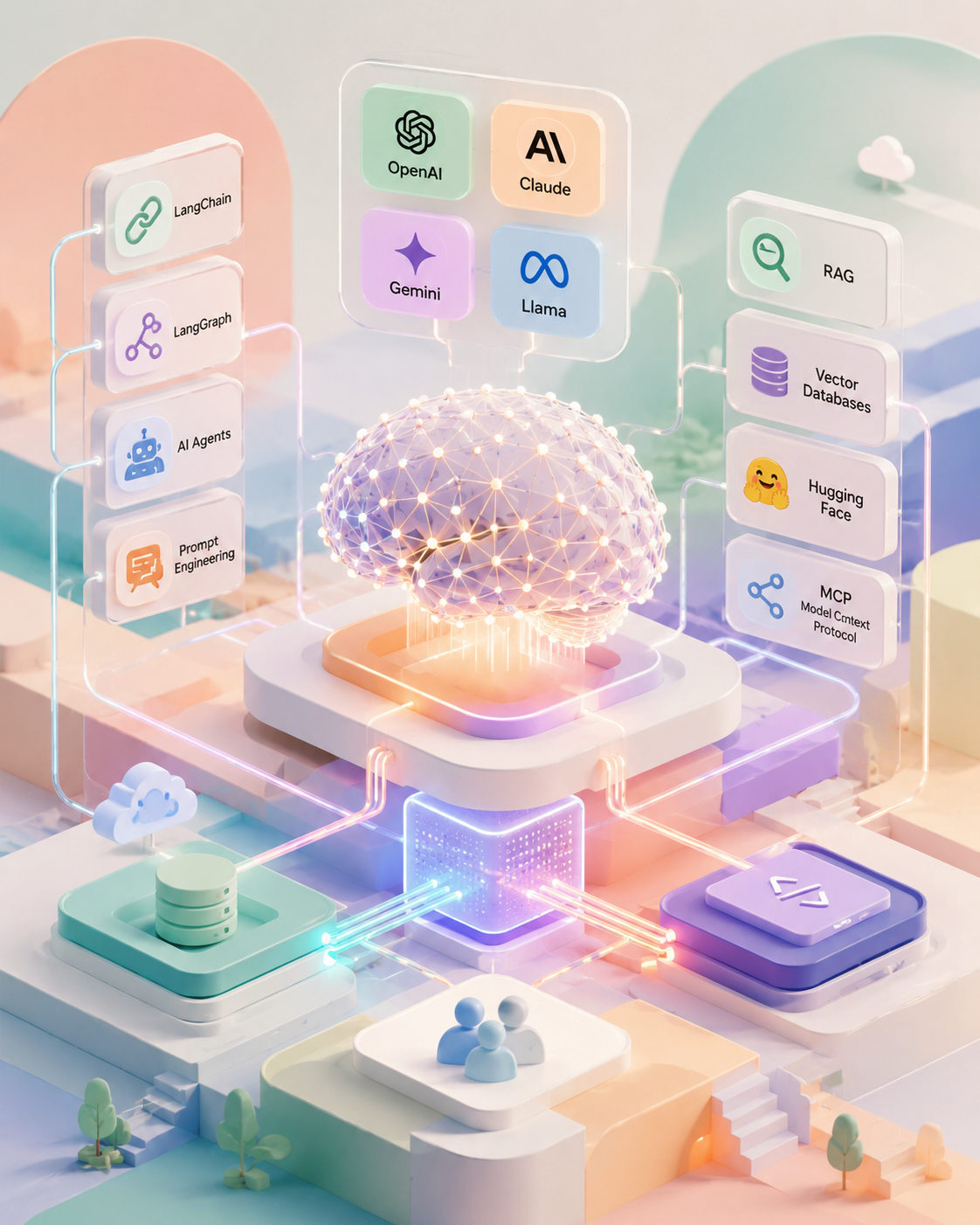
3Shadz builds production-ready AI and machine learning systems across OpenAI, Claude, Gemini and Llama, connected through LangChain, LangGraph, retrieval-augmented generation and AI agents, engineered as part of the same connected technology stack we bring to frontend, backend, mobile and cloud.
- OpenAI
- Claude
- Gemini
- Llama
- LangChain
- RAG
AI That Works Beyond the Demo
Connecting an application to a model is the easy part. What determines whether AI actually holds up in production is everything around that connection: the context it's given, the data it can retrieve, the way multiple steps are orchestrated, and how reliably it behaves once real users depend on it.
3Shadz treats AI as an engineering discipline, not a demo. We design for security, evaluation and integration from the start, so intelligent features hold up under real usage instead of falling apart the moment they leave a controlled test.
- Context
- Data
- Retrieval
- Orchestration
- Security
- Reliability
- Evaluation
- Integration
- Scalability
How the Pieces Actually Fit Together
AI products rarely run on a single model. These are the layers we combine (models, knowledge, orchestration and connection) around a shared intelligence core.
Models
The foundation models that generate, reason and respond to what they're given.
- OpenAI
- Claude
- Gemini
- Llama
Knowledge
Where a system grounds its answers in real, retrievable information instead of guessing.
- RAG
- Vector Databases
- Hugging Face
Orchestration
The logic that decides what happens next, in what order, and with which tools.
- LangChain
- LangGraph
- AI Agents
- Prompt Engineering
Connected Intelligence
How intelligence reaches into the tools, APIs and systems a business already runs.
- MCP
- APIs
- Enterprise Systems
A Prompt Is the Start of the Work, Not the End of It
Enterprise AI takes more than a well-written prompt. Here's what typically has to happen between a request and a response a business can actually rely on.
AI Agents That Actually Do Work
An agent isn't autonomous magic: it's an engineered system with defined boundaries, given tools and permission to use them. That distinction is what makes agents something a business can actually rely on.
- Understand the context of a request before acting on it.
- Retrieve the information needed to respond accurately.
- Use tools and functions to complete real tasks.
- Interact directly with APIs and existing systems.
- Coordinate multiple steps toward a single outcome.
- Make decisions within clearly defined boundaries.
- Automate repetitive, multi-step workflows end to end.
Knowledge That Models Can Actually Use
A model's training data is fixed the day training ends. Retrieval-augmented generation and vector databases let a system pull in current, organization-specific knowledge before it responds, keeping answers grounded in relevant information rather than relying on the model's memory alone.
A Model Working Alone
- Relies only on what it learned during training.
- Has no visibility into your product, documents or data.
- Answers can drift from what your organization actually knows.
A Model Connected to Your Knowledge
- Retrieves relevant information before generating a response.
- Uses vector databases and semantic search to find what's actually relevant, not just keyword matches.
- Keeps responses grounded in your own documents, data and systems.
We use tools like Hugging Face for embeddings and open-source models where they fit the product, alongside vector databases that make semantic search practical at scale.
Choosing a model is one decision. Context management, retrieval, orchestration and evaluation are what actually determine whether AI works once real people depend on it.
Practical Places Intelligence Earns Its Place
Ten areas where we've seen AI create genuine business value, not as a novelty, but as part of how a product or team actually works.
Intelligent Automation
Routine, rule-heavy work handled by systems that can reason about context, not just follow fixed steps.
AI Assistants
Conversational interfaces that help people get answers, complete tasks or navigate a product faster.
Enterprise Knowledge Systems
Internal knowledge made searchable and usable, grounded in an organization's own documents and data.
Document Intelligence
Extracting, summarizing and structuring information locked inside contracts, reports and records.
Customer Support Intelligence
Support experiences that understand context and route or resolve issues more efficiently.
Developer Productivity
AI-assisted tooling that speeds up how engineering teams write, review and ship code.
Data & Insight Experiences
Turning raw data into answers people can actually query in plain language.
AI-Powered Product Features
Intelligence built directly into a product's core experience, not bolted on as an add-on.
Workflow Automation
Multi-step processes coordinated across tools and systems with less manual handoff.
Intelligent Search
Search that understands meaning and intent, not just keyword matches.
From AI Experiments to Intelligent Products.
Whether you're evaluating models, designing an AI agent, or architecting retrieval for your own data, 3Shadz can help turn AI capability into a production-ready product.