











Every Capability Depends on Something. Rarely Is That Made Visible.
3Shadz Enterprise Architecture Consulting maps how business capabilities, applications, data, integrations, platforms and technology foundations actually fit together, so duplication, dependency and drift become deliberate decisions instead of discoveries made during an incident or a migration.
Five architecture layers, each drifting to its own width and alignment: coherence nobody quite owns.
The Discipline of Making the Landscape Understandable
Enterprise Architecture Consulting is the 3Shadz practice that works out how business capabilities, applications, data, integrations, platforms and technology foundations fit together, and what architecture is required for that landscape to keep evolving without losing coherence.
It is not a exercise in producing an enormous diagram, documenting every system for its own sake, or designing an idealized future state that has no realistic path from where the organization actually is. It is the work of making relationships and consequences visible: which capability a system supports, what depends on it, where it duplicates something else, and what constrains changing it.
That understanding is what turns a modernization plan, a platform decision or an AI initiative from a good idea into something the organization can actually execute, and what tells you, credibly, when the right decision is to leave something alone.
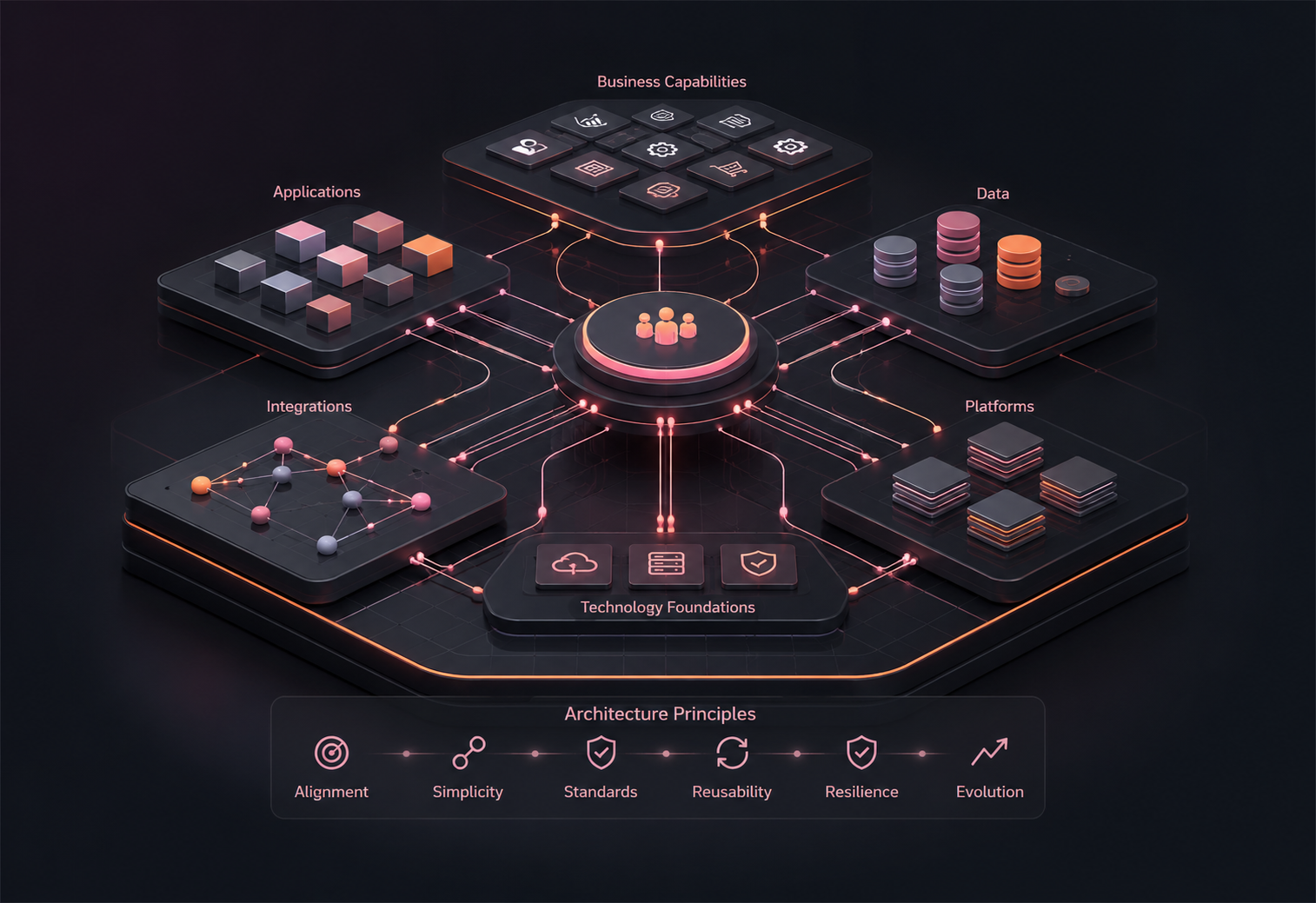
Architecture is not the diagram. It is what the diagram reveals about what depends on what.
Not Servers. Not a Preferred Vendor. What the Business Needs to Be Capable Of.
Enterprise architecture that starts with technology tends to produce technology decisions that don’t actually serve the business. Starting with capabilities, what the organization needs to be able to do, keeps the applications, data, integration and platform decisions underneath it honest. Expand a capability below to see what that usually uncovers.
Sales and support each run their own version of onboarding, built at different times for different pressures. Neither is wrong on its own, but together they create two records of truth for the same customer and no single place to change the process.
The core order flow works. Returns, partial shipments and exceptions were bolted on later and now route through the same narrow integration point, which is why every peak season surfaces the same fragile handoff.
A configurable workflow engine was built for a volume and complexity the capability never reached. Simplifying it, not extending it further, is usually the more valuable conversation.
Procurement trusts the spreadsheet more than the system it’s supposed to replace, usually a sign that the system doesn’t yet do what the capability actually needs.
Nobody planned this dependency: it accumulated one convenient export at a time, until an executive dashboard turned out to rest on a tool nobody remembers approving.
Current-State Architecture Is Not an Inventory
Documentation is treated as a hypothesis, not a source of truth. Understanding the landscape that actually exists, not the one described three reorganizations ago, means looking across a consistent set of areas.
Business & Ownership
Applications & Data
Integration & Identity
Infrastructure & Lifecycle
- What exists
- Version numbers and license counts
- Server and hosting locations
- What depends on what
- Where duplication and risk concentrate
- What constrains the next change
Large Portfolios Accumulate. Rationalization Is a Decision, Not a Purge.
Applications build up through growth, acquisitions, departmental purchasing, tactical delivery and overlapping transformation programmes. The goal isn’t to replace everything old: it’s to give every application in the portfolio a deliberate outcome, evaluated across a consistent set of dimensions.
Business Importance
Which capability does the application support?
Functional Fit
Does it still meet the business need it was built for?
Duplication
Do other systems perform substantially the same role?
Dependencies
What processes, data or integrations rely on it?
Maintainability
Can it be operated and changed sustainably?
Technology Risk
Does the underlying technology introduce material constraints?
Integration Depth
How embedded is it into the wider landscape?
Data Ownership
What important information does it own or exchange?
Strategic Fit
Does it belong in the future architecture?
No arbitrary scoring model decides these outcomes. Each is a judgment call, weighed across the dimensions above and checked against what the organization can realistically fund and deliver.
Six Perspectives. None of Them Designed Alone.
Business, application, data, integration, technology and security are useful lenses for organizing architecture work, but a change made inside one of them routinely has consequences in another. Treating them as independent is where architecture drift usually begins.
Stands Alone
Business Architecture
Capabilities, operating structures and business relationships
Application Architecture
Applications, services, responsibilities and boundaries
Data Architecture
Information domains, ownership, movement and access
Technology Architecture
Platforms, runtime environments, cloud and infrastructure
Integration Architecture
APIs, events, interfaces and communication patterns
Security Alignment
Identity, trust boundaries and access across decisions
What a Useful Target-State Architecture Actually Clarifies
A target state isn’t a perfect future diagram disconnected from delivery reality. It establishes direction, without pretending every implementation decision is already known.
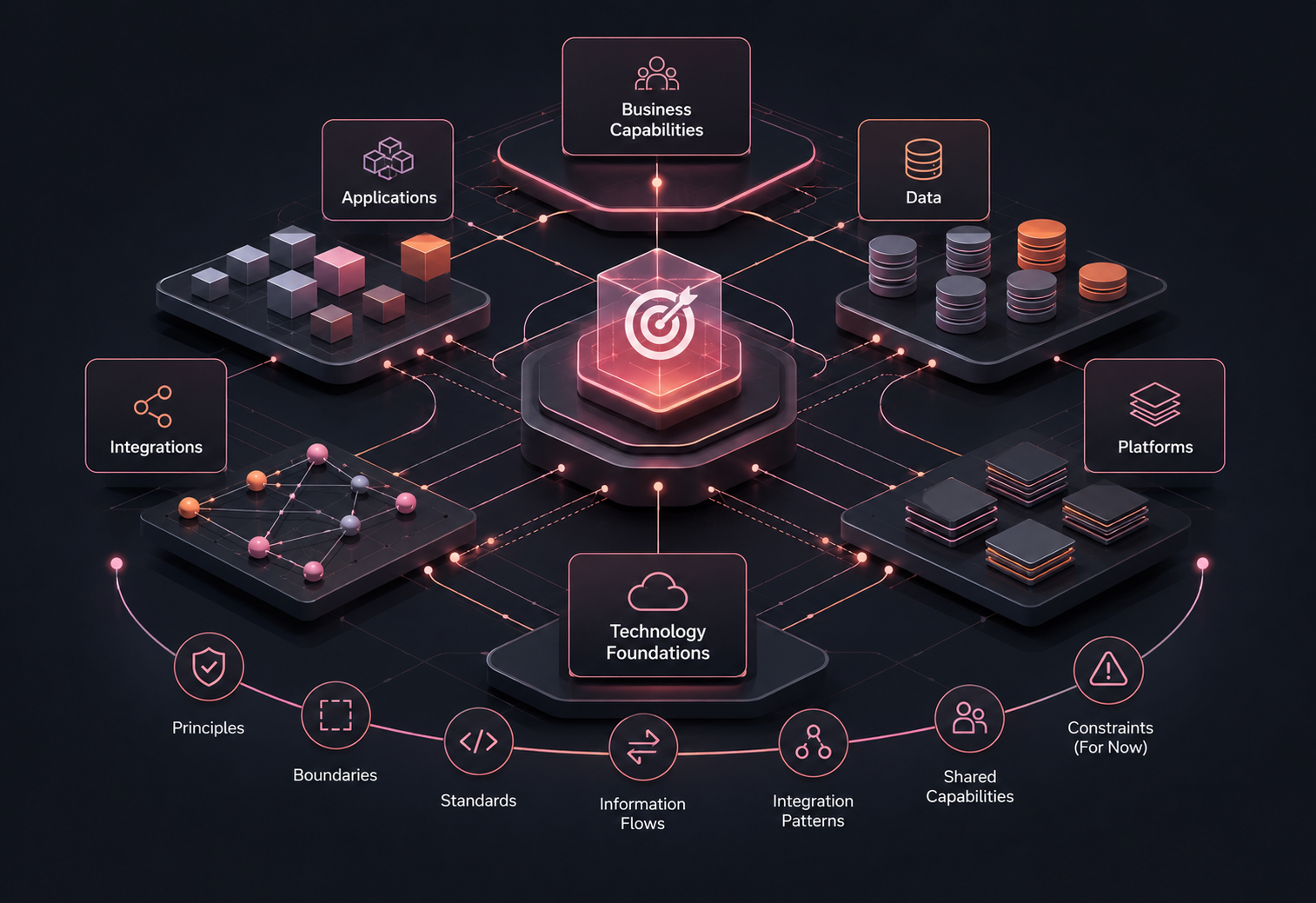
A Target State Without a Transition Path Is Only a Picture
Organizations rarely move directly from current state to target state. Business operations have to continue while the architecture evolves, which means the path between the two matters as much as either end of it.
Current State
Coexistence
Old and new systems run in parallel; a bridge keeps operations continuous while data migrates.
Contained Legacy
The legacy platform is boxed behind a governed API; new work stops touching it directly.
Consolidation
Overlapping systems converge onto the shared platform; remaining dependents migrate deliberately.
Target Direction
“A target architecture without a credible transition path is only a picture.”
Guidance for the Decisions the Architecture Can’t Prescribe
Principles exist because architecture can’t specify every implementation detail in advance. They reflect this organization’s business direction, existing constraints, risk profile and technology strategy, not a generic list that sounds sophisticated regardless of context.
Modularity
Boundaries that let one part change without forcing another to
Loose Coupling
Dependencies made explicit, not implicit and hidden
Clear Ownership
Every system and dataset has one accountable owner
Interoperability
Systems designed to work together, not just alongside each other
Data Ownership
One authoritative source per important piece of information
Security by Design
Identity and access considered from the first decision, not retrofitted
Observability
Systems built to reveal their own behavior, not just their output
Resilience
Failure contained rather than propagated through dependencies
Controlled Diversity
Technology variation allowed where it serves a real need
Lifecycle Responsibility
Someone accountable for a system from adoption to retirement
Build vs Buy Discipline
Build only where the capability is a genuine differentiator
Reuse Before Rebuild
Check what already exists before adding something new
Most Architecture Problems Live in the Connections
A system that looks healthy on its own can still sit at the center of a fragile web of point-to-point connections. Architecture makes those dependencies visible so teams understand what changes when one component changes, not every organization needs the same integration architecture, but every organization needs to know what its own actually is.
The Architecture Questions Around Information, Not the Platform Build
This is the architecture lens on data, where deeper pipeline, warehousing and governance implementation continues through Data & Analytics.
Enterprise Architecture is not a cloud architecture exercise, an AI architecture page, or a technology-product selection process. Technology choices follow architectural requirements, not the other way around.
Coherence, Without Becoming a Committee That Says No
Governance isn’t positioned as a gate whose main purpose is rejecting projects. It’s the mechanism that keeps architecture decisions coherent as conditions change, without unnecessarily slowing delivery.
Who can make which architecture decisions, against what principles, and how are exceptions handled?
What Should Be Standardized, and Where Should Teams Have Freedom?
Excessive standardization creates rigidity. Uncontrolled choice creates fragmentation. Enterprise architecture’s job is deciding where the boundary actually belongs.
Standardize
the Boundary
Local Freedom
What a Modernization Initiative Needs to Understand First
Architecture is what tells a modernization programme what it’s actually touching, before the touching starts.
Deeper modernization delivery continues through Technology Modernization Consulting, with implementation carried out through Software Engineering and Cloud & DevOps.
A Sequence With Reasons, Not a Gantt Chart
A useful architecture roadmap connects business priorities, capability gaps, application and platform decisions, data dependencies, integration changes and governance, and explains why one change has to happen before another. Not every organization needs the same sequence.
Stabilize
Contain the risks that can’t wait
Simplify
Give duplication and overlap a decision
Shared Foundations
Establish the standards other work builds on
Transition
Move deliberately through credible intermediate states
Consolidate
Bring overlapping systems onto shared platforms
Evolve
Treat architecture as a managed, ongoing capability
Architecture Operating Model
A diagram doesn’t maintain itself. The model below depends on organizational scale, delivery model, technology landscape, governance requirements and rate of change: there isn’t one universal answer.
Overall accountability and domain-level ownership (business, application, data, integration, technology) are named separately, so a gap in one domain doesn’t quietly become nobody’s problem.
A named path for exceptions (not silence, and not an automatic no) keeps standards credible instead of routinely worked around.
Reference material that nobody owns quietly goes stale. Someone is accountable for keeping it current enough to be trusted.
The working relationship (embedded, advisory, or a review checkpoint) needs to be explicit, or it defaults to whichever mode causes the most friction.
This connects directly to the standardize-versus-freedom boundary above, and needs to be revisited as the organization’s scale and delivery model change.
The Technology Estate Becomes Understandable, Deliberate and Changeable
Capabilities Have Clear Technology Support
The organization understands which applications and platforms support the capabilities that matter most.
Dependencies Are Visible
Teams can see what’s affected before a significant change begins.
Duplication Has a Decision
Overlapping systems are deliberately retained, consolidated, modernized or retired.
Architecture Has Direction
A target state and principles guide decisions without pretending every detail is already known.
Transition Is Designed
Modernization has credible intermediate states, not an unrealistic big-bang change.
Standards Have a Reason
Standardization is applied where consistency creates meaningful value, not everywhere.
Architecture Can Keep Evolving
It’s treated as a managed capability: teams know their decision boundaries, modernization stays coordinated across application, data, integration and platform, and the architecture is revisited as conditions change rather than filed away once and forgotten.
Related to Several Practices. Interchangeable With None of Them.
Enterprise Architecture Consulting is one of six connected capabilities inside Technology Consulting. Here’s specifically where it stops and each neighboring practice begins.
IT Strategy Consulting
They answer: where should technology investment go, and what happens first?
We go deeper into: the structures, relationships and transition states required to make that direction executable.
Digital Transformation Consulting
They answer: how do process, experience and operating-model change move together?
We go deeper into: the applications, data, integrations and platforms that transformation actually depends on.
AI Strategy Consulting
They answer: where does AI create meaningful value, and what governs its adoption?
We go deeper into: the applications, data, identity and platform structure AI capabilities have to operate within.
Software Engineering
They answer: how does an individual system get designed, built and deployed?
We go deeper into: how that system fits into, and doesn’t duplicate, the wider landscape around it.
Sometimes the Right Architectural Decision Is Not to Change Anything Yet
Enterprise architecture isn’t enormous diagrams, documenting everything, a committee for every decision, one mandated stack, or an idealized future with no transition path. Often the correct call is one of these instead:
One of Six Connected Technology Consulting Capabilities
Enterprise Architecture Consulting usually sits underneath direction set by IT Strategy Consulting or Digital Transformation Consulting, and hands its structure to Technology Modernization Consulting and delivery teams to execute.
Enterprise Architecture Consulting: Frequently Asked Questions
No. Diagrams and documentation support the work, but the actual output is a set of decisions: what’s retained, consolidated, modernized or retired, and the principles and transition path that make those decisions coherent. Documentation that isn’t tied to a decision doesn’t get produced just to exist.
No. Existing documentation is treated as a starting hypothesis, not a source of truth. Understanding what the current landscape actually looks like, including where it differs from what’s documented, is part of the work, not a prerequisite for it.
IT Strategy Consulting decides where investment and priority should go. Enterprise Architecture Consulting works out the structures, relationships, standards and transition states that direction depends on to actually be executable. Most engagements use both together.
No. A legacy system that’s stable, well understood and not blocking anything important is often better contained or left alone than replaced. Architecture decisions follow an assessment of dependency, risk and cost of change, not a default preference for modernization.
Enterprise Architecture Consulting defines how the landscape should fit together: capability, application, data, integration and platform boundaries. Building or changing an individual system continues through Software Engineering, Cloud & DevOps and Technology Modernization Consulting, using that architecture as its starting point.
It’s one of six connected capabilities inside Technology Consulting. IT Strategy Consulting and Digital Transformation Consulting typically set direction and coordinate change, AI Strategy Consulting determines where AI fits, and Technology Modernization Consulting and CTO as a Service carry decisions into delivery and ongoing leadership. Enterprise Architecture Consulting provides the structural layer that connects them.
Make the Architecture Clear Before the Next Major Change.
Before a modernization programme, a platform decision or a major AI investment becomes an expensive commitment, let’s map how your business capabilities, applications, data, integrations and technology actually fit together, and what a practical target state and transition path would look like from here.