











Everyone Wants AI Somewhere. Almost No One Has Decided Where.
3Shadz AI Strategy Consulting turns scattered pilots, executive pressure and disconnected proofs of concept into a prioritized set of AI opportunities, checked against data, readiness, risk and governance, so investment goes where AI can responsibly earn its place.
Deciding Where AI Belongs, Before Deciding Which AI to Use
AI Strategy Consulting is the 3Shadz practice that determines where artificial intelligence can create genuine business value (and just as importantly, where it currently can’t) before any platform, model or vendor gets chosen.
It is not a workshop that ends in a list of AI use cases, a mandate to adopt the newest model, or a plan to give every team a chatbot. It is the discipline of tracing AI decisions back to the business outcomes, processes and decisions they are meant to improve, then testing whether the organization has the data, technology, governance and appetite for risk that opportunity actually requires.
Executive pressure to “do something with AI” rarely comes with a definition of what that something should be. That gap is where most AI initiatives lose coherence, multiplying pilots instead of building a capability. AI Strategy Consulting closes it with prioritized opportunities, defined readiness, clear ownership and a roadmap connected to measurable outcomes.

AI should have to earn its place in the solution, not receive it by default.
The Same Business Objective Can Have Several Right Answers: AI Is Only One
Before any AI opportunity gets prioritized, the underlying business objective gets defined on its own terms: what decision, process or outcome actually needs to improve, and what happens today when it doesn’t. Only once that’s clear does it make sense to ask what kind of response fits.
The Business Objective
What decision, process or outcome actually needs to improve, not which AI model or platform to deploy.
AI-flavored responses are highlighted only to show they don’t start ahead of the alternatives. The objective decides; the response follows.
The Situations That Bring Organizations to AI Strategy
Rarely a single trigger. Most engagements begin wherever the friction is currently greatest, and grow into a fuller strategy from there.
Scattered Experiments & Pressure
Unclear Ownership & Governance
Data & Technology Uncertainty
Stalled Pilots & Vague ROI
Opportunities Are Found in Actual Work, Not a Generic Catalog
Potential AI opportunities tend to surface in recognizable kinds of work. Naming the pattern is only the start: each candidate still has to be understood on its own terms.
An opportunity understood in the abstract behaves differently once it’s placed inside a specific person’s actual workday.
If nothing about a decision, action or outcome actually changes, the opportunity isn’t one yet, regardless of how capable the underlying model is.
A promising idea and an available, trustworthy data source are two different things. This is usually where feasibility is first tested.
The consequence of a wrong output shapes how much autonomy, oversight and validation the opportunity actually requires.
An opportunity without a credible way to evaluate quality isn’t ready to be prioritized: it’s an open question dressed up as a use case.
An opportunity that requires people to leave their existing tools tends to be used once, in a demo, and rarely again after.
Defined before building anything, so the organization can later tell whether the opportunity actually delivered, instead of assuming it did.
Meaningful Parts of the Strategy, Not the Whole of It
Generative AI and AI agents are significant strategic considerations, but AI Strategy Consulting stays broader than either. Both are treated as points on a spectrum of autonomy, each requiring a different level of control.
AI Provides Information
Retrieves and surfaces what already exists
AI Recommends
Suggests an option; a person decides
AI Assists
Drafts or prepares work a person finishes
AI Executes Constrained Actions
Carries out a specific, bounded action
AI Coordinates Approved Workflows
Sequences steps within pre-approved limits
Autonomy increases left to right. So does the need for oversight, logging and a defined way to stop it.
Generative AI, Applied to Real Work
Questions That Define an AI Agent’s Boundaries
- What actions is it permitted to take?
- Which systems can it access?
- What information can it retrieve?
- What decisions require approval?
- When should it escalate to a person?
- What happens when a tool or dependency fails?
- How is its activity logged?
- How is its performance evaluated?
- Where does autonomy deliberately stop?

Structured Decision-Making Under Uncertainty, Not a Score
Organizations often surface dozens of potential AI opportunities. Deciding which deserve attention is not about a numerical AI score: it’s about weighing the same set of lenses, consistently, for every candidate.
Business Consequence
What meaningful business problem, capability or decision does this address?
User Impact
Who actually benefits: customers, employees, operators or decision-makers?
Data Readiness
Does the required data exist, and is it accessible, reliable and appropriate to use?
Technical Feasibility
Can this realistically be built, integrated and operated?
Risk
What happens when the output is incorrect, incomplete or inappropriate?
Human Oversight
Where must a person review, approve, correct or override the result?
Integration Complexity
Which systems, workflows and interfaces does this need to work with?
Adoption
Will people realistically use this within how they already work?
Scalability
Can this move beyond a demo into dependable, ongoing use?
Strategic Importance
How strongly does this support where the organization is trying to go?
A Feasible Use Case Is Not the Same as a Ready One
These dimensions are assessed together, because a gap in one usually surfaces as a problem in another.
Business Readiness
Are objectives, owners and expected outcomes defined?
Process Readiness
Is the process understood well enough to know where AI actually belongs in it?
Data Readiness
Is relevant information available, accessible, usable and appropriately governed?
Technology Readiness
Can existing architecture support integration, security, monitoring and scale?
Integration Readiness
Can AI interact reliably with the applications, APIs and workflows it depends on?
Governance Readiness
Are policies, controls, responsibilities and escalation paths defined?
People Readiness
Do teams understand how their responsibilities and workflows may change?
Risk Readiness
Can the organization identify, evaluate and manage AI-specific risk?
Operational Readiness
Who will monitor, maintain, evaluate and improve this after launch?
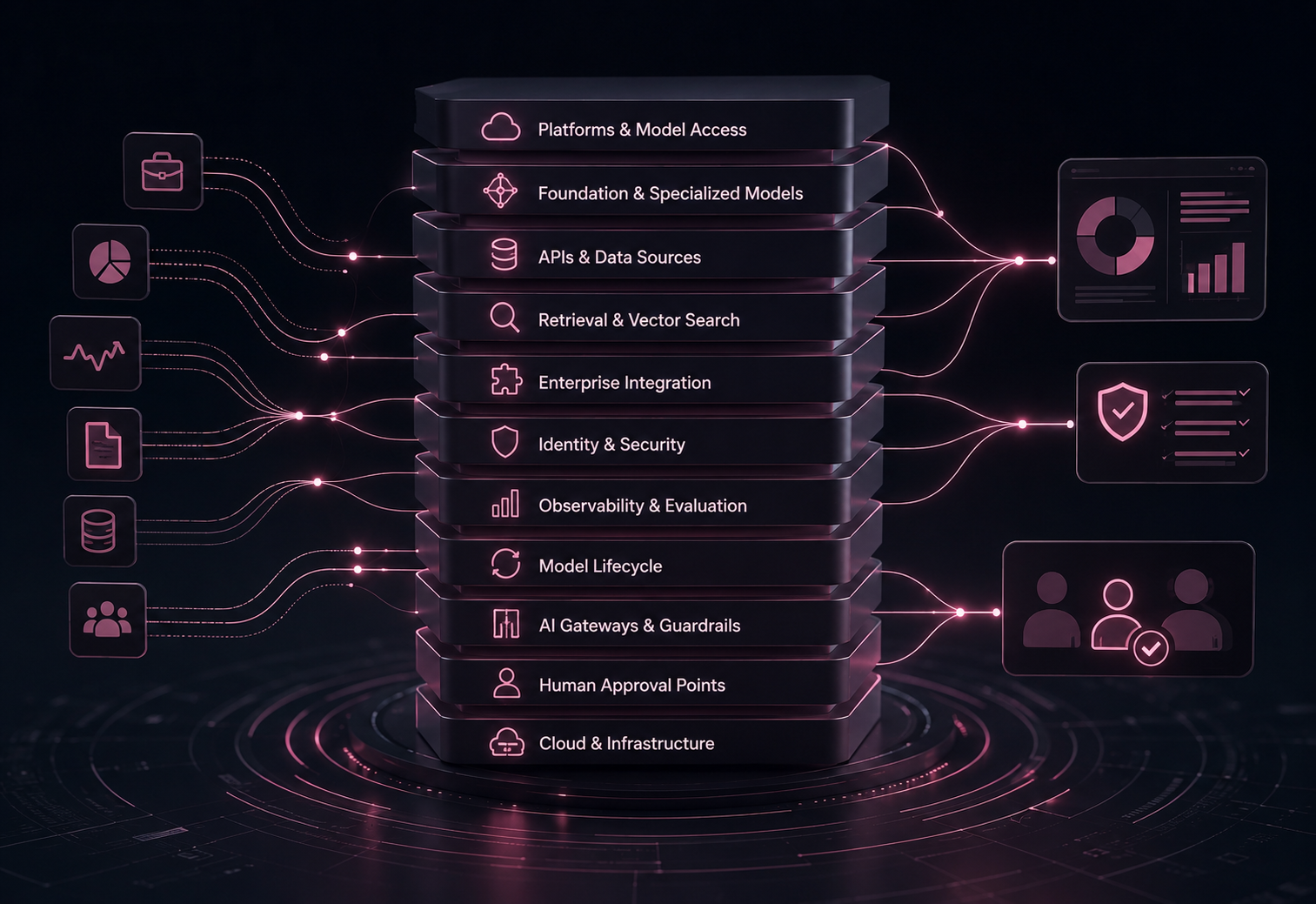
Architecture Choices Follow the Use Cases, Not the Other Way Around
AI strategy has architectural consequences. At the strategy level, that means forming a point of view on how AI capabilities will fit together, not selecting a specific technology stack in advance.
No two organizations require the same AI stack. Choices follow the use cases, risk profile, operating requirements and existing technology environment. For architecture at the implementation level, that continues through Enterprise Architecture Consulting and Software Engineering.
The Right Level of Ownership and Control, Not a Default Answer
Custom development isn’t automatically the preferred path. Each capability is weighed on its own terms.
Makes sense when the capability is a genuine differentiator, control and customization matter more than speed, and the team can own it long-term.
- Strategic differentiation
- Full control & customization
- Long-term operating ownership
Makes sense when the problem is already well solved elsewhere, differentiation isn’t at stake, and speed matters more than customization.
- A solved problem, not a differentiator
- Vendor accountability
- Faster time to value
Makes sense when an existing platform already provides most of what’s needed, and the remaining gap is genuinely small.
- Existing platform investment
- Lower integration overhead
- Faster, lower-risk change
Makes sense when no single option covers the requirement: commonly a platform, an integration layer and a specific in-house capability together.
- Mixed data sensitivity & control needs
- Partial differentiation
- Realistic for most enterprise AI
Strategic differentiation, data sensitivity, integration needs, skills, vendor dependency and long-term maintainability are weighed for each capability on its own terms.
Proportionate to What the AI Does, Not a Fixed Checklist
Governance is scoped to what the AI does, what it touches, who relies on it, and what happens when it’s wrong, not applied the same way to every use case.
It’s part of deciding whether a capability is ready to move from experiment toward production, not a step bolted on afterward.
What Should AI Decide, and What Should Remain Human?
Different activities warrant different boundaries. Defining them is a strategic decision, not an operational afterthought.
Where is human review required before output is used?
Where is explicit approval required before an action is taken?
Where is AI output advisory only, never authoritative?
Where can an action reasonably be automated end-to-end?
Where does confidence or uncertainty change what happens next?
Where do errors carry consequences serious enough to change the boundary?
Where should the system escalate to a person, and to whom?
Where should AI not be used at all, for now?
Experiments Should Answer Questions, Not Run Indefinitely
Experimentation is necessary. Without decision criteria, it produces an endless collection of proofs of concept instead.
Stopping an initiative is treated as a legitimate strategic decision when the evidence doesn’t support continuing, not a failure to be quietly buried.
A Coordination Mechanism, Not a List of Projects on a Timeline
A useful roadmap connects business priorities, use cases, data foundations, platform capabilities, governance and scaling horizons, not just dates.
Groundwork the highest-value opportunities will depend on
- Data accessibility & quality for priority use cases
- Platform, identity and security groundwork
- Initial governance & ownership decisions
Purposeful experiments that answer specific questions
- Proofs of concept scoped to defined questions
- Evaluation criteria set before testing begins
- Explore-tier ideas tested at low cost
Selected use cases move into production with controls in place
- Human oversight & escalation paths defined
- Monitoring, logging and evaluation running
- Clear operating ownership assigned
Reusable capabilities extend to adjacent opportunities
- Shared platform capabilities where they earn their cost
- Proven patterns reapplied to adjacent opportunities
- Governance reviewed as scope grows
Dependencies Worth Naming
A generative AI assistant usually depends on reliable knowledge sources being in place first.
An AI agent usually depends on stable APIs and clear authorization boundaries.
Predictive models usually depend on usable, sufficient historical data.
Customer-facing AI usually needs stronger evaluation and escalation controls than internal use.
AI-driven automation often needs process redesign before it, not after.
Scaling several use cases at once can justify shared platform capabilities a single pilot wouldn’t.
Production AI needs monitoring and operating ownership a proof of concept never required.
Enterprise AI Needs Ownership Beyond the Initial Build
There is no single correct structure. What should sit in a central AI function versus inside a business domain depends on organizational scale, technology structure, risk profile, AI maturity and where a given capability is deployed, not a template applied regardless of context.
Defined Before Scaling, Not Reconstructed Afterward
What matters depends entirely on why the use case existed in the first place.
Not a Measure of Success
- Number of AI pilots running
- Number of models deployed
- Employees with chatbot access
- Tokens or API calls generated
- Number of AI tools purchased
What Actually Matters, by Context
AI Becomes a Managed Capability, Not a Collection of Experiments
AI Has a Reason
Every prioritized initiative connects to a defined business problem, capability or decision.
Use Cases Are Prioritized
The organization knows which opportunities deserve investment, which need foundations first, and which should wait.
Foundations Match Ambition
Data, architecture, integration and operating capabilities are developed according to actual AI needs.
Experimentation Produces Decisions
Proofs of concept answer defined questions rather than existing indefinitely.
Humans Know Their Role
Review, approval, escalation and accountability boundaries are explicit.
Governance Is Built In
Risk, privacy, security and oversight are considered throughout the AI lifecycle.
Production Is Designed Deliberately
AI capabilities have ownership, monitoring, evaluation and operating responsibility after deployment.
Progress Can Be Evaluated
AI investment is measured against meaningful business and operational outcomes.
The Organization Keeps Learning
AI strategy evolves as technology, regulation, priorities and evidence change.
AI Strategy Consulting Sits Upstream of Delivery, Not Instead of It
AI Strategy Consulting decides where AI belongs, which opportunities deserve investment, and what foundations and controls responsible adoption requires. Turning a prioritized opportunity into a working, production-grade capability is delivery work: solution design, model integration, retrieval systems, agent implementation, evaluation and ongoing operation.
This sits alongside the connected capabilities inside Technology Consulting, and complements IT Strategy Consulting and Digital Transformation Consulting for organizations coordinating change more broadly.
AI Strategy Consulting: Frequently Asked Questions
No. It starts with the business objective, process or decision that needs to improve. Only after that is understood, and only when a non-AI response wouldn’t serve it better, does a platform, model or vendor choice enter the conversation.
No. Many organizations arrive with scattered pilots, executive pressure to “do AI,” or a general sense that initiatives aren’t connecting, without yet knowing which opportunities deserve investment. Discovering and prioritizing those opportunities is part of the engagement, not a prerequisite for it.
IT Strategy Consulting is broader: it covers applications, infrastructure, cloud, data and the wider technology portfolio. AI Strategy Consulting goes deeper into a narrower question: where AI can create meaningful value, which opportunities should be prioritized, and what foundations and controls responsible adoption requires.
Digital Transformation Consulting coordinates change across processes, experiences, technology and operating models more broadly, and AI is often one workstream inside that change. AI Strategy Consulting focuses specifically on where AI belongs within it, what it depends on, and how it should be governed and scaled.
AI Strategy Consulting decides where AI should go and why: opportunity assessment, prioritization, readiness and governance. Delivery-focused AI Consulting and engineering turn a selected opportunity into a working capability. Many organizations need both; the strategy work is what keeps delivery pointed at opportunities worth building.
Yes. Some business problems are better served by process redesign, better integration, cleaner data or conventional automation. Restraint is part of the discipline: AI is expected to earn its place against those alternatives, not receive it by default.
Governance decisions (ownership, risk classification, human oversight, escalation) are part of deciding whether an opportunity is ready to move from experiment toward production, not a compliance step added afterward. Proportionate governance is scoped as opportunities are prioritized, not bolted on at the end.
Decide Where AI Belongs
Before Scaling It
Whether AI initiatives feel scattered, a platform decision is looming, governance hasn’t caught up, or leadership needs a clearer picture of where investment should go next, the first conversation is about clarifying the decision in front of you, not committing to a large engagement.