











Data Nobody Owns Is Data Nobody Trusts.
Most organisations don’t have a data quality problem so much as an ownership problem: datasets nobody’s accountable for, definitions that drift between teams, access nobody remembers granting, and transformations nobody documented. 3Shadz Data Governance assigns ownership, sets the rules, and builds the metadata, lineage, and controls that turn that fragmented state into data your teams can trace, protect, and act on with confidence.
Data Governance is not a binder of policies nobody reads.
It’s the ownership model, standards, and controls that keep data understandable, traceable, and safe to act on as it moves across systems, teams, and tools.
3Shadz designs and implements the practical side of governance: who owns each domain of data, what a dataset actually means, where it came from, how sensitive it is, who can access it, how long it’s kept, and what happens when a definition needs to change. That work sits underneath every dashboard, model, and report your business relies on, whether anyone notices it or not.
We start by assessing where governance already exists informally (in a spreadsheet, in one person’s head, in a naming convention nobody wrote down) and build from there, rather than replacing it with a framework that doesn’t match how your teams actually work.

A Practical Read on Your Governance Maturity
Before recommending a framework, we assess how data is actually owned, defined, and controlled today, not how a policy document says it should be.
Fragmented
Ownership is informal or contested. Definitions vary by team. Access is granted ad hoc and rarely reviewed.
Defined
Domains and owners are identified. Core terms have agreed definitions. Classification exists for the most sensitive data.
Managed
Metadata, lineage, and access policies are maintained as data moves. Quality issues are caught and routed to an owner.
Optimised
Governance runs with monitoring and lightweight workflows. Standards evolve as platforms, teams, and regulations change.
Most engagements start between Fragmented and Defined: the assessment tells us exactly where, and what to prioritise first.
Someone Has to Be Accountable for Each Domain
Governance fails when ownership is assumed rather than assigned. We work with your teams to identify data domains, name accountable owners for each one, and define stewards who handle day-to-day questions, quality issues, and access requests.
Ownership isn’t always a new job. Most of the time, it’s making explicit who already knows the data best, and giving them the authority and support to be accountable for it.
Twelve Practices, Four Connected Groups
Every engagement draws from the same framework, scoped to what your organisation actually needs first.
Own & Define
Data Ownership & Stewardship
Named owners and stewards accountable for each domain, not a shared responsibility nobody actually holds.
Data Domains & Operating Model
A practical structure for decision rights and day-to-day governance, sized to how your organisation actually runs.
Business Glossary & Standards
Agreed, documented definitions for the terms and metrics teams currently argue about.
Understand & Trace
Metadata Management
Capturing what a dataset is, where it lives, and how it relates to everything else around it.
Data Cataloguing
Making data discoverable with context, so teams stop rebuilding what already exists.
Data Lineage
Tracing a field from its source system through every transformation to where it’s consumed.
Classify & Protect
Data Classification
Labelling data by sensitivity so the right handling rules apply automatically.
Data Access Governance
Role- and policy-based access, reviewed on a schedule, instead of ad hoc permission requests.
Privacy, Security & Compliance Alignment
Supporting GDPR, HIPAA, SOC 2, and similar frameworks through classification and controls, not a separate parallel process.
Monitor & Improve
Data Quality Rules & Monitoring
Defining what “good” means per dataset, and monitoring against it continuously.
Lifecycle & Retention Management
Deciding how long data is kept, archived, or deleted, and enforcing it.
Governance Workflows & Change Approval
A lightweight process for proposing, reviewing, and approving changes to critical definitions and rules.
One Framework Across Every Place Data Lives
Governance isn’t a separate system bolted onto your data platform. It’s built into how warehouses, lakes, analytics, and AI systems are designed and operated in the first place.
Cloud Data Warehouses
Ownership, classification, and access modelled alongside the warehouse itself.
Data Lakes & Lakehouses
Cataloguing and lineage that keep raw and curated zones understandable at scale.
Analytics & BI Platforms
One glossary and metric definition behind every dashboard, not five conflicting ones.
AI & Machine Learning Data
Training and feature data with known provenance, classification, and access boundaries.
Operational & Source Systems
Governance that starts where data is created, not only once it reaches a warehouse.
Regulated & Sensitive Data
Retention, access, and handling rules aligned to the frameworks your industry requires.
Because governance is designed alongside Data Engineering, Data Warehousing, and Business Intelligence work from the start, it doesn’t arrive as a retrofit once a platform is already built.
Governance Is a Cycle, Not a One-Time Project
Ownership models and policies need to hold up as platforms, teams, and regulations change, so the same five stages repeat, rather than run once and stop.
Assess
Review current ownership, data quality, access patterns, and risk before recommending anything.
Define
Agree domains, owners, stewards, definitions, and the policies that matter most first.
Implement
Stand up metadata, cataloguing, classification, lineage, and access controls around real data.
Monitor
Track quality, access, and policy exceptions through lightweight, visible reporting.
Improve
Adjust ownership, rules, and priorities as the platform, team, and regulatory landscape shift.
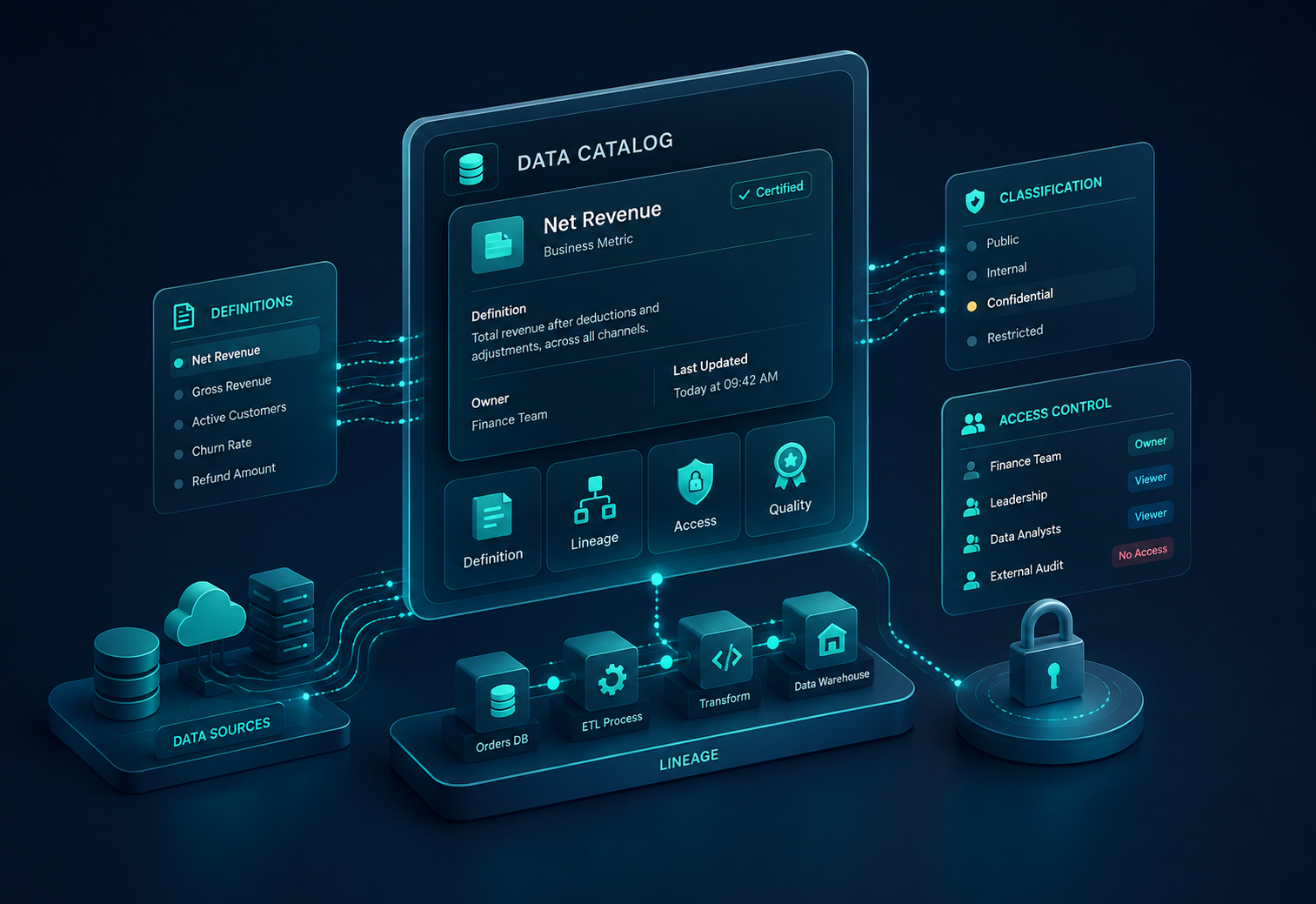
A Number You Can Trace Back to Its Source
Trust in data isn’t a feeling. It’s the ability to answer, in seconds, where a number came from, who owns it, and whether it’s current.
What Changes When Governance Is Deliberate, Not Assumed
Without Defined Governance
- Conflicting numbers because three teams define the same metric differently
- Access granted once and never reviewed again
- Nobody able to say where a report’s figures actually came from
- Sensitive data handled the same way as public data, or vice versa
- Duplicated datasets built because nobody knew one already existed
With 3Shadz Data Governance
- One agreed definition per metric, documented and owned
- Access reviewed against classification and role, not habit
- Lineage that shows a figure’s path from source to report
- Controls sized to sensitivity, not applied uniformly everywhere
- A catalogue that shows what already exists before something new is built
Practical Control, Not Paperwork
Governance programmes stall when they become a compliance exercise nobody outside the team reads. Here’s what keeps ours working.
Ownership That Sticks, Not Just Assigned on Paper
Owners and stewards are named, briefed, and supported, so accountability survives past the workshop that created it.
Governance Built Into the Platform, Not Bolted On
Metadata, classification, and access design happen alongside engineering and warehousing work, not after it ships.
Frameworks Sized to the Organisation
A five-person analytics team and a regulated enterprise need different amounts of process. We scope accordingly.
Lineage & Metadata That Get Maintained
Documentation is built into how pipelines and models are delivered, so it doesn’t go stale the week after go-live.
Controls Matched to Risk
Classification drives access and handling rules, so protection is proportionate rather than uniform friction.
One Team Across the Whole Data Practice
The same team that governs your data also builds the pipelines, warehouse, and dashboards it feeds.
Chosen to Fit Your Platform, Not Replace It
We work with the cataloguing, quality, and access tools you already run, or help select ones sized to your data estate, not a single vendor we default to.
Cataloguing & Metadata
- Microsoft Purview
- Collibra
- Alation
- Open-source catalogues (DataHub, Amundsen)
- Custom glossary tooling
Data Quality
- Great Expectations
- dbt tests
- Native warehouse quality checks
- Anomaly & freshness monitoring
- Rule-based validation frameworks
Access & Identity
- Role-based access control (RBAC)
- Attribute-based access control (ABAC)
- Cloud IAM (AWS, Azure, GCP)
- Warehouse-native row & column security
- Access review workflows
Privacy & Compliance
- GDPR-aligned classification
- HIPAA-aligned controls
- SOC 2 alignment
- Data retention & deletion tooling
- Consent & sensitive-data tagging
Data Governance: Frequently Asked Questions
Data & Analytics, under Services, is the umbrella practice covering engineering, warehousing, scale, insight, and governance. Data Governance is the specific discipline underneath it: the ownership, standards, metadata, lineage, classification, and access controls that keep everything else in that practice accurate and accountable.
Data Security & Compliance, under Company, describes how 3Shadz protects its own engagements and client data internally. Data Governance, under Services, is what we design and build for you: the ownership model, standards, metadata, lineage, classification, and access policies that govern your organisation’s data.
No. Most engagements start with an assessment of how data is actually owned and used today, then define an operating model and standards before recommending any tooling. A platform is introduced only where it provides practical value for your scale.
Not if it’s scoped correctly. We size controls to the sensitivity of the data and the maturity of the organisation, so low-risk data stays easy to reach while sensitive data gets appropriate ownership, classification, and access rules.
A maturity assessment typically takes two to four weeks. Defining an operating model, ownership structure, and initial standards usually runs four to eight weeks, with metadata, lineage, and access implementation phased in afterward depending on the number of domains and platforms involved.
Governance is designed alongside these capabilities rather than added afterward. Ownership, classification, and lineage are built into pipelines as they are engineered, into how warehouses and lakehouses are modelled, and into how dashboards and metrics are defined, so trust is part of the platform from the start.
Let’s Give Your Data an Owner, a History, and a Rule.
Whether you need a governance maturity assessment, a practical operating model, or full metadata, lineage, and access controls, our Data Governance team can help you get there.