











Every Technology Decision Touches Another. Most Get Made As If It Doesn’t.
3Shadz IT Strategy Consulting brings business priorities, current technology reality, constraints and investment options into one coherent direction, so applications, data, AI, cloud, integration and security decisions reinforce each other instead of quietly competing for the same budget.
The Discipline of Deciding What Happens First, and Why
IT Strategy Consulting is the 3Shadz practice that determines where technology investment should go, what should be modernized, what should be left alone for now, and in what order, based on what the business is actually trying to accomplish.
It starts from business direction, not from a preferred platform. The same objective can imply different decisions across applications, data, AI, cloud, integration, security, architecture and the operating model, and strategy exists to make those decisions coherent rather than independent.
It is narrower than Technology Consulting as a whole, and distinct from Enterprise Architecture Consulting: this practice sets direction and priority; enterprise architecture goes deeper into the structures that direction depends on.
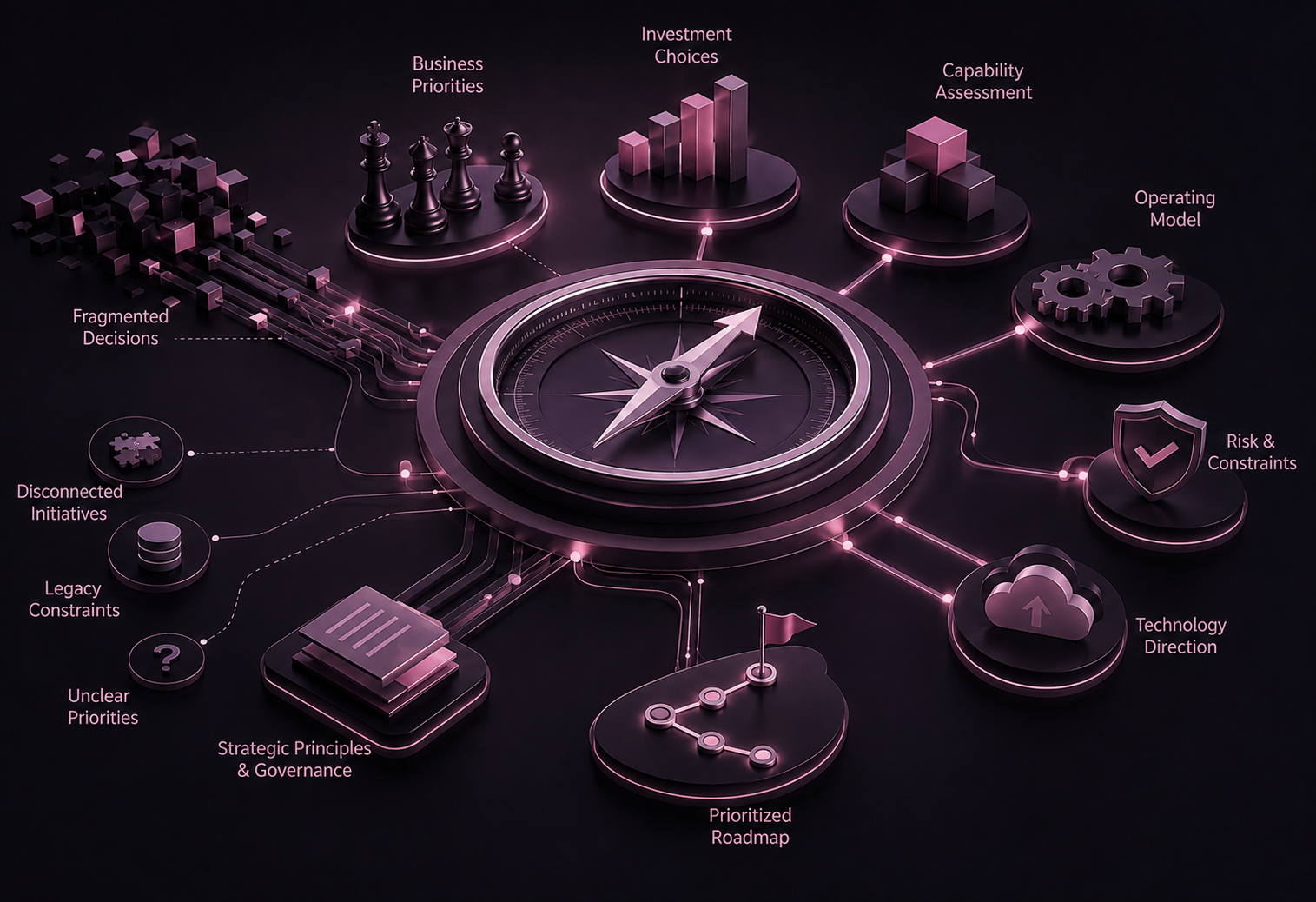
A strategy earns its name when it says what happens first, and what waits.
What This Practice Deliberately Avoids
- A slide deck nobody references again
- A generic three-year roadmap applied regardless of context
- More technology, because more feels safer
- Replacing systems simply because they are old
- Moving everything to the cloud by default
- AI added to every process it can technically touch
- A target architecture with no realistic way to get there
- Every initiative treated as equally urgent
- A set of decisions checked against your architecture, teams and budget
- A roadmap sequenced around real dependencies and constraints
- Investment tied to a specific business capability, risk or requirement
- Modernization prioritized by value, risk and dependency
- Cloud decisions made domain by domain, on their own merits
- AI adoption sequenced behind the data foundations it depends on
- A target architecture paired with realistic transition states
- Explicit priority, so teams know what can wait
Signals That Priorities and Platforms Have Drifted Apart
Few organizations start with a blank page. Most start with a specific frustration, and the strategy work grows outward from there.
Competing Priorities, No Shared Criteria
Every initiative looks important in isolation. Without shared decision criteria, the loudest proposal wins instead of the most valuable one.
Rising Spend, Unclear Case
Technology spend keeps growing, but it’s difficult to trace back to a specific business outcome.
Modernization Keeps Restarting
Initiatives launch with energy, stall against an unaddressed dependency, and quietly restart under a new name.
Cloud, Data and AI Moving Independently
Each team is making reasonable decisions on its own, and the platform is becoming harder to reason about as a whole.
Architecture Without Direction
The architecture reflects years of individually sound decisions that no longer add up to a coherent structure.
Leadership Needs a Defensible Investment Story
A board, investor, or executive team wants to understand where technology money is going and why, in terms that connect back to the business, not just a list of projects.
One Business Objective, Several Coordinated Decisions
IT strategy does not start with a preferred technology. It starts with what the organization is trying to accomplish, then works out which technology domains that objective actually touches, and how those decisions need to move together.
| Technology Domain | Enter a New Market | Reduce Operating Cost | Strengthen Regulatory Readiness |
|---|---|---|---|
| Applications | |||
| Data & AI | |||
| Cloud & Infrastructure | |||
| Integration | |||
| Security & Compliance | |||
| Architecture | |||
| Operating Model & Skills | |||
| Governance |
Illustrative, not exhaustive: the point is that the same objective rarely maps to a single domain, and rarely maps to the same domains twice. Strategy is what keeps these decisions moving in the same direction instead of being made in isolation by whichever team owns that domain.
A Landscape Worth Trusting, Before Any Target State
IT strategy does not begin with a future-state diagram. It begins with making the current technology landscape legible, what exists, what it supports, what constrains change, and where risk and cost sit disproportionately. This is not a maturity score. It is a working understanding of what the organization actually has to work with.
Business Capabilities
What the organization needs to be able to do, independent of any specific system.
Application Portfolio
What each system does, who depends on it, and how difficult it is to change.
Platforms & Architecture
How systems connect, where structure has drifted, and where overlap has quietly accumulated.
Data, Cloud & Infrastructure
Where data actually lives, how workloads are hosted, and what that implies for future options.
Technical Debt & Risk
Where deferred decisions are now shaping what the business can and can’t do.
Cost & Vendor Dependencies
Where spend is concentrated, and where a single vendor or contract creates outsized exposure.
Skills & Operating Model
Whether the organization is structured and staffed to execute the direction it sets.
Governance & Existing Initiatives
How decisions currently get made, and which transformation work already underway still earns its place.
The Portfolio Is a Connected System, Not a List
Treating every application as an individual decision misses how they depend on each other. Reading the portfolio as a whole surfaces duplication, concentrated risk, and systems whose importance and condition have quietly diverged.
Placing a system on this map is not a verdict. It is a starting point for a conversation about value, risk, cost and what depends on it, and modernization does not always mean replacement.
Modernize
Important to the business, increasingly constraining change
Invest & Extend
Important and healthy: worth building on further
Retire or Contain
Limited value, disproportionate ongoing risk or cost
Maintain As-Is
Stable and doing its job: no urgent case for change
More Opportunities Than Any Organization Can Fund at Once
Prioritization is structured decision-making, not an arbitrary ranking. Each initiative is weighed across complementary dimensions, not scored against a single number that hides the trade-offs underneath it.
Business Value
What measurable business capability or outcome does this initiative actually support?
Strategic Importance
How strongly does it connect to the priorities the organization has already committed to?
Risk
What happens if the organization acts, and what happens if it doesn’t?
Dependency
Which other initiatives, platforms or capabilities depend on this decision being made?
Feasibility
Does the organization have the architecture, skills, data and capacity this actually requires?
Time Sensitivity
Is there a regulatory, vendor, market or operational reason this has to happen by a certain point?
Technology Consequence
Does this initiative simplify the landscape, or does it create another platform, exception, and long-term obligation the organization will have to carry?
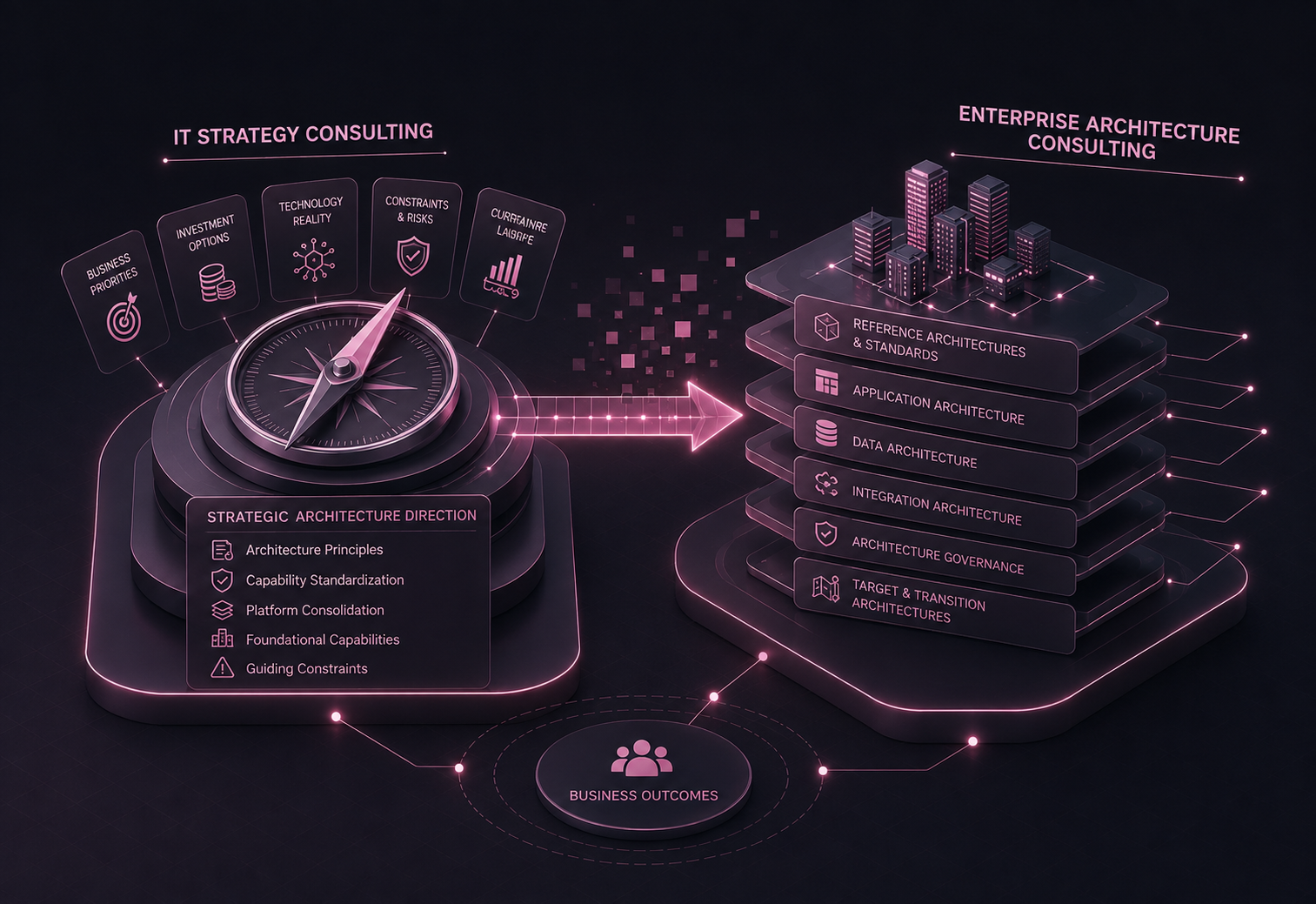
Architecture Principles Set Here. Architecture Detail Set Elsewhere.
IT Strategy Consulting establishes the architecture direction a strategy depends on: which capabilities should be standardized, where platforms should consolidate, which constraints limit what’s realistic, and what principles should guide decisions the strategy itself can’t anticipate.
It deliberately stops short of the deeper architecture work: reference architectures, architecture governance, domain-level application, data and integration architecture, and detailed transition-state design. That work continues through Enterprise Architecture Consulting, using the direction this practice sets as its starting point.
- What architecture direction supports the strategy?
- Which capabilities should be standardized?
- Where should platforms consolidate?
- Which foundational capabilities need to exist first?
- Reference architectures and standards
- Application, data and integration architecture
- Architecture governance
- Target-state and transition architectures
A Roadmap Is a Coordination Mechanism, Not a Calendar
A timeline of projects rarely survives a changed budget or a new priority. A useful roadmap shows what depends on what, so foundational work gets funded before the initiatives that quietly rely on it.
Sequencing also means accepting that a target architecture is rarely reached in a single move. A useful roadmap defines the realistic transition states in between, not just the starting point and the destination.
Strategy Fails Quietly When Nobody Owns the Decisions
A strategy document changes nothing on its own. It survives contact with reality when ownership, decision rights, and review points are clear enough that priorities stay priorities after the workshop ends.
The goal is governance sized to the organization: clearer decisions and more consistent execution, not additional process for its own sake.
Technology Decisions That Reinforce Each Other, Not Compete
A useful IT strategy makes important technology decisions easier to understand, prioritize and coordinate. It does not pretend that conditions will hold still for several years.
Investment Has a Reason
Each initiative connects to a defined business capability, strategic priority, risk, or operational requirement.
Priorities Are Explicit
Teams understand what matters now, what can wait, and why, instead of guessing from whoever asked most recently.
Dependencies Are Visible
Foundational work is identified and funded before the initiatives that quietly depend on it get committed.
Architecture Has Direction
New decisions follow shared principles, rather than creating another isolated platform or one-off exception.
Modernization Is Sequenced
Legacy constraints are addressed by consequence and dependency, not simply by age.
The Roadmap Can Change
Direction is provided without pretending that technology, regulation and business priorities will stay fixed for years.
One of Six Connected Technology Consulting Capabilities
IT Strategy Consulting typically sets the direction that the rest of the Technology Consulting practice helps execute, from transformation and architecture through to modernization and ongoing technology leadership.
IT Strategy Consulting: Frequently Asked Questions
The output is a set of prioritized decisions, an architecture direction, and a sequenced roadmap, checked against your budget, teams, and existing commitments. A presentation can summarize that work, but it isn’t the deliverable itself.
No. Many engagements begin with a general sense that investment, modernization, or governance isn’t working the way it should, without yet knowing what to change first. Assessing the current landscape is the starting point, not a prerequisite.
IT Strategy Consulting sets the direction, which capabilities matter, what gets funded first, and what architectural principles should guide decisions. Enterprise Architecture Consulting goes deeper into the reference architectures, standards, and transition-state designs that direction depends on. Most engagements draw on both.
No. A meaningful part of the work is identifying what can reasonably be left alone for now, because the cost of changing it exceeds the benefit at this point. Recommendations follow the assessment of value, risk, and dependency, not a default toward change.
Whenever the assumptions behind it change materially: a shift in business priorities, a new regulatory requirement, a platform reaching end-of-support, or a transformation initiative that isn’t delivering what it promised. Treating strategy as a fixed multi-year document tends to produce a roadmap nobody trusts by year two.
It is one of six connected capabilities inside Technology Consulting, alongside Digital Transformation Consulting, AI Strategy Consulting, Enterprise Architecture Consulting, Technology Modernization Consulting, and CTO as a Service. IT Strategy typically sets the direction that the others help execute.
Before the Next Platform Or Vendor Decision Gets Made, Let’s Confirm It Still Fits the Strategy.
Whether priorities need re-sequencing, investment needs a clearer case, or nobody can quite say what should happen first, the opening conversation is about clarifying that decision, not committing to a large engagement.