







Browse our current openings and find a role that matches your skills and ambition.
Know more ▸
Get a feel for our culture, our people and the way we work together every day.
Know more ▸
Health, flexibility and growth benefits designed to support you and your family.
Know more ▸

Kickstart your career with hands-on internship opportunities and mentorship.
Know more ▸

Written by 3Shadz Editorial Team
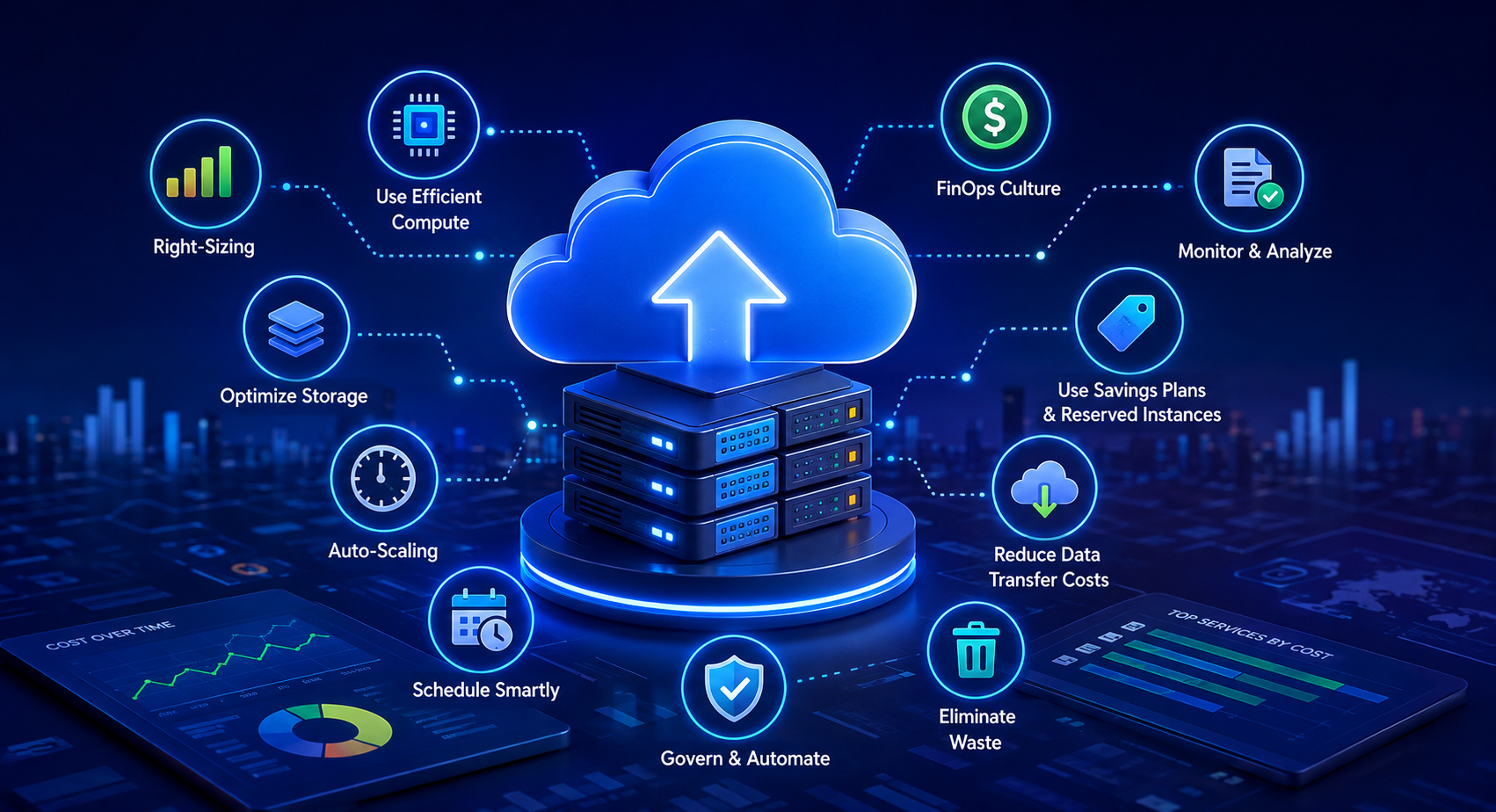
A cloud bill has a way of growing quietly. A few extra instances here, an oversized database there, a test environment nobody switched off over the weekend: each item is trivial on its own, yet together they push spending well past what the workload actually needs. Cloud cost optimization is the discipline of reversing that drift: cutting the money that buys nothing while protecting the capacity that keeps applications fast and reliable. Done well, it is not a one-time cleanup but a standing practice that ties every dollar of cloud spend back to a team, a product, and a decision.
Written for engineering and finance leaders who share a cloud bill, this guide breaks down where cloud money leaks and how to plug it. You’ll learn:
On-premises hardware imposed a natural brake on spending: buying a server took budget approval, procurement, and weeks of lead time. The cloud removed that friction on purpose. Any engineer can now provision a database or a fleet of servers in seconds, and that same ease is why costs escape. Capacity gets sized for an imagined peak and never revisited. Environments spun up for a demo keep running. Discounts go unclaimed because no one owns the bill.
That leaves a structural gap between what is provisioned and what is actually used. Study after study of cloud spending reaches the same conclusion: a significant portion of it is wasted on resources that sit idle or run far larger than the workload requires. The encouraging part is that this waste is highly addressable, because it stems from a handful of recurring patterns rather than one intractable problem.

No single setting cuts a cloud bill. Meaningful savings come from pulling several levers together, in rough order of effort against payoff.
You cannot optimize what you cannot attribute. The first move is a tagging policy that labels every resource by team, product, and environment, so the monthly invoice can be broken down instead of landing as one opaque number. With that in place, cost dashboards and automated anomaly alerts turn a billing surprise into an early warning, and showback or chargeback makes each team accountable for the spend it creates.
Most resources are provisioned by guesswork and never revisited, leaving virtual machines, databases, and containers running at a fraction of the capacity they were given. Rightsizing compares actual CPU, memory, and throughput against what was allocated, then steps instances down to a size that fits real demand. It is often the fastest source of savings because it changes nothing about the architecture, only the price tag.
Elasticity is the cloud’s core advantage, yet many workloads still run at full size around the clock. Autoscaling adds and removes capacity as traffic rises and falls, so you pay for the peak only during the peak. Just as valuable, non-production environments (development, testing, staging) can be scheduled to shut down on nights and weekends, cutting their cost by more than half with no impact on users.
Cloud providers charge the most for on-demand capacity because it commits you to nothing. For the steady baseline a business runs every day, commitment discounts (reserved instances, savings plans, or committed-use contracts) trade a one- or three-year pledge for substantially lower rates. Fault-tolerant, interruptible jobs such as batch processing or CI pipelines can run on spot capacity at a deep discount. The pattern is to cover the predictable base with commitments, absorb spikes on demand, and push interruptible work onto spot.
Storage costs accumulate silently. Data that is rarely read can move to cheaper archival tiers through automated lifecycle rules, while orphaned disk volumes, forgotten snapshots, and stale backups can be deleted outright. Data transfer deserves the same scrutiny: moving large volumes between regions or out to the public internet carries egress fees that a little architectural care can avoid.
Between the resources you use and the ones you pay for sits a layer of pure waste: unattached storage, idle load balancers, duplicate environments, and instances that were spun up once and never turned off. A regular sweep, ideally automated, that flags and removes these zombies keeps the bill honest and stops the same clutter from creeping back month after month.
Architecture delivers the deepest savings, because they are designed in rather than tuned after the fact. Serverless functions and managed services bill per request or per second, so an idle workload costs close to nothing. Caching cuts repeated compute and database calls. Picking the right service for the job, instead of running everything on general-purpose servers, frequently lowers both the cost and the operational load at once.
The levers above deliver a one-time drop, but a cloud bill left alone starts drifting again within months. FinOps, shorthand for cloud financial operations, is the practice that keeps it from doing so. It brings engineering, finance, and product into a shared conversation about cost, so the people who provision resources can see the price of their choices and the people who hold the budget understand what drives it.
In practice, FinOps runs as a continuous loop rather than a project. Teams first inform themselves with accurate, allocated cost data; then they optimize by applying the levers where they pay off; then they operate, setting budgets, alerts, and policies that catch drift early. Crucially, it reframes cost as an engineering metric that sits alongside performance and reliability, something a team designs for, not a bill that arrives after the fact. The goal is not the cheapest possible cloud but the most efficient one: the best performance and reliability for each dollar spent.
It is the ongoing practice of reducing what you spend on cloud services without sacrificing the performance, reliability, or capacity your applications need. It pairs technical levers (rightsizing, autoscaling, commitment discounts, storage tiering) with the financial accountability of a FinOps discipline that keeps costs from drifting back up.
It depends on how much waste has built up, but organizations that have never optimized usually find double-digit percentage reductions available quickly, mostly from rightsizing, switching off idle resources, and buying commitment discounts for steady workloads. The larger, more durable gains come from sustaining the practice rather than running a single cleanup.
Not if it is done deliberately. Most optimization removes waste (idle resources, oversized instances, redundant data) that contributes nothing to performance. The levers that touch live capacity, such as rightsizing and autoscaling, are guided by real utilization data and headroom targets, so the aim is to remove slack, not the buffer that keeps applications responsive.
FinOps is the cross-functional discipline of managing cloud cost as a shared responsibility across engineering, finance, and product. Any organization whose cloud bill is large enough to matter benefits from it, because it turns cost optimization from an occasional fire drill into a routine part of how teams build and operate.
Modernize Your Cloud & Data
3Shadz helps businesses modernize cloud infrastructure and build secure, scalable data platforms that turn raw information into real-time insight and competitive advantage.