




Browse our current openings and find a role that matches your skills and ambition.
Know more ▸
Get a feel for our culture, our people and the way we work together every day.
Know more ▸
Health, flexibility and growth benefits designed to support you and your family.
Know more ▸

Kickstart your career with hands-on internship opportunities and mentorship.
Know more ▸

Written by 3Shadz Editorial Team
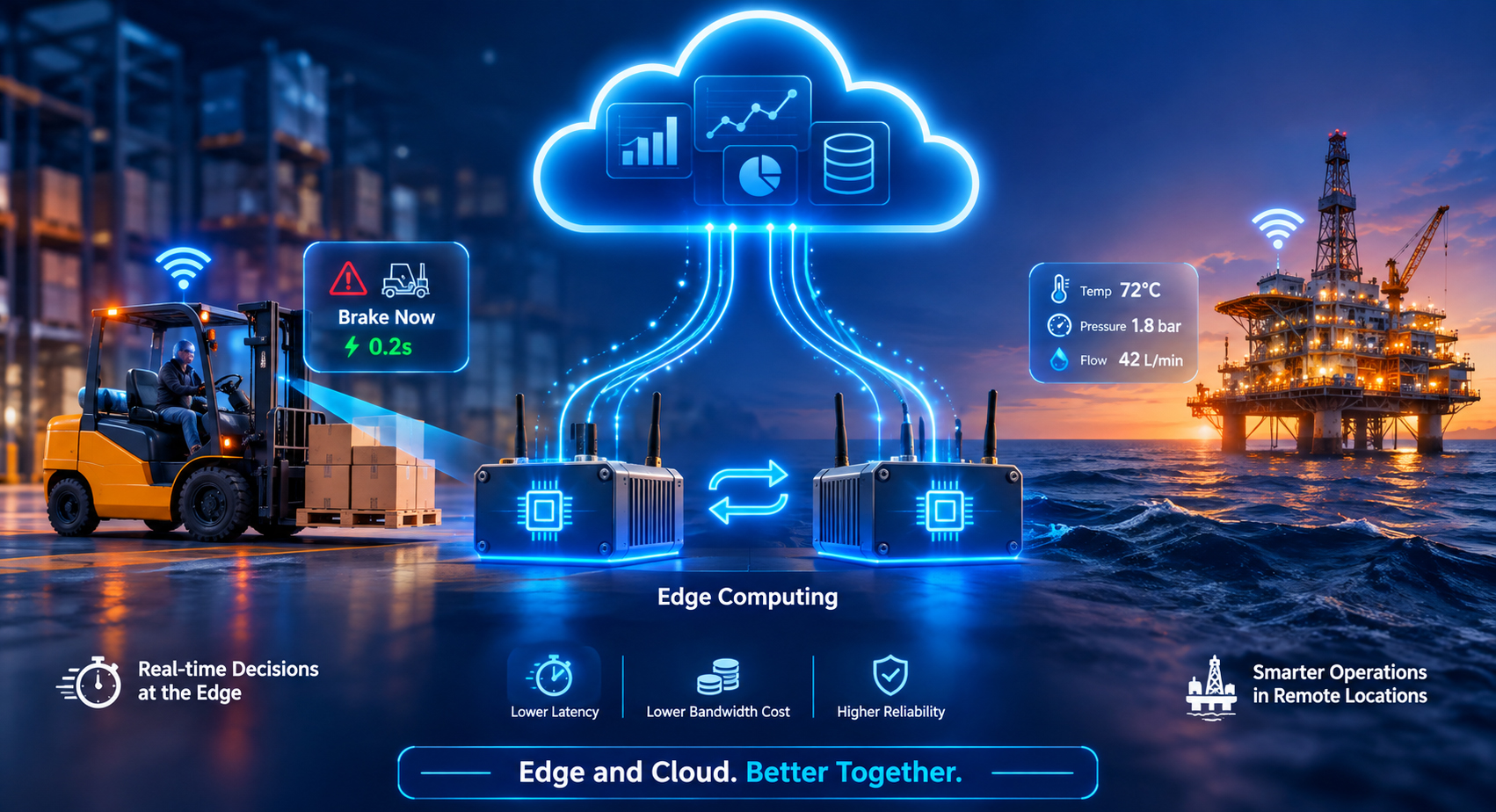
A self-driving forklift cannot wait a fifth of a second for a data center on another continent to decide whether it should brake. A remote oil platform cannot stream every sensor reading over a satellite link that charges by the megabyte. As machines, cameras, and sensors generate more data than ever, sending all of it to a distant cloud is often too slow, too expensive, or simply impossible. Edge computing answers that by doing part of the work close to where the data is born, and it works best not as a replacement for the cloud but as its partner.
This article is written for technology leaders weighing where their computing should actually run. You’ll come away understanding:
The cloud model, concentrate compute in a handful of enormous data centers and send data to it, has been one of the most successful ideas in modern technology. It assumes, though, that moving data to the compute is cheap and fast. For a growing class of workloads that assumption quietly breaks. Physics sets a floor: a round trip to a distant region takes tens of milliseconds even at the speed of light through fiber, before any real work begins. And bandwidth is neither free nor infinite: a single site full of high-resolution cameras or industrial sensors can produce terabytes a day, most of it unremarkable.
Three further forces pull work outward. Connectivity is never guaranteed: ships, mines, vehicles, and rural sites lose their links, and a system that stops functioning the moment the network drops is unacceptable for a production line or a payment terminal. Data gravity and regulation mean some information is easier, cheaper, or safer to process where it already sits than to haul across regions or borders. And the sheer volume of machine-generated data makes filtering and summarizing at the source far cheaper than shipping raw feeds to a central store. Edge computing is the structural response to all four pressures at once.
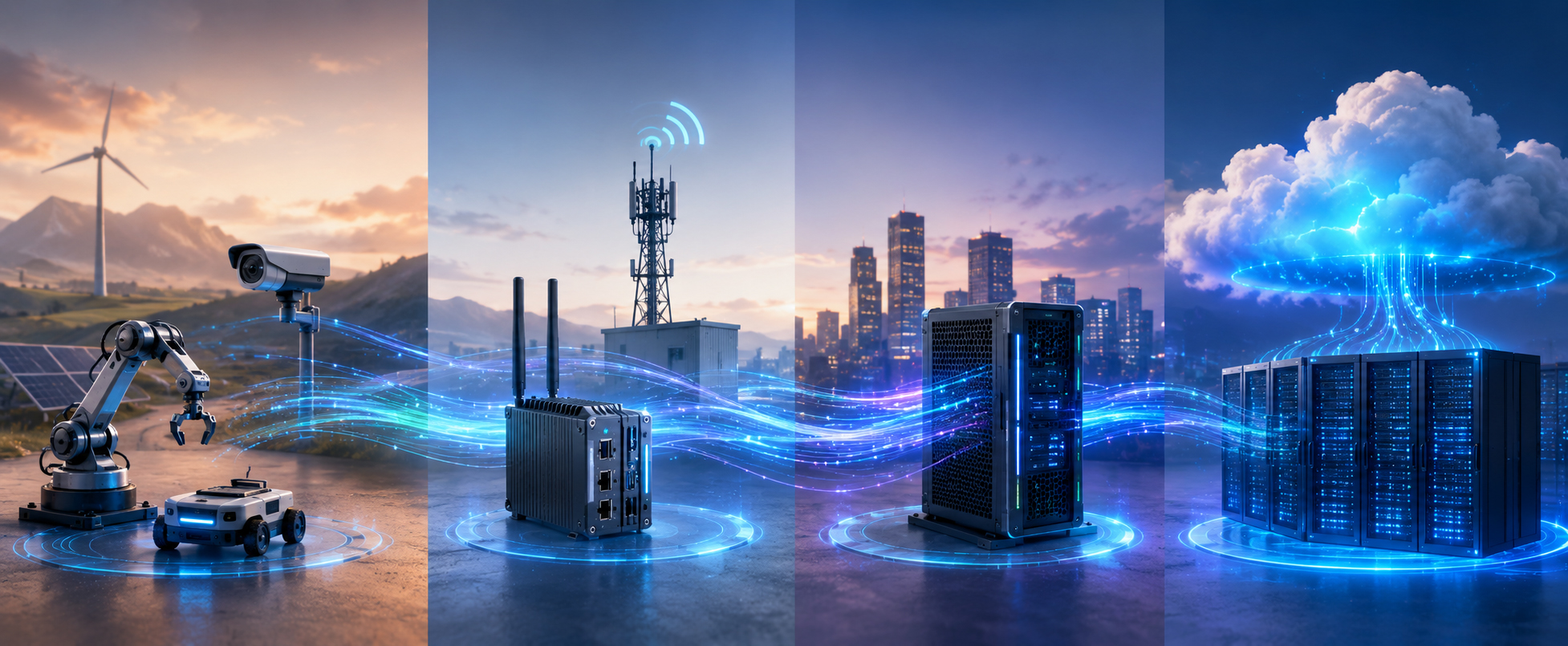
Edge and cloud are not rival camps; they are points on a spectrum. Work can be placed anywhere along a continuum that runs from the device generating data, through local infrastructure, to the central cloud, and most real systems span several tiers at once. Seeing the tiers separately is what makes the trade-offs concrete.
At the far end sit sensors, cameras, controllers, phones, and machines. Compute and power here are tightly constrained, so the processing is simple: filtering noise, checking a reading against a threshold, or closing a fast control loop. Latency is effectively zero because the decision never leaves the device. This tier is about reacting instantly and discarding what nobody upstream needs to see.
A step inward are gateways, servers in a store or factory, micro data centers, and the points of presence that carriers and content networks run near users. This tier aggregates many devices, runs heavier logic than a sensor can, caches frequently used data, and buffers events when the uplink is down. It gives a site local resilience and single-digit-millisecond response while forwarding only summaries and exceptions to the cloud.
At the center is the cloud: elastic compute and storage in a few large regions. It gathers data from every site, trains models across the whole fleet, runs analysis that needs the complete picture, holds the long-term record, and coordinates the tiers beneath it. Latency is higher, but scale is effectively unlimited: this is where breadth of data and heavy computation belong.
The real design question is never edge or cloud but which tier each task belongs to. Time-critical decisions and data reduction happen at or near the source; aggregation, training, and cross-site analysis happen in the cloud; results and updated logic flow back down. A good architecture makes that split explicit and can shift work between tiers as costs, data volumes, and requirements change.
| Dimension | Edge | Cloud |
|---|---|---|
| Location | At or near where data is generated | Centralized regional data centers |
| Latency | Sub-millisecond to a few milliseconds | Tens to hundreds of milliseconds |
| Compute scale | Limited by local hardware | Elastic, effectively unlimited |
| Data handling | Filters and processes locally | Ingests and stores what is sent |
| If the link drops | Keeps operating | Unreachable |
| Best for | Real-time control, filtering, resilience | Aggregation, training, long-term storage |
The edge justifies its extra complexity wherever distance, bandwidth, or a dropped connection would otherwise break the workload. Four patterns recur across industries.
A production line needs control decisions in milliseconds and cannot pause because the internet did. Edge nodes run the control and safety logic on-site, sending the cloud only summaries, alerts, and the trends worth keeping.
Checkout, pricing, and inventory have to keep working through an outage. Local edge servers keep each store or branch running independently and reconcile with the cloud once the connection returns.
Vehicles, trains, and fleets move through patchy coverage and cannot stake a safety-relevant choice on a round trip to a distant server. They compute locally and sync opportunistically when a good link is available.
Streaming, gaming, and live experiences cache and serve content from edge locations close to users, shortening the distance every packet travels so that playback and interaction feel immediate.
Distributing computation is not free. Every edge site is hardware that must be secured, patched, monitored, and physically maintained, frequently with no technical staff on the premises. Rolling software out to hundreds or thousands of locations is a harder problem than updating one cloud service. The sensible default is to keep work centralized and push it outward only when a specific pressure clearly justifies the effort.
Edge computing runs data processing at or near the place where data is generated (on a device, a local gateway, or a nearby micro data center), instead of sending everything to a central cloud. It cuts latency, reduces the data that has to travel, and lets systems keep working when connectivity drops.
No: the two are complementary. The edge handles time-critical work and local resilience, while the cloud provides elastic scale for aggregation, training, and long-term storage. Most systems span a continuum from device to cloud rather than choosing one over the other.
It is the idea that computing sits on a spectrum (from the device generating data, through local edge nodes, to the central cloud) with each task assigned to the tier that best fits its latency, bandwidth, and scale needs, rather than forcing everything into one place.
It is a trade-off. Keeping sensitive data local can reduce exposure and help satisfy data-residency rules, but many small, physically accessible sites are harder to patch and protect than a few hardened data centers. Security depends on how the whole system is designed and operated, not on the edge alone.
Modernize Your Cloud & Data
3Shadz helps businesses modernize cloud infrastructure and build secure, scalable data platforms that turn raw information into real-time insight and competitive advantage.