






Browse our current openings and find a role that matches your skills and ambition.
Know more ▸
Get a feel for our culture, our people and the way we work together every day.
Know more ▸
Health, flexibility and growth benefits designed to support you and your family.
Know more ▸

Kickstart your career with hands-on internship opportunities and mentorship.
Know more ▸

Written by 3Shadz Editorial Team

The conversation about cloud has quietly changed. A decade ago the question was whether to move to the cloud at all; today it is how to run it well, without runaway bills, without lock-in, and with data trustworthy enough to feed the AI systems now riding on top of it. Cloud and data have stopped being separate agendas and merged into one. The trends below are the forces reshaping that combined landscape in 2026, and what each one asks of the teams building on it.
Written for technology and business leaders setting cloud and data strategy, this overview maps the shifts that matter most in 2026. You’ll come away understanding:
For years, cloud strategy and data strategy were owned by different teams chasing different goals. That separation no longer holds. The applications that matter most now depend on data that lives across several clouds, moves in real time, and must satisfy regulators, and the AI features everyone wants are only as good as the pipeline feeding them. Deciding where to run a workload has become inseparable from deciding where its data lives and who is allowed to touch it.
Two forces sit underneath almost every trend that follows. The first is cost discipline: after a decade of near-unlimited elasticity, organizations are becoming deliberate about what they spend and why. The second is trust: as data drives automated decisions and generative models, being able to prove where it came from and who can see it has become a prerequisite rather than a nicety.

No organization will chase all of these at once, and none of them stands alone. Read them as a map: each points toward a deeper subject we treat in its own right, so you can follow the ones that match the pressure you are actually under.
The era of treating the monthly cloud bill as an unavoidable surprise is ending. As elastic infrastructure scaled, and as GPU-hungry AI workloads added an expensive new line item, finance and engineering began sharing accountability for spend. FinOps is the name for that discipline: cost tracked and optimized as a first-class signal alongside latency and uptime, with resources tagged to owners and architecture choices weighed by their cost curve. Budgets increasingly shape design rather than merely review it. The specific levers (rightsizing, commitment discounts, storage tiering) are a subject in their own right, which we take up in our guide to cloud cost optimization.
Very few large organizations run on a single provider or entirely in the public cloud. Acquisitions, data-residency rules, resilience requirements, and a healthy fear of lock-in have spread workloads across multiple clouds and back into private data centers. What has changed is intent: the messy estates that grew by accident are giving way to deliberate designs with unified identity, consistent networking, and portability planned up front. The distinction between a multi-cloud strategy and a hybrid one matters more than the labels suggest: we compare the two directly in our multi-cloud versus hybrid cloud guide.
Not all data can make the round trip to a distant cloud region and back. Factory floors, vehicles, retail locations, and connected devices generate more information than is practical to ship, and many of them need answers in milliseconds or while offline. The response is a shift of processing toward where data is created, with cloud and edge operating as one continuum rather than as opposites: the cloud for scale and coordination, the edge for immediacy. Knowing when the added complexity is worth it is the harder question, which we explore in our article on edge computing and the cloud.
Overnight batch jobs no longer meet the bar for fraud detection, personalization, dynamic pricing, or logistics tracking. The expectation is shifting toward processing events continuously, the moment they occur. Streaming architectures that were once specialist infrastructure are becoming a default assumption for new systems, and business users increasingly expect dashboards and alerts to reflect what is happening now, not last night. The mechanics of stream processing are a deep topic covered in our piece on real-time data processing; here it is enough to note that ‘real-time’ has moved from differentiator to baseline.
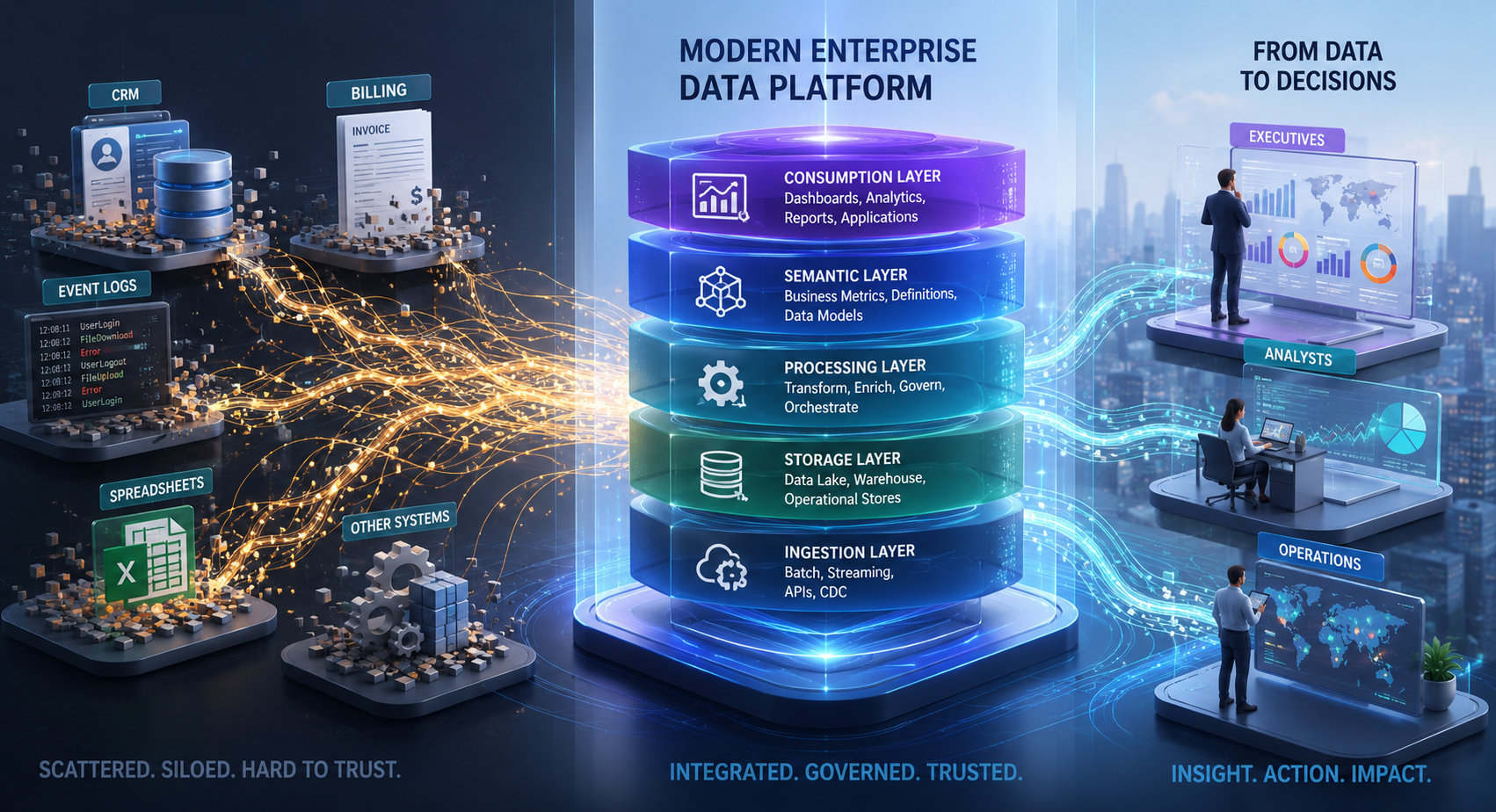
For much of the last decade, organizations ran two parallel worlds: a data lake for raw and machine-learning data, and a separate warehouse for business intelligence. Copies drifted, costs doubled, and governance fractured. The lakehouse pattern merges them: open table formats let a single governed store serve both SQL analytics and machine learning without duplicating data. Around it, the modern data platform is taking shape as a defined set of layers rather than a pile of point tools. What that end-to-end blueprint looks like is the subject of our guide to the modern enterprise data platform.
As data moves from back-office reporting to revenue-critical products and AI features, the pipelines that carry it are held to software-engineering standards. Version control, automated testing, monitoring, and explicit service levels on freshness and quality are replacing the fragile, hand-tended scripts of the past. ‘Data downtime’ is now treated much like application downtime, with observability to catch it early and clear ownership when it breaks. This maturing craft (how raw data becomes reliable, usable data) is what we examine in our look at modern data engineering.
Privacy regulation, emerging AI rules, and the plain risk of feeding bad data to a model have pushed governance from afterthought to prerequisite. Catalogs, lineage, classification, and access control are increasingly woven into the platform rather than bolted on afterward. This is also what ‘AI-ready data’ really means: not merely clean data, but data that is well-described, correctly permissioned, and traceable, so both people and models can use it with confidence. Self-serve analytics only works when it rests on that trusted foundation. We go deep on the controls in our article on data governance in the cloud.
The long-running direction of the cloud is to hide the machinery. Serverless functions, managed databases, and scale-to-zero services let teams consume infrastructure as a utility, paying for what they use rather than for idle capacity, and spending their attention on the product instead of the servers. In 2026 that abstraction is climbing higher up the stack, reaching data platforms and AI infrastructure. The trade-off is real (less control, potential lock-in, and cost models that reward careful design), but the direction is clear: more of the undifferentiated heavy lifting becomes someone else’s problem.
The defining themes are cost discipline through FinOps, deliberate multi-cloud and hybrid architectures, processing at the edge, real-time streaming as a default, the lakehouse consolidating data platforms, data engineering maturing into a reliability discipline, governance that yields AI-ready data, and the steady rise of serverless. Beneath them all sit two pressures: controlling spend and earning trust in data.
Because the workloads that matter now depend on both at once. Applications span several clouds, need data in real time, and must satisfy regulators, while the AI features driving investment are only as good as the data behind them. Deciding where to run something and where its data lives, and who may touch it, can no longer be separate decisions.
It describes data that models and retrieval systems can use with confidence: organized, high in quality, well-described with metadata, correctly permissioned, and traceable back to its source. Most AI initiatives stall not on the model but on data that is scattered, poorly labeled, or unsafe to expose, which is why governance and AI readiness go hand in hand.
Not by chasing every one at once. Make cost and governance visible first, since they underpin everything else, then prioritize the trends that map to real business pressure: latency, resilience, regulation, or an AI roadmap. Treat each as a capability to build deliberately rather than a product to buy, and read the deeper articles on the ones that matter most to you.
The trends above are not a shopping list. They are a set of pressures (cost, resilience, latency, real-time expectations, and trust), surfacing in different corners of the same converged cloud-and-data landscape. The organizations that navigate 2026 well will make spend and governance visible first, because almost every other decision depends on them, and then invest in the specific trends that fit their business rather than the ones generating the most noise.
Use this overview as a map. Where a trend touches something you are actually wrestling with (a runaway bill, a lock-in worry, a latency problem, a stalled AI project), follow it into the deeper article on that topic, where the trade-offs and the how-to live. The goal is not to adopt everything, but to know which forces are shaping your stack and to move on them on purpose.
Modernize Your Cloud & Data
3Shadz helps businesses modernize cloud infrastructure and build secure, scalable data platforms that turn raw information into real-time insight and competitive advantage.