






Browse our current openings and find a role that matches your skills and ambition.
Know more ▸
Get a feel for our culture, our people and the way we work together every day.
Know more ▸
Health, flexibility and growth benefits designed to support you and your family.
Know more ▸

Kickstart your career with hands-on internship opportunities and mentorship.
Know more ▸

Written by 3Shadz Editorial Team
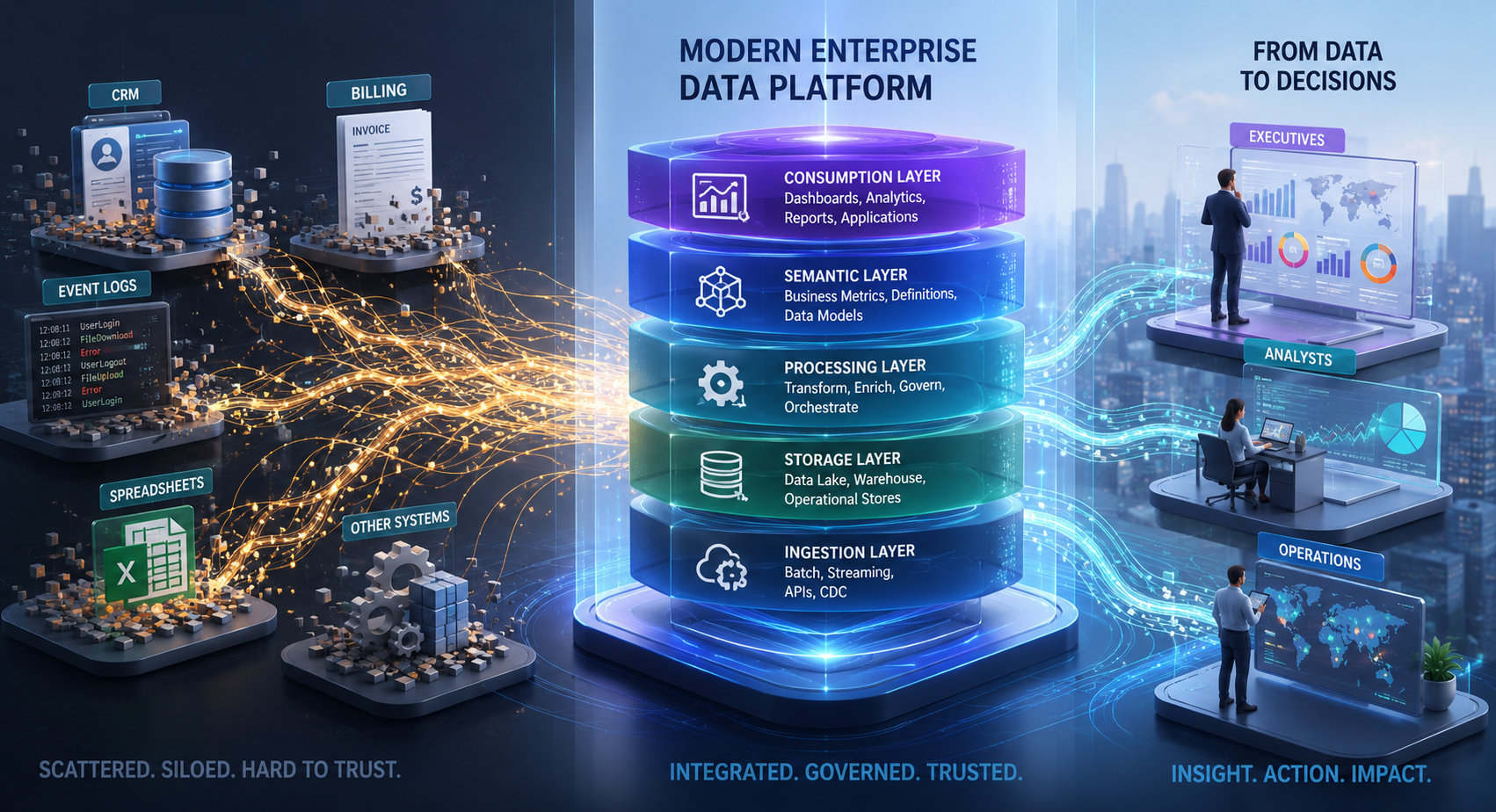
Most companies do not suffer from a shortage of data. They suffer from data scattered across a dozen systems that were never meant to talk to each other: a CRM in one place, billing in another, event logs, spreadsheets, and a warehouse only the finance team understands. A modern enterprise data platform is the architecture that ends that fragmentation: a stack of layers, each with a defined job, that together carry data from where it is created to where it drives a decision. Understanding that blueprint, not any single tool, is what separates a platform from a pile of databases.
This article is written for technology and data leaders designing or evaluating a data platform. You’ll come away understanding:
A data platform is not a single product you install. It is a layered system, and the layers matter more than the brand names inside them. Each layer solves one problem (getting data in, holding it, shaping it, governing it, serving it) and hands a clean result to the next. That separation is the whole point: when storage and compute are decoupled and each layer has a clear boundary, you can replace a tool in one layer without rewriting the rest.
Every layer exists to serve a single outcome. Raw, inconsistent data arrives from many sources at one end; trusted answers that people and applications can act on come out the other. Keeping that goal in view is what stops a platform from decaying into another silo: a faster, more expensive version of the mess it was meant to replace.
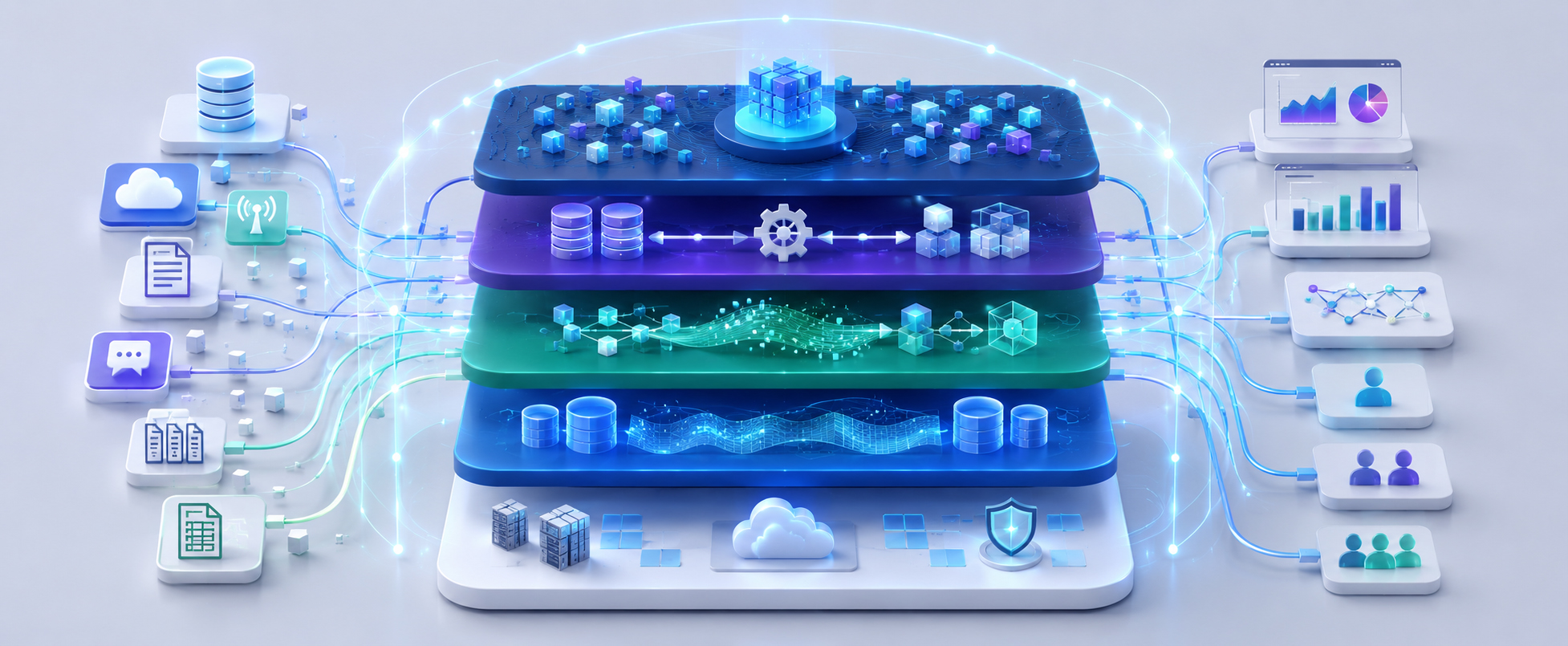
Read from the bottom up, a platform stacks five layers. The first three move data along a path; the fourth wraps around all of them; the fifth opens the result to the business.
Ingestion connects to source systems and brings their data onto the platform. It handles scheduled batch loads from databases and files, change data capture that streams row-level updates as they occur, and continuous event feeds from applications and devices. Its job is deliberately narrow: land data reliably and completely, with as little transformation as possible, so nothing is lost and the raw record is always available to reprocess later.
Once data lands, it has to live somewhere, and this is the layer the lakehouse changed most. A data warehouse stores clean, structured tables optimized for fast SQL; a data lake stores almost anything cheaply in open file formats but offers little built-in structure; a lakehouse combines them, adding warehouse-like reliability and performance directly on low-cost lake storage.
Whatever the engine, mature platforms organize storage into zones: a raw landing area that preserves data exactly as ingested, a refined zone where it is cleaned and conformed, and a curated zone of business-ready tables. That progression, often called a medallion layout, means every consumer draws from the right level of trust, and engineers can always trace a curated figure back to its raw source.
| Aspect | Data warehouse | Data lake | Lakehouse |
|---|---|---|---|
| Stores | Structured, modeled tables | Any format, raw and cheap | Both, on open formats |
| Best at | Fast SQL and BI | Scale and machine learning | One store for BI and ML |
| Watch out for | Cost and rigidity for raw data | Turning into an ungoverned swamp | Younger, needs engineering discipline |
In this layer, raw facts become information the business recognizes. Data is cleaned, deduplicated, joined across sources, and modeled into consistent entities: a single definition of a customer, an order, or revenue that everyone shares. Modern platforms favor an ELT approach: load raw data into storage first, then transform it in place using the platform’s own compute, which keeps the original intact and lets transformations be rerun and versioned like code.
Governance is not a stage data passes through; it is a layer that wraps every other one. A data catalog provides a searchable inventory of what exists and what it means; lineage records where each dataset came from and how it was transformed; access controls decide who can see what; classification flags sensitive fields; and quality rules watch for drift and breakage. Strip this layer away and even a technically excellent platform slides into a swamp no one trusts, which is why it belongs in the architecture from day one, not bolted on after launch.
At the top, the serving layer exposes curated data to the people and systems that consume it. For analysts and executives that means BI dashboards, self-service SQL, and a semantic layer that maps physical tables to business terms so reports agree with one another. For engineers and data scientists it means APIs and feature access that feed machine learning models and applications. Serving both audiences, human decisions and machine consumption, from the same governed foundation is what a modern platform is ultimately for.
What makes this a platform rather than a stack of disconnected tools is the connective tissue between the layers. Metadata and governance thread through all of them, so a sensitivity label set at ingestion still applies at serving. Decoupled storage and compute let each layer scale on its own, so a spike in analytics queries does not disturb ingestion. And the medallion progression gives every dataset a known level of trust as it moves upward. Clean interfaces between the layers are what let a platform grow for years without a rebuild.
It is a layered architecture that brings an organization’s data together and turns it into trusted, usable information. Ingestion, storage, processing, governance, and serving each handle one job and connect through clean interfaces, so the platform can evolve without being rebuilt.
A warehouse is one component, typically the structured storage and query engine. A platform is the whole architecture around it, including ingestion, a data lake or lakehouse, transformation, governance, and serving for both analytics and machine learning.
If your data is mostly structured and your needs are reporting and BI, a warehouse may be sufficient. A lakehouse earns its place when you also handle semi-structured or streaming data and want one store that serves both analytics and machine learning without copying data between systems.
Start with a real business question and the data it needs, not with a full-stack purchase. Stand up a thin slice through every layer (ingest one important source, land and model it, govern it, and serve one dashboard), then widen out from that working foundation.
Modernize Your Cloud & Data
3Shadz helps businesses modernize cloud infrastructure and build secure, scalable data platforms that turn raw information into real-time insight and competitive advantage.