





Browse our current openings and find a role that matches your skills and ambition.
Know more ▸
Get a feel for our culture, our people and the way we work together every day.
Know more ▸
Health, flexibility and growth benefits designed to support you and your family.
Know more ▸

Kickstart your career with hands-on internship opportunities and mentorship.
Know more ▸

Written by 3Shadz Editorial Team
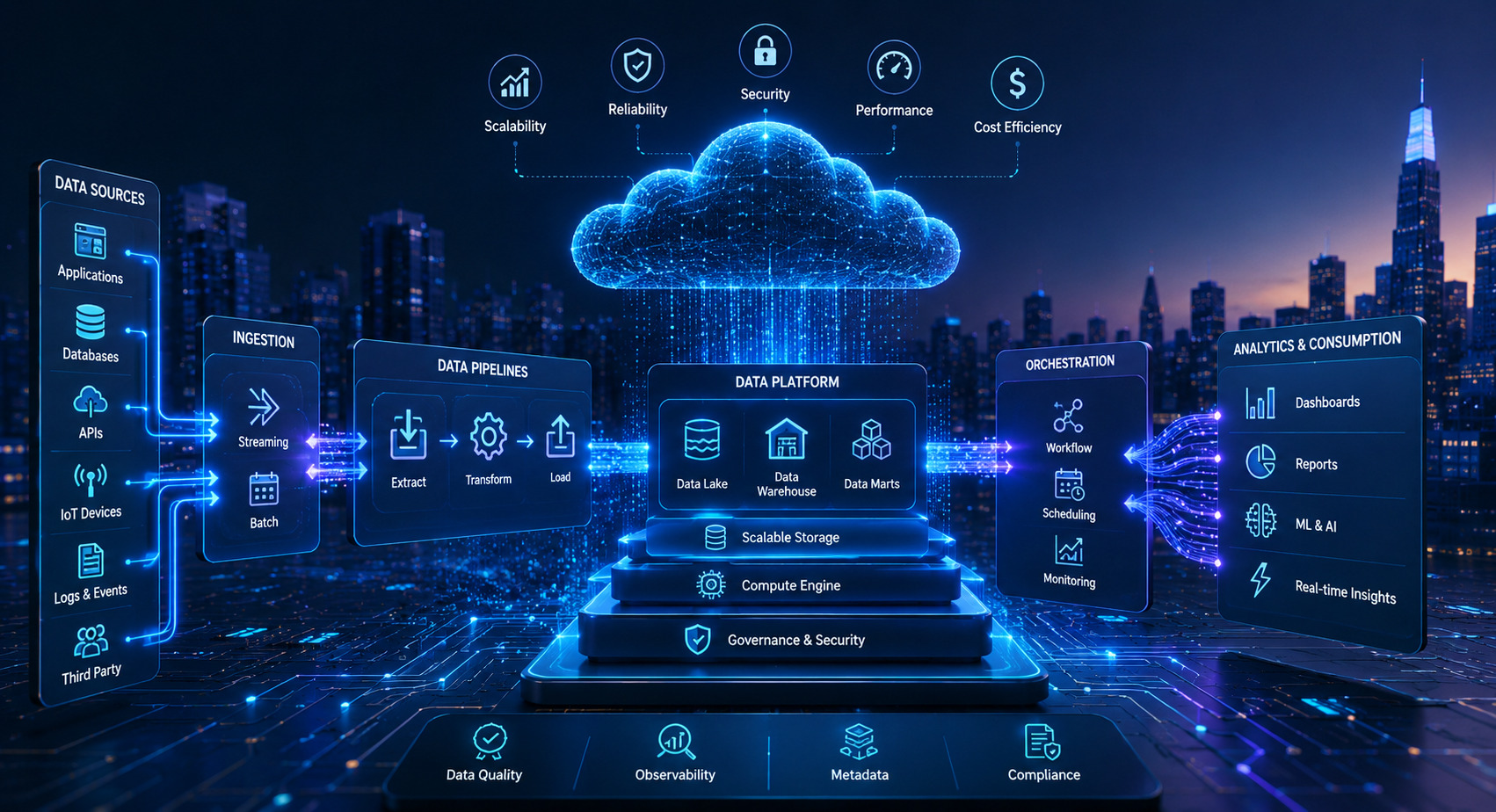
Every dashboard, forecast, and machine-learning model rests on a quiet assumption, that the data feeding it is complete, current, and correct. Making that assumption safe is the work of data engineering. It is the discipline that carries raw, inconsistent data out of dozens of source systems and delivers it clean, reliable, and query-ready: dependable enough to stake real decisions on. As data volumes climbed and the appetite for near-real-time insight grew, that work matured from ad hoc scripting into a rigorous engineering practice with its own patterns, tooling, and standards.
This article is written for technology and data leaders who depend on trustworthy data but want to understand the engineering that produces it. You’ll come away understanding:
Not long ago, moving data meant a handful of overnight scripts copying rows from one database into a warehouse. That worked while sources were few and the only consumer was a monthly report. It stopped working once the picture fractured: data now arrives from transactional databases, SaaS applications, event streams, and files, and feeds self-service analytics, product features, and machine-learning models, each with its own freshness and quality expectations.
Data engineering emerged to handle that complexity with the rigor of software engineering. A useful distinction: a data platform is the infrastructure, while data engineering is the craft of building and operating the pipelines that run on it. This article is about the craft: the repeatable practices that turn a fragile chain of scripts into pipelines a business can rely on.

A pipeline is a sequence of stages, each with a distinct job and its own way of going wrong. Walking through them shows where reliability is won or lost, and why engineers care as much about the seams between stages as the stages themselves.
The pipeline begins by pulling or receiving data from source systems: databases, application APIs, message streams, and file drops. The modern preference is to load raw data first and shape it later, and to move only what changed rather than reloading everything. Techniques like change-data-capture stream inserts and updates as they happen, keeping ingestion incremental, timely, and cheap even as source volumes grow.
Ingested data lands in cheap, scalable object storage, a data lake, that can hold structured tables and raw files alike. The lakehouse pattern adds an open, transactional table layer on top, giving lake storage warehouse-grade reliability: schema enforcement, ACID guarantees, and the ability to query a table as it looked at an earlier point in time. One store then serves both open-ended exploration and production queries.
Raw data is rarely fit for use. Transformation cleans it, resolves duplicates, joins related sources, and models the result into tables that mirror real business concepts: a customer, an order, a subscription. Modern teams run this step after loading, inside the warehouse or lakehouse, expressing the logic as version-controlled, tested SQL or code rather than as an opaque tool no one can inspect.
A real pipeline is many interdependent tasks, and something has to run them in the correct sequence. Orchestration schedules the work, enforces dependencies so a step starts only after the ones it relies on succeed, retries transient failures, and backfills history when logic changes. Defined as code, the workflow becomes reviewable, reproducible, and observable instead of a tangle of cron jobs no one fully understands.
A pipeline that runs without error is not the same as one that is correct. Data quality tests assert explicit expectations (a key is never null, row counts stay within a sane range, values remain unique) and fail loudly when reality drifts. Observability watches freshness, volume, schema changes, and lineage across the whole pipeline, so an upstream change that breaks a downstream table is caught before it surfaces in a report.
The final stage hands curated data to whatever consumes it: business-intelligence tools, feature stores for models, APIs, and reverse-ETL that pushes clean data back into operational applications. Good serving means consumers receive consistent, well-modeled, documented datasets, not raw tables they must decode, so the trust built earlier actually reaches the people making decisions.
For years the standard was ETL (extract, transform, then load) because storage was expensive and transformation ran on separate, purpose-built infrastructure. Cheap cloud storage and elastic compute inverted that logic. Today most teams extract, load, and only then transform: ELT.
| Dimension | ETL (extract, transform, load) | ELT (extract, load, transform) |
|---|---|---|
| Where transformation runs | Separate engine, before loading | Inside the warehouse or lakehouse, after loading |
| Raw data | Often discarded after processing | Kept, so it can be reprocessed later |
| Scales with | Dedicated ETL infrastructure | Elastic cloud compute |
| Adapts to change | Logic fixed early in the flow | New models built anytime from raw data |
| Best suited to | Stable sources, costly storage | Shifting needs, cheap storage |
What separates a mature data team from a struggling one is rarely the choice of tool. It is the engineering habits applied around whichever tools they use: the same habits that made application software dependable.
Most failures are not exotic. They are the predictable result of skipping the discipline above under deadline pressure.
It is the discipline of designing, building, and operating the pipelines that move and transform raw data into reliable, usable datasets. It borrows software-engineering practices (version control, testing, and monitoring) and sits between source systems and the analysts, applications, and models that ultimately consume the data.
Both extract data from sources and transform it for use. ETL transforms first, on separate infrastructure, then loads the result; ELT loads raw data first and transforms it inside a cloud warehouse or lakehouse. Cheap, elastic cloud storage and compute have made ELT the common default, because it preserves raw data and adapts more easily to changing requirements.
A lakehouse combines the low cost and flexibility of a data lake with the reliability of a data warehouse. An open, transactional table layer over lake storage adds schema enforcement, ACID transactions, and fast queries on the same data, so teams avoid copying data back and forth between a lake and a separate warehouse.
A pipeline can run without error and still deliver wrong numbers if a source changes or a value drifts. Quality tests assert what should be true, and observability tracks freshness, volume, schema, and lineage. Together they catch problems before they reach dashboards and models, protecting the trust the whole business places in its data.
Data engineering rarely gets the spotlight, yet it quietly decides whether everything downstream can be believed. A dashboard is only as honest as the pipeline behind it, and a model is only as good as the data it learned from. The discipline exists to make that foundation dependable by design rather than by luck.
The through-line of modern practice is simple: treat data pipelines as production software. Put them under version control, test them, monitor them, and give every dataset an owner. Tools will keep changing, but pipelines built on those habits stay reliable as volumes grow and requirements shift.
For most organizations the payoff is not one dramatic project but a steady dividend: fewer late-night data fires, faster answers to new questions, and the confidence to automate decisions on data the team genuinely trusts.
Modernize Your Cloud & Data
3Shadz helps businesses modernize cloud infrastructure and build secure, scalable data platforms that turn raw information into real-time insight and competitive advantage.