





Browse our current openings and find a role that matches your skills and ambition.
Know more ▸
Get a feel for our culture, our people and the way we work together every day.
Know more ▸
Health, flexibility and growth benefits designed to support you and your family.
Know more ▸

Kickstart your career with hands-on internship opportunities and mentorship.
Know more ▸

Written by 3Shadz Editorial Team
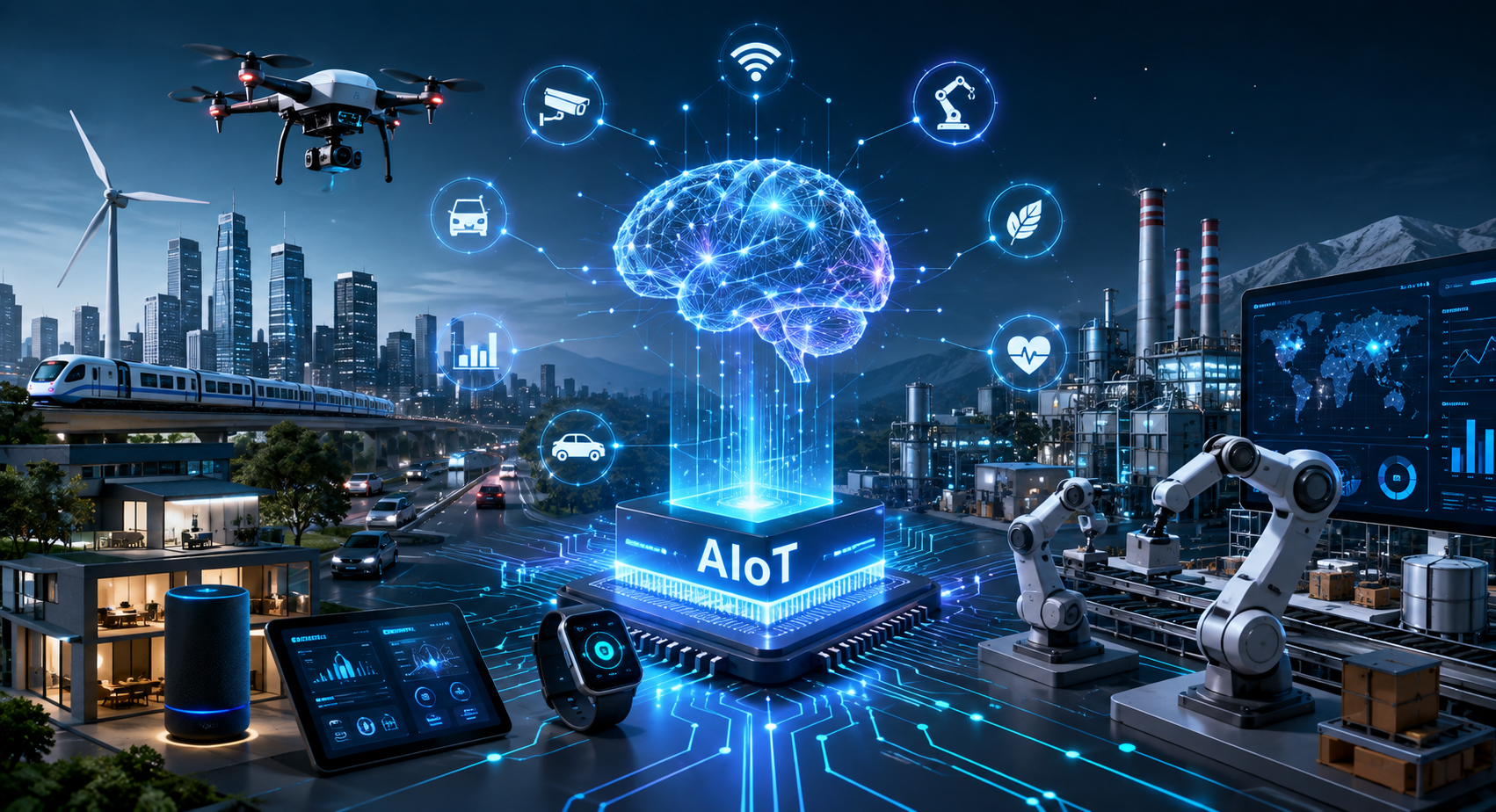
A failing factory motor never announces itself. It hums a little differently, runs a fraction warmer, and vibrates at a frequency no operator would notice on a walk-by. For years, connected sensors dutifully captured those signals and shipped them to a server for someone to review, often the morning after the motor had already seized. AIoT closes that gap by moving the interpretation to where the signal is. When artificial intelligence meets the Internet of Things, connected hardware stops merely reporting the physical world and starts making sense of it, and acting on it, in the moment.
This article is for technology and operations leaders weighing where intelligence belongs in their connected products and systems. You’ll come away understanding:
Classic IoT solved a plumbing problem: get data off physical things and into the cloud. A thermostat reported temperature, a truck reported location, a turbine reported vibration, and all of it streamed to a central system where dashboards were drawn and, eventually, humans or nightly rules decided what to do. The devices themselves were sensors with a network card, not decision-makers.
AIoT adds the missing half. By running machine-learning models on or near the device, a connected thing can interpret its own data and respond without waiting on a round trip to a distant server. The turbine no longer sends a raw vibration stream for someone to analyze later; it recognizes the signature of a wearing bearing and raises a specific, actionable alert by itself. The distinction is worth making concrete.
| Dimension | Traditional IoT | AIoT |
|---|---|---|
| What the device does | Collects and transmits data | Interprets data and decides |
| Where decisions happen | A server or person, later | The device or a nearby gateway, now |
| Connectivity needed | Constant link to the cloud | Keeps working when offline |
| Data sent upstream | Raw streams, high bandwidth | Insights and exceptions only |
| Adapting to change | Rules rewritten by hand | Models retrained from field data |
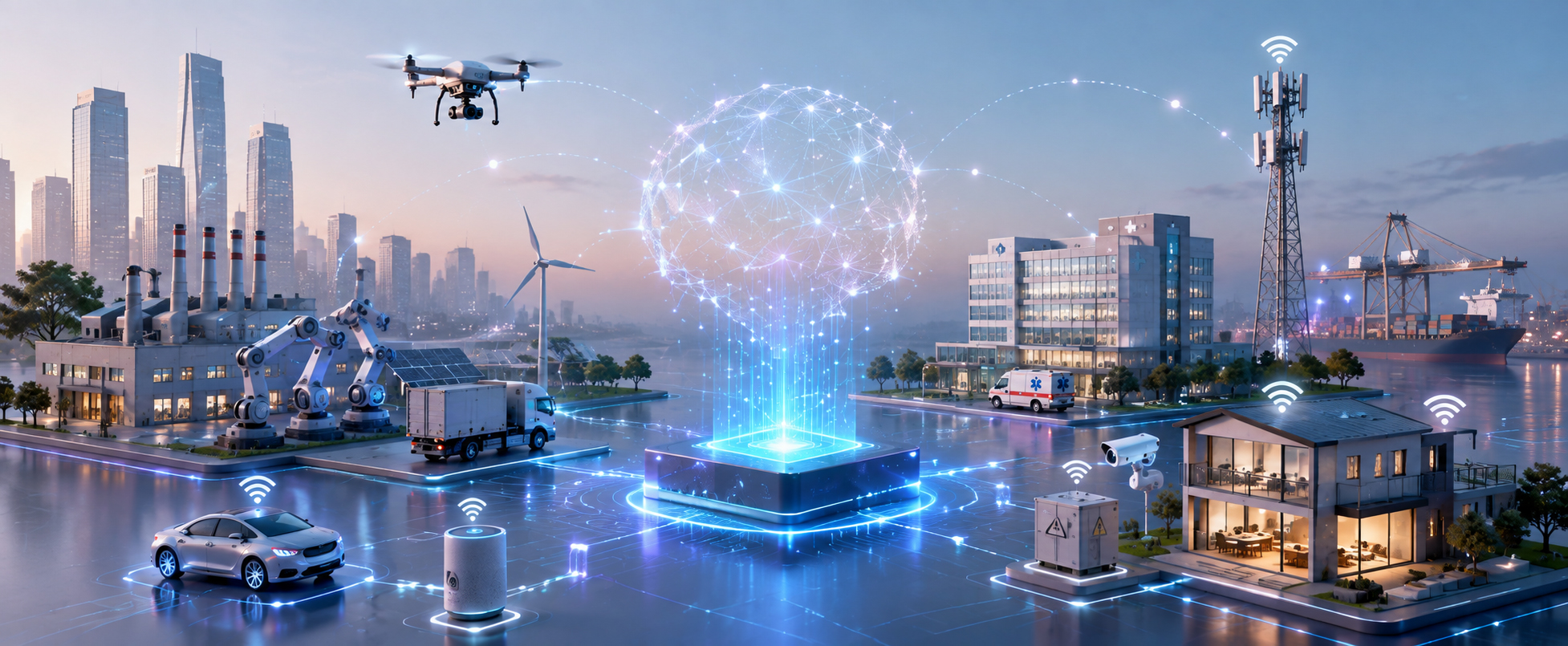
What makes a device intelligent is not a single feature but a loop that turns raw physical signals into action and then improves with experience. Four stages repeat continuously, and understanding them clarifies where the AI actually lives.
Everything starts with instrumentation: accelerometers, thermometers, microphones, cameras, gas and pressure sensors, GPS, and current meters converting physical phenomena into a stream of timestamped readings. Smart sensors increasingly do light processing right here, filtering noise and packaging signals, so the data arriving at the model is clean and relevant rather than a firehose of raw voltages.
Inference is the stage AIoT adds to plain IoT. A trained model examines the incoming signals and draws a conclusion: this vibration pattern means a bearing is degrading, this image shows a scratched part, this rhythm is an irregular heartbeat. Crucially, that inference frequently runs on the device or a local gateway rather than in the cloud. Keeping it at the edge cuts the delay to milliseconds, works even when the network drops, avoids streaming gigabytes of video or telemetry upstream, and keeps sensitive data local. To fit on modest hardware, these models are compressed, quantized and pruned, so they run in a few megabytes on a low-power chip.
An inference is only useful if it drives a response. The device might throttle a machine before it overheats, open a valve, reroute a vehicle, raise a targeted maintenance ticket, or simply notify a person with the specific finding rather than a wall of charts. For higher-stakes decisions a human stays in the loop, approving the action the device recommends; for routine, reversible ones the device acts on its own.
Outcomes and hard cases flow back to a central platform, where models are retrained on real field data and redeployed to the fleet. A camera that misjudged an unusual defect, a monitor that missed a rare fault: each becomes a training example. Over successive cycles the fleet grows more accurate, and the loop closes: the device that acted on the world also learns from how the world responded.
The clearest returns come wherever a fast, local decision about a physical process beats a delayed report. A few domains stand out.
Vibration and acoustic sensors run anomaly detection on-device to flag the exact component wearing out days before failure, turning unplanned downtime into scheduled maintenance. Cameras on the line catch defects in real time without shipping video anywhere.
Telematics units score driving and predict vehicle faults on the road, while cold-chain sensors watch temperature and humidity and alert only when a shipment genuinely drifts out of range, not on every routine reading.
Bedside monitors and wearables detect an arrhythmia or a fall on the device itself, so a clinician is alerted within seconds and raw, sensitive health signals never have to leave the patient’s environment in bulk.
Building controllers learn occupancy and weather patterns to tune heating, cooling, and lighting for comfort and lower bills, while sensors on transformers and inverters spot faults early and help balance load across the grid.
Intelligence at the edge earns its keep, but it asks more of an engineering team than a cloud dashboard does. Hardware is the first constraint: a model that runs comfortably in a data center has to be shrunk to fit the memory, compute, and power budget of a sensor that may run on a battery for years. Managing the fleet is the second. Pushing a new model to thousands of devices in the field demands secure over-the-air updates, staged rollouts, version tracking, and a reliable way to roll back when a new model misbehaves: all without bricking equipment that is expensive to reach.
Security widens with every device deployed. Each unit is a physical object an attacker can touch, and a potential entry point into the wider network, so signed firmware, encrypted communication, and strong device identity are not optional. Then there is drift: the physical world changes as machines age, seasons turn, and new equipment arrives, so a model that was accurate at launch quietly degrades unless its performance is monitored and it is periodically retrained. Deciding what runs on the device versus in the cloud is an ongoing balancing act, not a one-time choice, and getting it wrong shows up as latency, cost, or missed events.
It is the combination of artificial intelligence and the Internet of Things. Instead of connected devices only collecting data and sending it away, machine-learning models run on or near those devices so they can interpret their own signals and act on them in real time.
Running inference at the edge cuts the response time to milliseconds, keeps the device working when connectivity drops, avoids streaming huge volumes of video or telemetry, and keeps sensitive data local. For decisions about a fast-moving physical process, those advantages usually outweigh the extra effort.
No. The device handles time-sensitive inference locally, while the cloud still trains models, aggregates insights across the whole fleet, stores history, and pushes updated models back out. AIoT splits the work between edge and cloud rather than replacing one with the other.
Through fleet management: monitoring each model’s performance in the field, collecting hard cases, retraining centrally, and delivering the new version by secure over-the-air update with staged rollouts and the ability to roll back. Without this, models drift as conditions change and quietly lose accuracy.
Start Your AI Journey
Whether you are exploring AI for the first time or scaling enterprise-wide initiatives, 3Shadz helps businesses design, develop, and deploy intelligent solutions that drive measurable results.