





Browse our current openings and find a role that matches your skills and ambition.
Know more ▸
Get a feel for our culture, our people and the way we work together every day.
Know more ▸
Health, flexibility and growth benefits designed to support you and your family.
Know more ▸

Kickstart your career with hands-on internship opportunities and mentorship.
Know more ▸

Written by 3Shadz Editorial Team

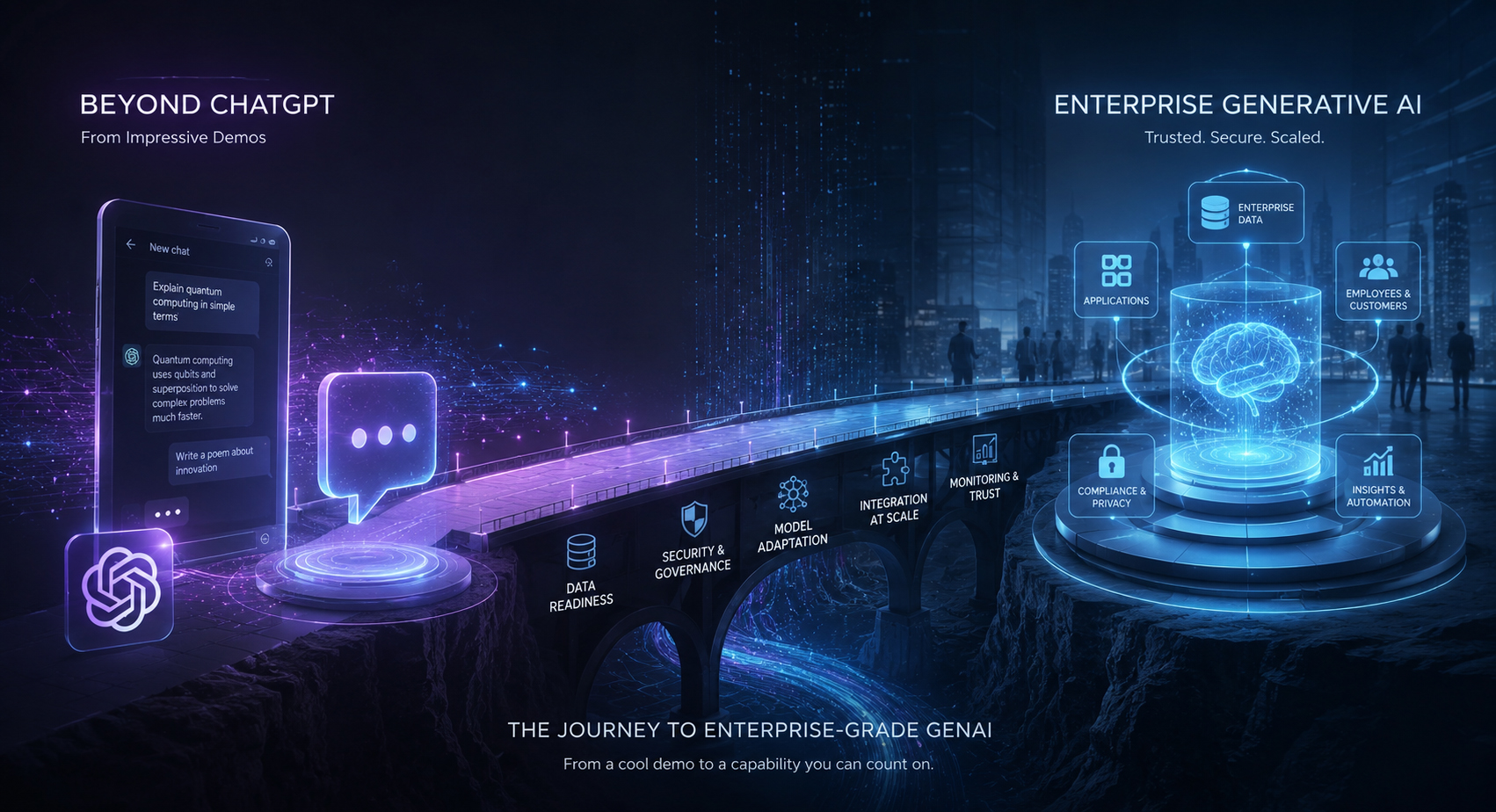
Generative AI arrived as a shock and settled into a routine with unusual speed. In barely three years it went from party trick to standard feature, embedded in email, search, and design tools that millions of people now use without a second thought. That very ordinariness is the signal: when a technology becomes infrastructure, the frontier moves on. The interesting question for 2026 is no longer what generative AI can write: it is what comes after it, and which of the emerging capabilities are worth planning around today.
This is a horizon scan for technology and business leaders deciding where to look next. You’ll come away understanding:
By 2026, generative AI has crossed from novelty to utility. Writing, summarizing, and drafting code are table stakes now, available in every productivity suite and increasingly commoditized. When a capability becomes ordinary, attention and money move to what it still cannot do: act reliably, reason through hard problems, work across the senses, and reach into the physical world.
Several forces are pushing that shift at once. The cost of running a model keeps falling, models are being made smaller and faster, and enterprises that spent two years experimenting now want systems that do work rather than produce text. The technologies below are the ones drawing serious research and early production budgets: none is science fiction, each is already in use somewhere, and each answers a limitation that pure text generation left open.
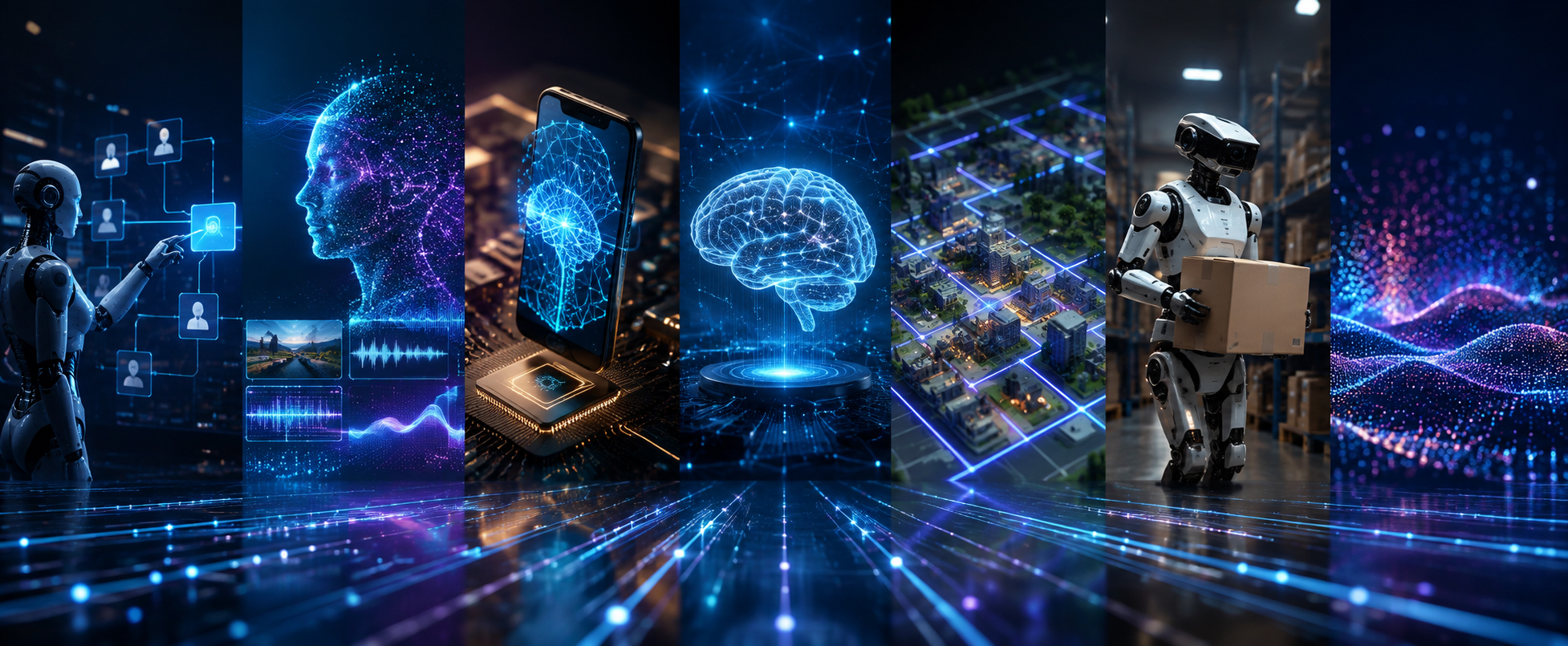
The list below is not exhaustive, but these seven are drawing the most serious attention today. Each answers a limitation that pure text generation leaves open, and each is already running somewhere in the real world.
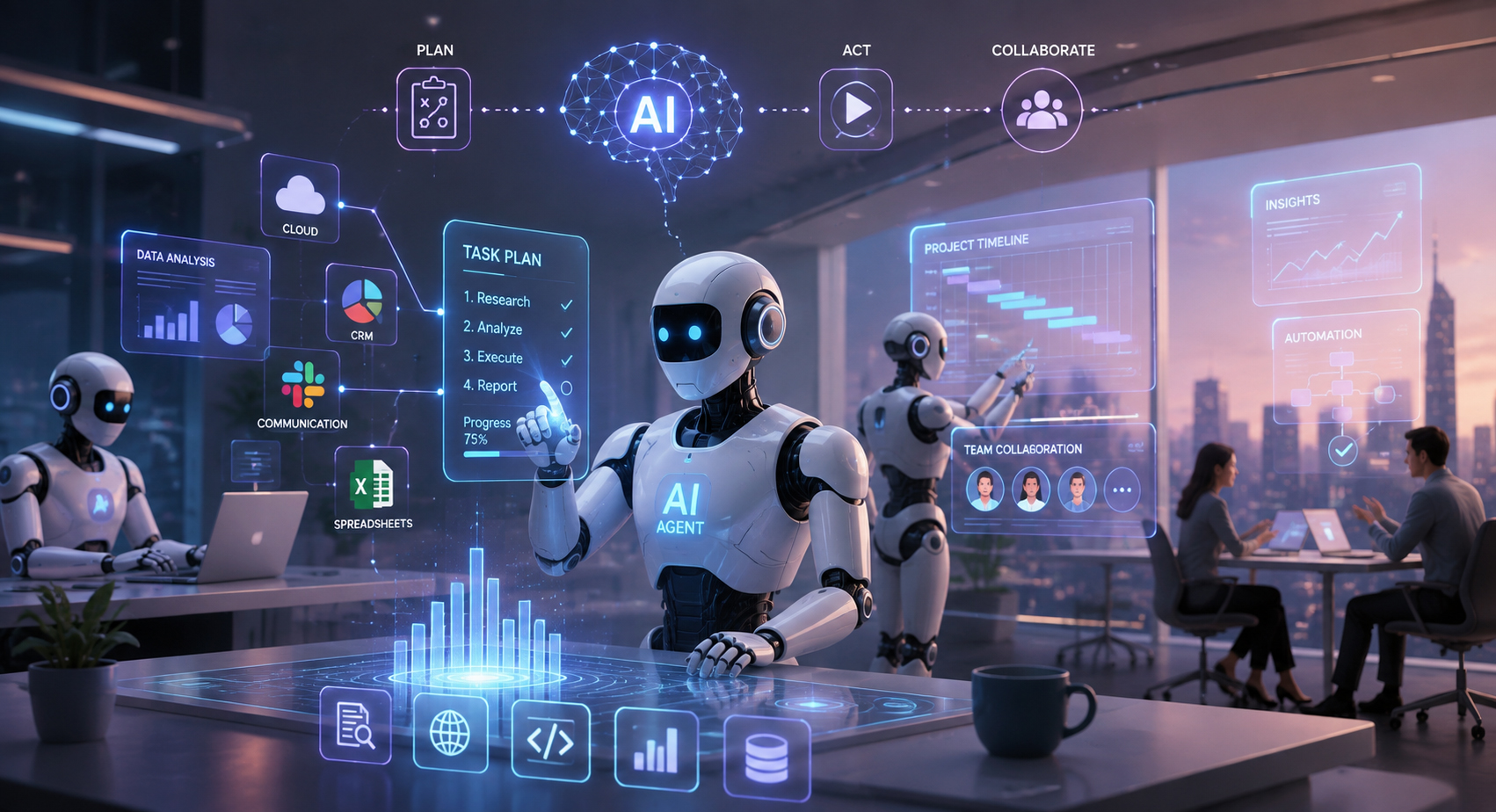
A generative model answers; an agentic system acts. Given a goal, an agent breaks it into steps, calls tools and APIs to carry them out, checks its own progress, and adjusts, shifting AI from producing a draft to completing a task. Early enterprise use is narrow and closely supervised: booking, reconciling, researching, and triaging inside tight guardrails. It is the most immediate frontier, and one we cover in depth in a dedicated article.
Most models still think in a single medium. Multimodal systems take in text, images, audio, and structured data together and reason across them, so an insurance claim can be assessed from a photo and a written note at once, or a machine diagnosed from a sound and its manual. Combining the senses unlocks tasks that no single-modality model can reach, a shift we explore separately.
Bigger is no longer the only direction of travel. Small language models, distilled and tuned for a narrow job, now rival far larger ones on specific tasks while running on a laptop, a phone, or a factory sensor. That changes both the economics and the privacy story: inference costs drop, latency all but disappears, and sensitive data need never leave the device. Expect more workloads to run locally, with large models reserved for the hardest reasoning.
Today’s models are fluent but shallow reasoners; they pattern-match more than they work a problem through. A wave of reasoning-focused systems is changing that, spending extra computation to plan, verify intermediate steps, and show their working: valuable anywhere a wrong answer is expensive. A close relative is causal AI, which tries to model cause and effect rather than correlation, so a system can answer “what happens if we change this?” instead of merely predicting what usually comes next.
World models learn the underlying dynamics of an environment (how objects move, how a market or supply chain responds) and can then simulate outcomes before they happen. Rather than reacting to data after the fact, systems built on them can rehearse decisions, test scenarios, and plan. For business, that points toward richer digital twins, safer training grounds for robots and autonomous systems, and planning tools that ask “what if” at scale.
For years, the smartest AI lived entirely on screens. Physical AI puts perception, language, and planning into machines that act in the world: warehouse robots, inspection drones, and manufacturing systems that understand a spoken instruction and adapt to a cluttered, unpredictable environment. Progress in vision and control, paired with the world models above, is making general-purpose robotics plausible in settings that were previously too messy to automate.
Good models need good data, and the highest-quality real data is finite, sensitive, or expensive to label. Synthetic data, realistic records generated to resemble the real thing, helps fill the gap: it can balance rare cases, stand in for personal records to protect privacy, and create labeled examples for situations too rare or too dangerous to capture. Used carefully, with checks against bias and drift, it becomes a practical way to train and test systems where real data falls short.
Not every announcement deserves a place on a roadmap. A useful filter is whether a technology solves a problem you actually have, whether it holds up outside a curated demo, and whether the surrounding data and integration work is realistic for your team. The direction of travel is clearer than any single product: more autonomy, more reasoning, more senses, and more reach into the physical world.
Momentum, not maturity, is what these seven share right now. Some will reshape entire industries; a few will quietly fold into other tools and vanish as distinct categories. Betting on the direction is far safer than betting on any one label, which is why the foundations (clean data, sound governance, and capable people) matter more than picking a winner.
Not a single replacement but a set of capabilities that build on it: systems that act (agentic AI), that combine senses (multimodal AI), that reason and model cause and effect, that run on-device, that simulate the world, and that operate physical machines. Generative AI becomes one layer in a larger stack rather than the endpoint.
No. It is becoming infrastructure: embedded, dependable, and increasingly taken for granted. The emerging technologies extend it rather than replace it; most of them use generative models as a component while adding the reasoning, action, or perception the base models lack.
Agentic AI and small on-device models are the nearest-term for most organizations, because they attach directly to existing work and existing budgets. Reasoning systems and multimodal AI follow closely. Physical AI and world models arrive sooner in manufacturing, logistics, and other operations that touch the physical world.
Build the foundations every wave depends on (clean data, clear governance, and staff who understand what AI can and cannot do) while running small, reversible pilots on the one or two shifts closest to your business. That keeps you ready without betting the company on any single forecast.
None of this means generative AI has run out of road; it means the interesting road now runs beside it. The next wave is about acting, reasoning, sensing, and simulating: capabilities that turn a model which produces text into a system that gets work done.
In practice, the smart move is not to chase every headline. Pick the two or three shifts that touch your business, invest in the data and governance every one of them will need, and keep experimenting in small, reversible steps. The organizations that treat this as a decade-long transition, not a single product launch, are the ones that will be ready as each technology matures.
Start Your AI Journey
Whether you are exploring AI for the first time or scaling enterprise-wide initiatives, 3Shadz helps businesses design, develop, and deploy intelligent solutions that drive measurable results.