







Browse our current openings and find a role that matches your skills and ambition.
Know more ▸
Get a feel for our culture, our people and the way we work together every day.
Know more ▸
Health, flexibility and growth benefits designed to support you and your family.
Know more ▸

Kickstart your career with hands-on internship opportunities and mentorship.
Know more ▸

Written by 3Shadz Editorial Team
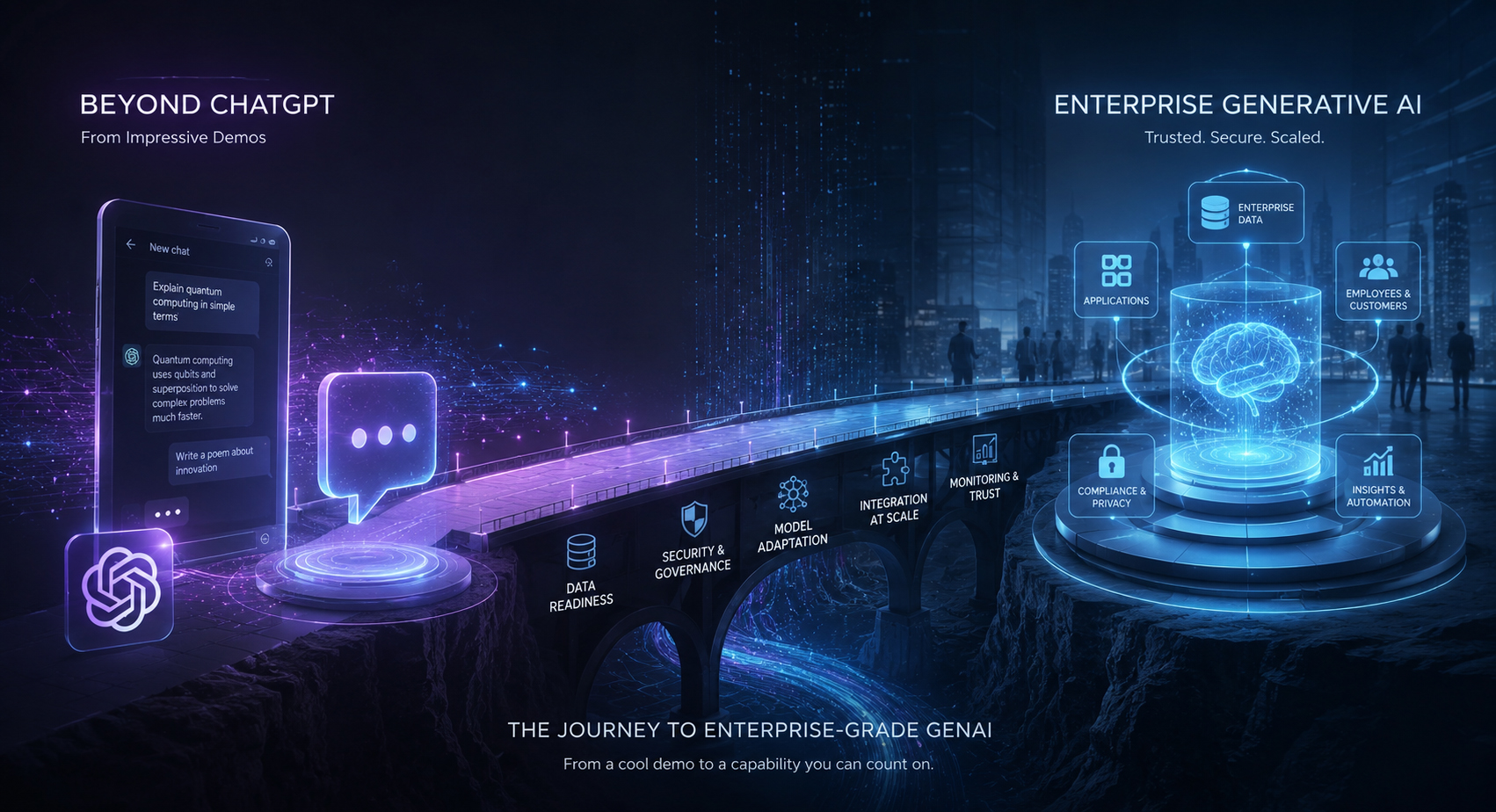
A convincing demo takes an afternoon. A generative AI feature that thousands of employees or customers can trust takes considerably more. That gap, between a chatbot that sounds impressive and a system that behaves reliably on real company data, is where most enterprise GenAI programs live in 2026.
This article is written for technology and business leaders moving generative AI from experiment to production. You’ll come away understanding:
Public tools like ChatGPT taught an entire market what large language models can do. They also set an expectation that turned out to be misleading: that generating good answers is the hard part. In practice, generation is the part that already works. The hard part is everything around it, grounding responses in your own data, keeping confidential information contained, preventing confident-sounding errors, and proving to auditors and executives that the system does what it claims.
A consumer chatbot can afford to be occasionally wrong or vague; the stakes are a re-typed question. An enterprise system that quotes the wrong contract clause, exposes salary data, or invents a refund policy creates legal, financial, and reputational exposure. Enterprise generative AI, then, is less about the model and more about the system built around it.

The two look similar on the surface, a text box and a helpful answer, but the requirements diverge sharply once real business data and accountability are involved.
| Dimension | Consumer chatbot | Enterprise generative AI |
|---|---|---|
| Knowledge source | Public training data | Your documents, systems, and policies |
| Acceptable error | Minor inconvenience | Compliance and financial risk |
| Data privacy | Shared, general-purpose | Isolated, access-controlled |
| Traceability | Not required | Every answer needs a source |
| Success measure | Sounds helpful | Verifiably correct and safe |
Production GenAI is an assembly of parts, each solving one of the failure modes above. Understanding them helps leaders ask the right questions of a vendor or internal team.
Retrieval-augmented generation (RAG) is the workhorse pattern. Instead of hoping the model “knows” your policies, the system searches your own knowledge sources at query time and hands the relevant passages to the model as context. The model then answers from that material and can cite it. This is what turns a general chatbot into one that speaks accurately about your products, contracts, and procedures, and it is far cheaper and faster to update than retraining a model.
Enterprises rarely rely on a single model. A practical setup mixes commercial API models for the hardest reasoning, smaller open models hosted privately for sensitive or high-volume tasks, and clear rules for which requests go where. The decision hinges on data sensitivity, cost per request, latency, and whether the workload can leave your environment at all.
Useful systems do more than talk. Orchestration connects the model to the tools it needs (searching a knowledge base, calling an internal API, looking up an order, drafting a ticket) and sequences those steps. This is the layer that turns a question-answering toy into something that completes work.
Guardrails enforce the boundaries: filtering sensitive inputs and outputs, blocking prompt-injection attempts, and respecting who is allowed to see what. Crucially, the AI must inherit existing permissions: a support agent and a finance manager should get different answers from the same assistant because they can access different data.
Because outputs are probabilistic, “it seems to work” is not a release criterion. Mature teams build test sets of real questions with known-good answers, score new versions automatically, and monitor quality, cost, and latency in production. Without this, every model or prompt change is a gamble.
The strongest returns come from narrow, well-scoped jobs where language is the bottleneck, not open-ended “ask me anything” assistants.
Employees ask questions in plain language and get sourced answers from thousands of internal documents, cutting time spent hunting through wikis and PDFs.
Agents get drafted replies grounded in the actual account and policy, resolving cases faster while a human stays in control of what is sent.
Contracts, claims, and invoices are read, summarized, and checked against rules, replacing hours of manual review in legal, insurance, and finance teams.
Developers accelerate coding and testing, while business users query data in natural language and get explained results instead of waiting on a report.
A dependable rollout looks less like installing software and more like standing up a small product. It usually moves through a recognizable sequence: pick one high-value, low-risk use case; connect and clean the relevant knowledge sources; assemble retrieval, model, and guardrails into a working prototype; evaluate it against real questions; pilot with a friendly group of users; then harden security, monitoring, and cost controls before widening access. Data readiness is typically the longest step: scattered, outdated, or poorly permissioned content is the most common reason a promising pilot stalls.
It is generative AI engineered for business use, grounded in a company’s own data, wrapped in privacy controls, guardrails, and evaluation, and integrated with internal systems so it can be relied on in production rather than treated as a novelty.
Usually not. Most enterprise value comes from retrieval, connecting an existing model to your data, rather than training one from scratch. Custom training or fine-tuning is reserved for specialized language or tasks where retrieval alone is not enough.
Ground answers in retrieved source material, require citations, constrain the system to approved knowledge, and evaluate against known-good answers. These measures sharply reduce fabrication, and a human reviewer covers the highest-risk decisions.
It can be, with the right architecture: private or contractually isolated model hosting, strict access controls that mirror existing permissions, and clear policies on what data is sent where. Safety is a property of how the system is built, not of the model alone.
Start Your AI Journey
Whether you are exploring AI for the first time or scaling enterprise-wide initiatives, 3Shadz helps businesses design, develop, and deploy intelligent solutions that drive measurable results.