

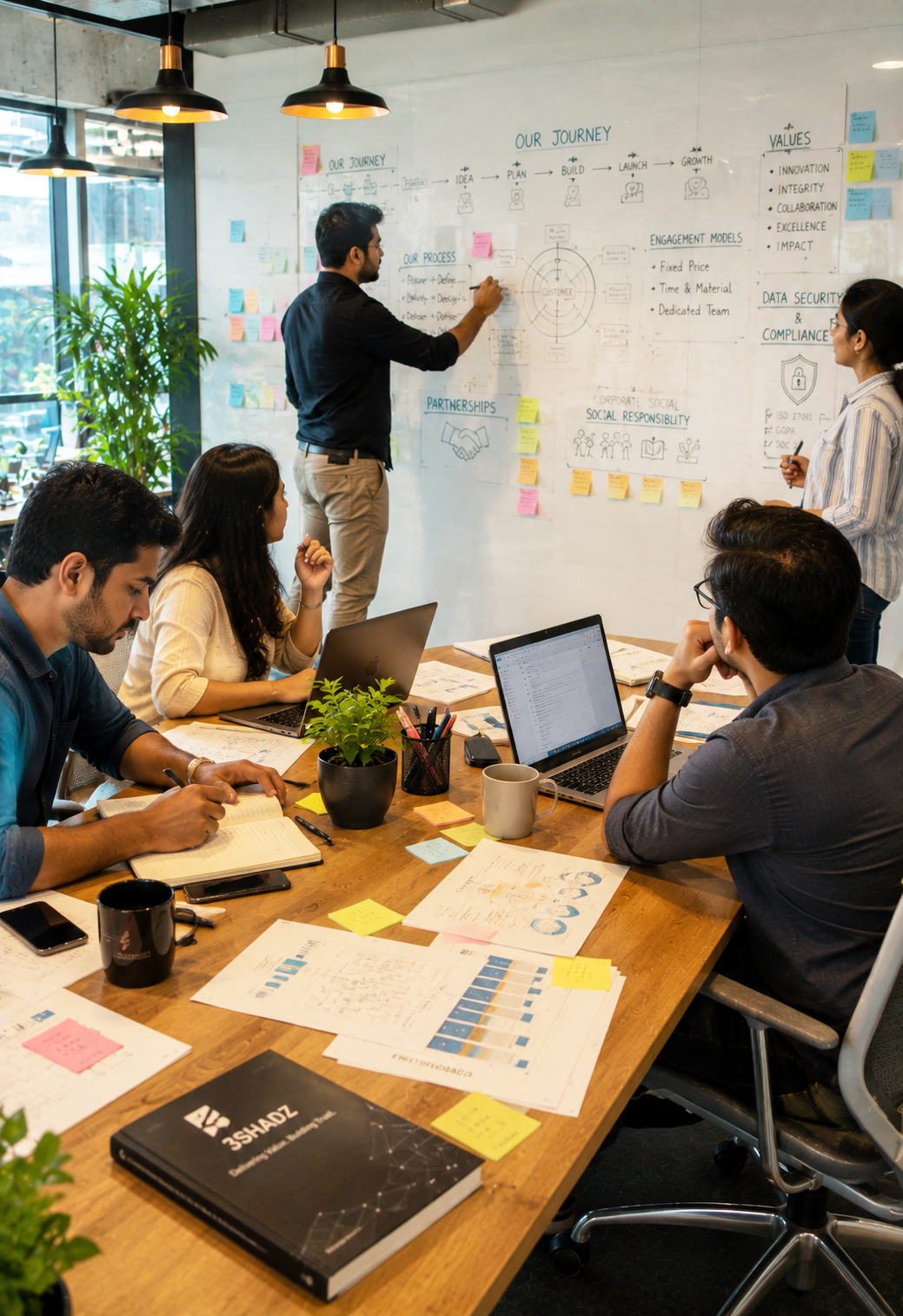


Browse our current openings and find a role that matches your skills and ambition.
Know more ▸
Get a feel for our culture, our people and the way we work together every day.
Know more ▸
Health, flexibility and growth benefits designed to support you and your family.
Know more ▸

Kickstart your career with hands-on internship opportunities and mentorship.
Know more ▸

Written by 3Shadz Editorial Team

The way software gets built changes far more slowly than the headlines suggest, and then, every few years, several shifts land at once and the baseline moves. That is where the industry sits heading into 2026. Writing code is no longer the scarce skill; wiring together AI assistance, shared platforms, and well-designed contracts is. This article maps the forces reshaping software development, what each one actually changes, and what it means for the teams doing the work.
Written for engineering leaders and the developers who work with them, this article is a map rather than a deep dive. You’ll come away understanding:
One thread runs through every trend below: a move away from building and operating everything by hand toward assembling software from dependable parts, and from individual heroics toward repeatable systems. AI takes on more of the routine typing. Platforms remove the undifferentiated setup work. APIs and managed cloud services supply capabilities a team once had to build itself. The developer’s role shifts up a level: from producing every line to composing, integrating, and verifying.
None of these forces is entirely new, and none stands alone: they reinforce one another. Each also runs deep enough to warrant its own treatment, and several are explored in detail elsewhere in this series. The overview below is deliberately broad, so you can see how the pieces fit before going deep on any one of them.

Here is the shift in brief, not a clean break on a single date, but the way the defaults are moving.
| Dimension | The last decade | 2026 and beyond |
|---|---|---|
| Writing code | Typed line by line | AI-assisted, human-reviewed |
| Environments | Each team wires its own | Provided by an internal platform |
| Architecture | Large, tightly coupled | Composable, API-first services |
| Where it runs | Servers you operate | Cloud-native, managed services |
| Security | Checked before release | Built in at every stage |
| Quality | A testing phase at the end | Engineered in continuously |
Each force below is a deep subject in its own right; here they are as a connected map, with what each one changes and what it means in practice.
AI coding assistants moved quickly from novelty to daily tool. The frontier now is agentic assistance: systems that can scaffold a feature, write tests, and open a pull request from a described task rather than merely autocomplete the next line. The gains are real but bounded: assistants accelerate the routine and free attention for design, review, and the judgment calls that stay firmly human.
Reviewing and directing generated code well becomes the scarce skill. Strong tests, clear architecture, and disciplined code review matter more, not less, because more code now arrives faster.
For a decade, every team was expected to assemble its own pipelines, infrastructure, and tooling. That reinvention is expensive and inconsistent. Platform engineering answers it with an internal developer platform: a supported, self-service layer offering paved paths to build, ship, and run services without wiring up the plumbing each time.
Developers spend less time fighting tooling and more on the product itself. The trade-off is that the platform has to be run as a product in its own right, with real internal users and a team accountable for it: a shift we examine on its own.
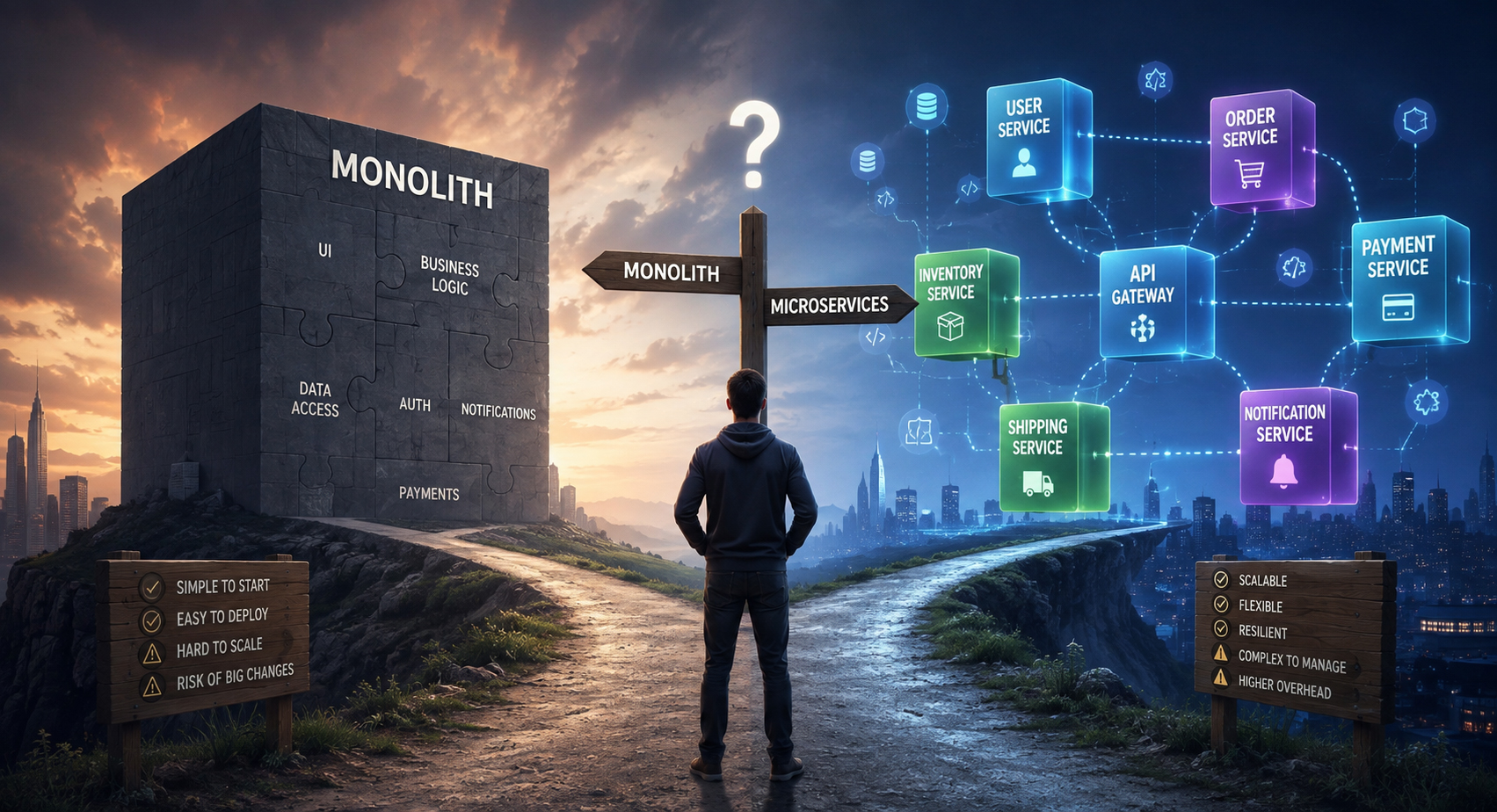
Systems are increasingly assembled from services and third-party capabilities rather than built as one monolithic block. That only holds together when interfaces are dependable, so teams are designing the API contract first, agreeing how a service behaves before writing its implementation, and treating each capability as a component others can compose.
Teams can then build in parallel against an agreed contract and reuse or swap components with confidence, though designing and versioning those contracts becomes non-negotiable. The discipline of API-first work deserves a closer look than a trends map allows.
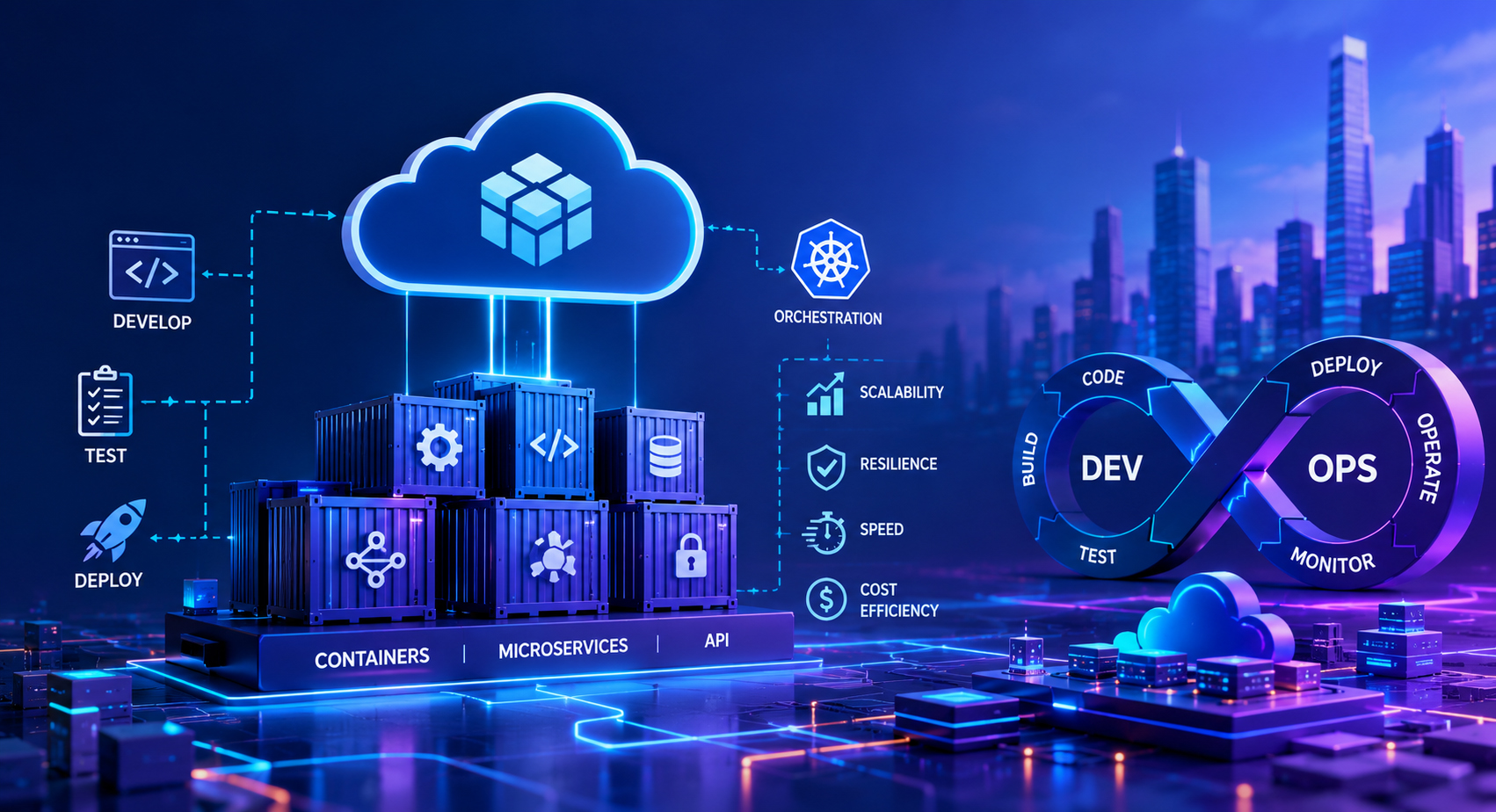
New systems are designed for the cloud from the first commit rather than lifted onto it later. In practice that means containers and orchestration, stateless services, and leaning on managed databases, queues, and identity instead of operating them by hand. Resilience patterns such as retries, health checks, and graceful degradation are designed in rather than bolted on after an outage.
In return, teams gain elasticity and shed operational toil, at the cost of new skills in distributed systems and cloud cost management. The design principles behind it are a topic in their own right.
Treating security as a gate at the end no longer holds up against the pace of modern releases or the risk in today’s software supply chains. DevSecOps weaves security through the whole lifecycle: threat modeling during design, automated scanning of code and dependencies, hardened build and deploy steps, and monitoring in production. It becomes a shared responsibility rather than one team’s problem at the finish line.
Vulnerabilities surface early, when they are cheap to fix, while developers take on security awareness as part of the daily job rather than a late handoff.
Quality is moving from a phase performed by a separate group to a discipline owned by the whole team. Quality engineering means building testability into the design, automating checks across the pipeline, and watching real behavior in production, shifting both left and right, instead of inspecting for defects at the end. The aim is to prevent defects, not merely catch them.
Confidence to release often then comes from an engineered test and observability strategy, not from a manual sign-off that slows everyone down. It is a mindset shift we unpack separately.
Tying the rest together is the expectation that change flows to users safely and often. Continuous integration and delivery pipelines automate the path from commit to production, and teams increasingly measure themselves on delivery performance, how fast a change reaches users, how often they ship, and how quickly they recover from failure. Frequent, small releases turn out to be safer than rare, large ones.
Shipping stops being an event and becomes routine, which reshapes how teams plan, review, and take ownership of what they put in front of users.
These forces are not a checklist to adopt all at once, and chasing each new practice for its own sake is a failure mode of its own. What matters is the direction they point in: less time spent on undifferentiated setup and repetitive typing, more on design, integration, security, and verifiable quality. A team that grasps the through-line can decide which shift will move the needle in its own context (whether that is API design, cloud-native architecture, or delivery automation) and go deep there, rather than adopting everything and mastering nothing.
Seven shifts stand out: AI-assisted development, platform engineering, API-first and composable architecture, cloud-native design, DevSecOps, quality engineering, and mature continuous delivery. Together they move the work from writing every line toward composing, integrating, and verifying software built from reliable parts.
Not in any near-term sense. AI is automating routine coding and speeding up parts of the workflow, but design decisions, architecture, review, and accountability for what ships stay with people. The skill that grows in value is directing and verifying AI output well, not producing every line by hand.
No, that is a common way to overextend a team. Each of these is a deep discipline in its own right. Pick the shift that addresses your biggest constraint (slow releases, brittle integrations, or security risk), prove the value there, and expand from a position of confidence.
A move away from building and operating everything by hand toward assembling software from dependable components (AI assistance, shared platforms, APIs, and managed cloud services) while pushing quality and security earlier and making delivery continuous.
Build Better Software
From architecture to delivery, 3Shadz helps teams design, build, and scale reliable software with modern engineering practices, automation, and quality built in from day one.