





Browse our current openings and find a role that matches your skills and ambition.
Know more ▸
Get a feel for our culture, our people and the way we work together every day.
Know more ▸
Health, flexibility and growth benefits designed to support you and your family.
Know more ▸

Kickstart your career with hands-on internship opportunities and mentorship.
Know more ▸

Written by 3Shadz Editorial Team
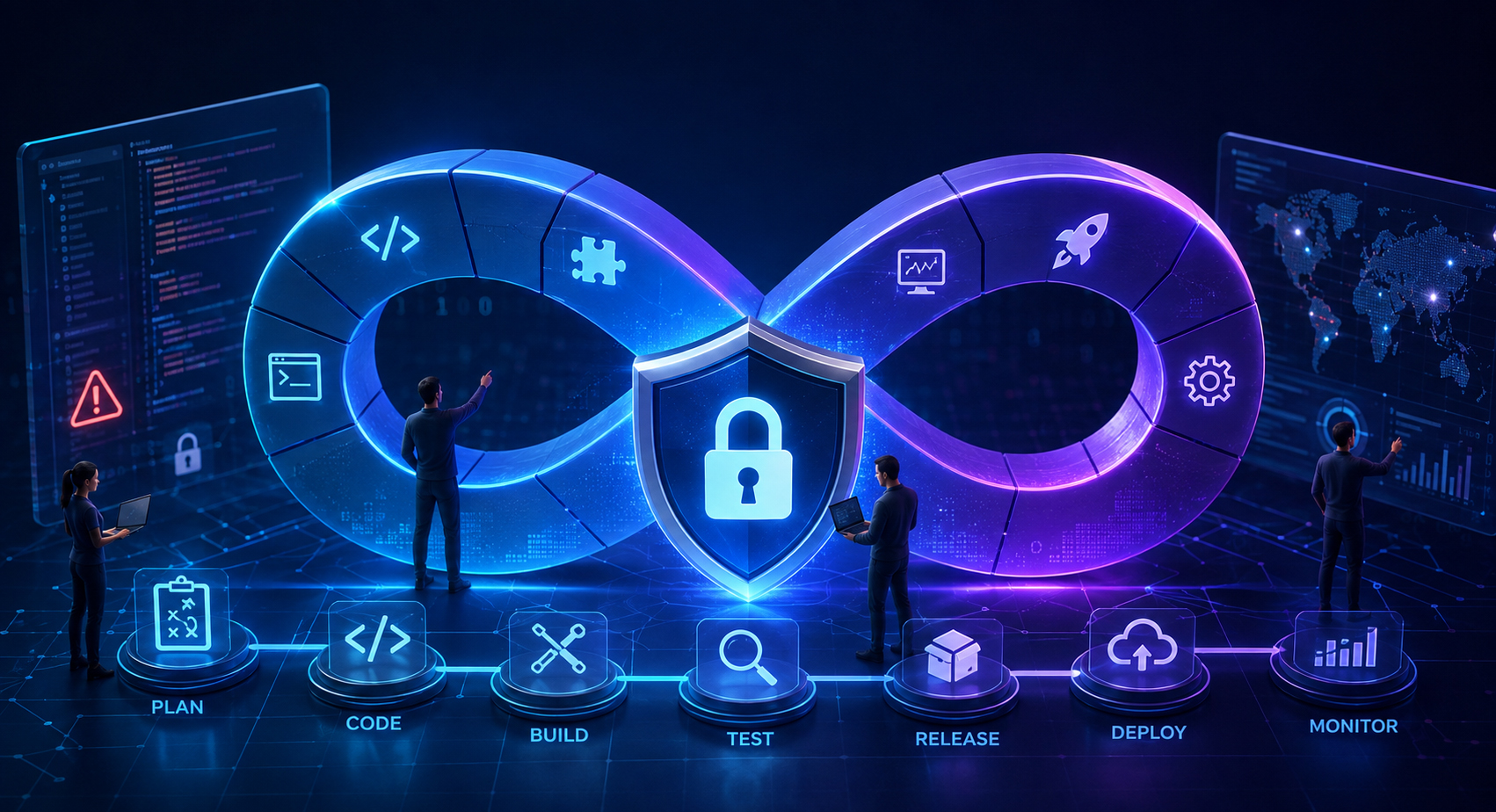
Most breaches don’t begin with an exotic attack. They begin with an ordinary mistake (a dependency left unpatched, a secret committed to a repository, a storage bucket set to public), the kind of thing a security review at the end of a project either misses or catches too late to fix cheaply. DevSecOps rejects the idea that security is a final gate. It treats security as something built into every commit, build, and deployment, owned by the whole team rather than a separate department consulted at the finish line. This article looks at what “shift-left” means once you get past the slogan, and how security fits into each stage of a modern delivery pipeline.
This article is for engineering leaders, developers, and security professionals who want security to keep pace with continuous delivery. It covers:
When software shipped a few times a year, a security review before release was manageable. A team could pause, hand the build to a specialist group, wait for a report, and remediate before launch. That model quietly collapsed once teams began deploying weekly, sometimes many times a day. A manual audit that takes weeks cannot sit in front of a pipeline that releases in minutes, so it becomes a bottleneck teams learn to route around, and security drifts from being a safeguard to being an obstacle.
The economics make the case sharper. A vulnerability a developer fixes while the relevant code is still fresh in their head costs minutes. The same flaw discovered after release costs far more: it means an incident, an emergency patch, coordination across teams, and often a disclosure. Finding problems late doesn’t just add risk: it adds cost, precisely because context has evaporated by the time anyone looks.
“Shift-left” refers to moving security activities earlier in the timeline, toward design and coding, rather than clustering them at testing and release. In practice it is less a single event and more a set of small, automated checks distributed across the whole lifecycle, each running at the point where a problem is cheapest to catch. It does not mean turning every developer into a penetration tester, and it does not mean drowning teams in alerts. It means giving people fast, specific feedback at the moment they can act on it, and letting machines handle the repetitive checks they perform more reliably than humans.
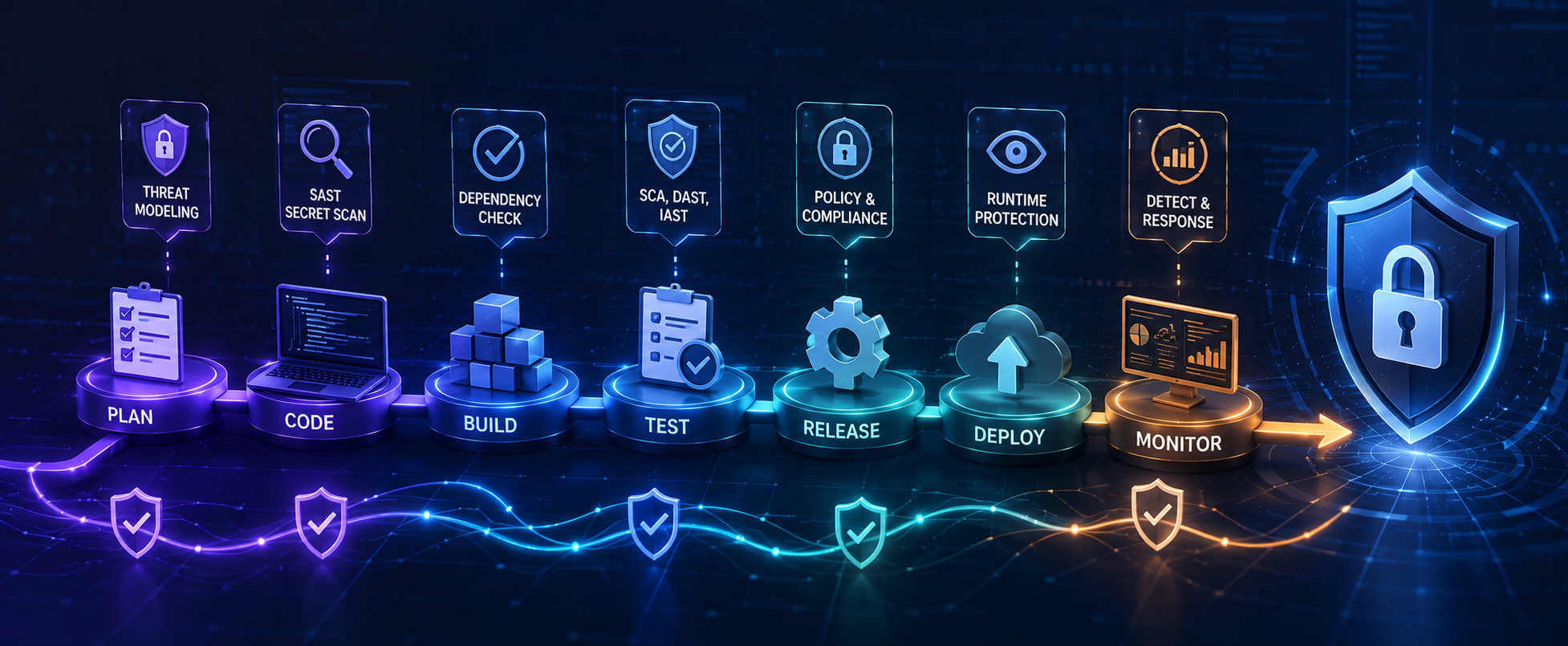
Weaving security in means giving each stage of delivery its own guardrail, so that a weakness is intercepted where it is introduced rather than accumulating until the end.
The cheapest vulnerability to fix is the one you design out before any code exists. Threat modeling is a structured conversation early in a feature’s life: what are we building, what could go wrong, who might attack it, and what would that cost us? It need not be heavyweight: a whiteboard session that maps data flows and trust boundaries surfaces the risks worth guarding against, so security requirements enter the backlog alongside functional ones instead of arriving as surprises during a late audit.
Two checks belong close to the keyboard. Static application security testing (SAST) reads source code for insecure patterns (SQL injection, unsafe deserialization, weak cryptography) and flags them in the pull request while the author still holds the context to fix them. Secrets scanning does the narrower but critical job of stopping API keys, tokens, and passwords from ever being committed. Running both automatically on every change turns security findings into ordinary code review comments rather than end-of-line emergencies.
Modern applications are mostly other people’s code. Open-source libraries and their transitive dependencies routinely make up the bulk of a shipped application, and a flaw in any one of them is your flaw. Software composition analysis (SCA) inventories every dependency, matches it against known-vulnerability databases, and alerts you when a component you rely on turns out to be exposed. A software bill of materials (SBOM) makes that inventory explicit, so when the next widely used library is found vulnerable you can answer “are we affected?” in minutes rather than days.
The artifact you deploy deserves its own inspection. Container images bundle an operating system and system libraries that carry vulnerabilities independent of your application code. Image scanning in the build stage checks those layers, flags outdated or vulnerable packages, and can block a promotion that would ship a known-bad base image. This is also where you protect the integrity of the build itself, verifying that dependencies came from expected sources and that the pipeline has not been tampered with along the way.
Some of the most damaging incidents trace back not to code but to a setting: a public storage bucket, an over-permissive access role, an unencrypted database. When infrastructure is defined as code (Terraform, CloudFormation, Kubernetes manifests), those definitions can be scanned before they are ever applied. Infrastructure-as-code scanning and policy-as-code catch misconfigurations in the pull request and enforce rules such as “no public buckets” or “encryption required” automatically, rather than trusting every engineer to remember them.
Security does not end at deployment. New vulnerabilities are disclosed daily, and code that was clean at release can become exposed overnight. Runtime monitoring watches production for anomalous behavior, dynamic application security testing (DAST) probes the running system the way an attacker would, and continuous scanning re-checks live dependencies against fresh threat data. Feeding what you learn in production back into design and code closes the loop, which is what makes DevSecOps continuous rather than a stage you finish and forget.
DevSecOps is the practice of building security into every stage of software delivery instead of treating it as a review at the end. It makes security a shared responsibility across development, security, and operations, and relies on automated checks embedded in the pipeline so that flaws are caught as code is written, built, and deployed.
SAST analyzes your source code at rest for insecure patterns. DAST tests the running application from the outside, the way an attacker would probe it. SCA inspects the open-source dependencies you include for known vulnerabilities. They cover different blind spots, so a mature program uses all three at the stages where each is most effective.
No. It changes the security team’s role from gatekeeper to enabler. Instead of manually reviewing every release, they set policy, choose and tune the automated tooling, model threats, and handle the hard cases that automation cannot. Developers gain fast feedback and shared ownership, while the security team focuses its expertise where it matters most.
Begin with one high-value check rather than every tool at once. Adding dependency scanning and secrets detection to the pipeline is a common first step because it delivers immediate value with little disruption. Make findings visible in the developer’s workflow, tune out the noise so alerts stay trustworthy, then extend into SAST, container scanning, and runtime monitoring as the habit takes hold.
Build Better Software
From architecture to delivery, 3Shadz helps teams design, build, and scale reliable software with modern engineering practices, automation, and quality built in from day one.