







Browse our current openings and find a role that matches your skills and ambition.
Know more ▸
Get a feel for our culture, our people and the way we work together every day.
Know more ▸
Health, flexibility and growth benefits designed to support you and your family.
Know more ▸

Kickstart your career with hands-on internship opportunities and mentorship.
Know more ▸

Written by 3Shadz Editorial Team
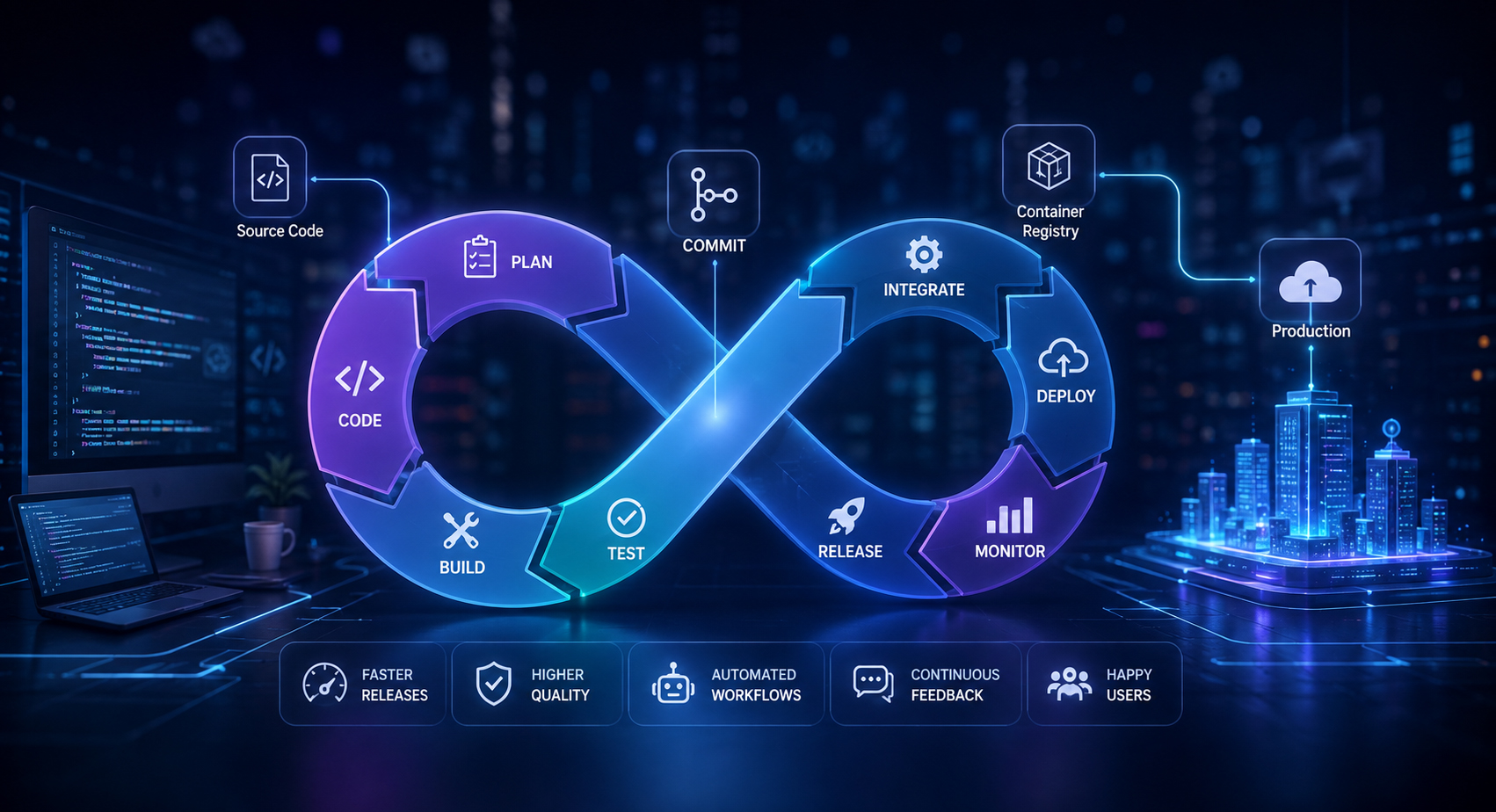
Merging code and getting it safely in front of users are two very different milestones, and the distance between them is where a great deal of engineering pain hides. Manual deployments, late-night release windows, and the quiet fear of shipping are all symptoms of a delivery process that has never been automated. CI/CD closes that distance: it turns the path from a committed change to a running feature into a repeatable pipeline that builds, tests, and releases software with as little human intervention as possible. This article walks through how that pipeline works, stage by stage, and how to tell whether yours is actually performing.
This piece is written for engineering leaders and developers who want frequent releases without sacrificing stability. It covers:
Traditional release processes batch weeks or months of change into a single deployment, push it through a manual checklist, and often schedule the whole thing for a weekend. The logic feels prudent (release rarely, test heavily), but it tends to backfire. A larger release carries more untested interactions between changes; when something breaks, the change set is so big that finding the culprit is slow; and rolling back is risky precisely because so much moved at once.
Frequent, small releases invert that risk. Each deployment carries one change or a handful, so a failure is easy to isolate and cheap to reverse, and feedback from real users arrives in hours rather than quarters. The catch is that shipping many times a day by hand is impossible to sustain and error-prone when attempted. That is the problem CI/CD automation exists to solve, making a frequent release not a heroic event but a boring one.
The three terms are often blurred together, but each describes a distinct commitment. Continuous integration is the discipline of merging small changes into a shared branch frequently; every merge triggers an automated build and test run, so integration problems surface within minutes instead of at the end of a project.
Continuous delivery builds on that by keeping every change that passes the pipeline in a deployable state, releasing becomes a one-click business decision rather than an engineering ordeal. Continuous deployment removes even that click: any change that clears the automated checks ships to production on its own. Most teams practice continuous delivery and reserve full continuous deployment for services where their tests and monitoring have earned that trust.
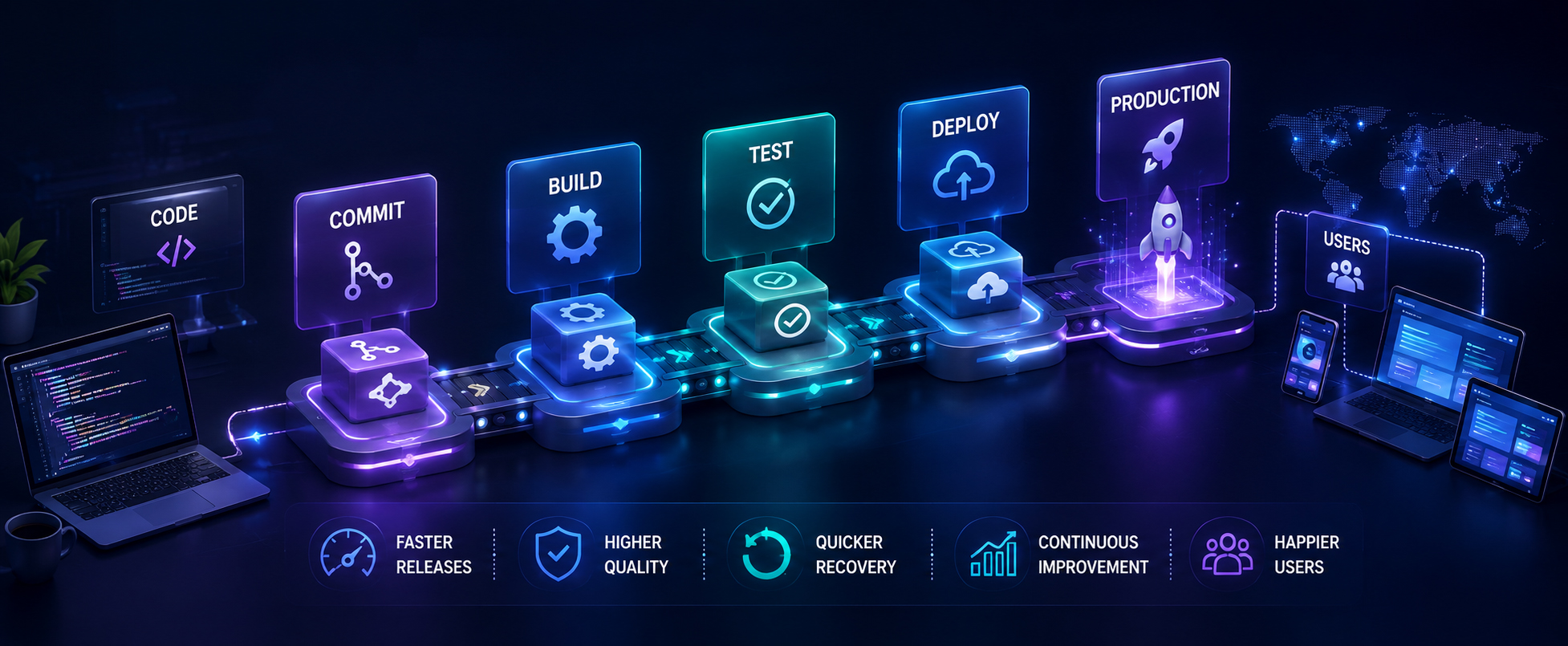
Every CI/CD pipeline chains together a series of automated stages, each a gate the change must clear before it can move on. The exact tools vary, but the shape is remarkably consistent.
As soon as a developer pushes a change to version control, the pipeline starts automatically: no one kicks it off by hand. Version control is the single source of truth for what gets built, which means the pipeline only ever acts on code that has been committed and is visible to the whole team.
Source code is compiled and assembled into a deployable artifact (a container image, binary, or bundle) exactly once. That same artifact is then promoted through every later stage, so the thing you test in staging is bit-for-bit the thing you ship to production. Rebuilding at each step is where subtle “works in one environment, not the other” bugs creep in.
Automated tests run against the build, usually fastest first: unit tests in seconds, then integration tests, then slower end-to-end checks. Ordering them this way means the pipeline fails quickly on the cheapest signal. If any test fails, the run stops and the change never advances: a broken build is treated as the team’s top priority, not a warning to ignore.
Beyond correctness, a set of gates enforces standards automatically: static analysis for code smells, coverage thresholds, dependency and container image scanning for known vulnerabilities, and license checks. Because these run on every change, human review can focus on design and intent rather than policing style and catching obvious risks by eye.
Once every check passes, the validated artifact is released using a scripted, repeatable process rather than a manual runbook. Progressive strategies limit exposure: a blue-green switch keeps the old version warm for instant fallback, while a canary release routes a small slice of traffic to the new version first and widens it only if the metrics stay healthy.
Releasing is not the end of the pipeline. Automated monitoring watches error rates, latency, and key business metrics the moment a change goes live. If something degrades past a threshold, an automated rule, or a one-command action, rolls back to the previous known-good artifact, often before most users notice anything is wrong. Fast, safe rollback is what makes frequent deployment feel low-risk.
A pipeline that runs is not the same as one that performs. Years of research into software delivery converged on four metrics that, taken together, capture both speed and stability. The important finding is that high performers score well on all four at once, which dismantles the old assumption that you must trade safety for speed.
| Metric | What it measures | Signal of a healthy pipeline |
|---|---|---|
| Deployment frequency | How often you release to production | On demand, multiple times a day |
| Lead time for changes | Time from commit to running in production | Less than a day |
| Change failure rate | Share of deployments that cause a failure | A low single-digit percentage |
| Time to restore | How long to recover from a failed change | Under an hour |
The first two metrics describe speed; the last two describe stability. Watching all four keeps a team honest: you can no longer celebrate a rising deploy count while the change failure rate climbs alongside it.
When releasing is cheap and safe, a set of good habits follows almost on its own.
CI/CD is a set of automated practices that move a code change from commit to production through a repeatable pipeline. Continuous integration builds and tests every change as it is merged; continuous delivery keeps every passing change ready to release; continuous deployment releases it automatically.
Both automate the pipeline all the way up to production. Continuous delivery stops at a manual approval: the software is always releasable, but a person decides when to ship. Continuous deployment removes that gate, releasing every change that passes the automated checks without human sign-off.
The evidence points the other way. Teams that deploy frequently tend to have lower change failure rates and faster recovery, because small changes are easier to test, isolate, and roll back than large batched releases. Frequency and stability improve together when the pipeline is well built.
Four measures of software delivery performance: deployment frequency, lead time for changes, change failure rate, and time to restore service. The first two capture speed and the last two capture stability, so tracking all four stops a team from optimizing one at the expense of another.
Build Better Software
From architecture to delivery, 3Shadz helps teams design, build, and scale reliable software with modern engineering practices, automation, and quality built in from day one.