







Browse our current openings and find a role that matches your skills and ambition.
Know more ▸
Get a feel for our culture, our people and the way we work together every day.
Know more ▸
Health, flexibility and growth benefits designed to support you and your family.
Know more ▸

Kickstart your career with hands-on internship opportunities and mentorship.
Know more ▸

Written by 3Shadz Editorial Team
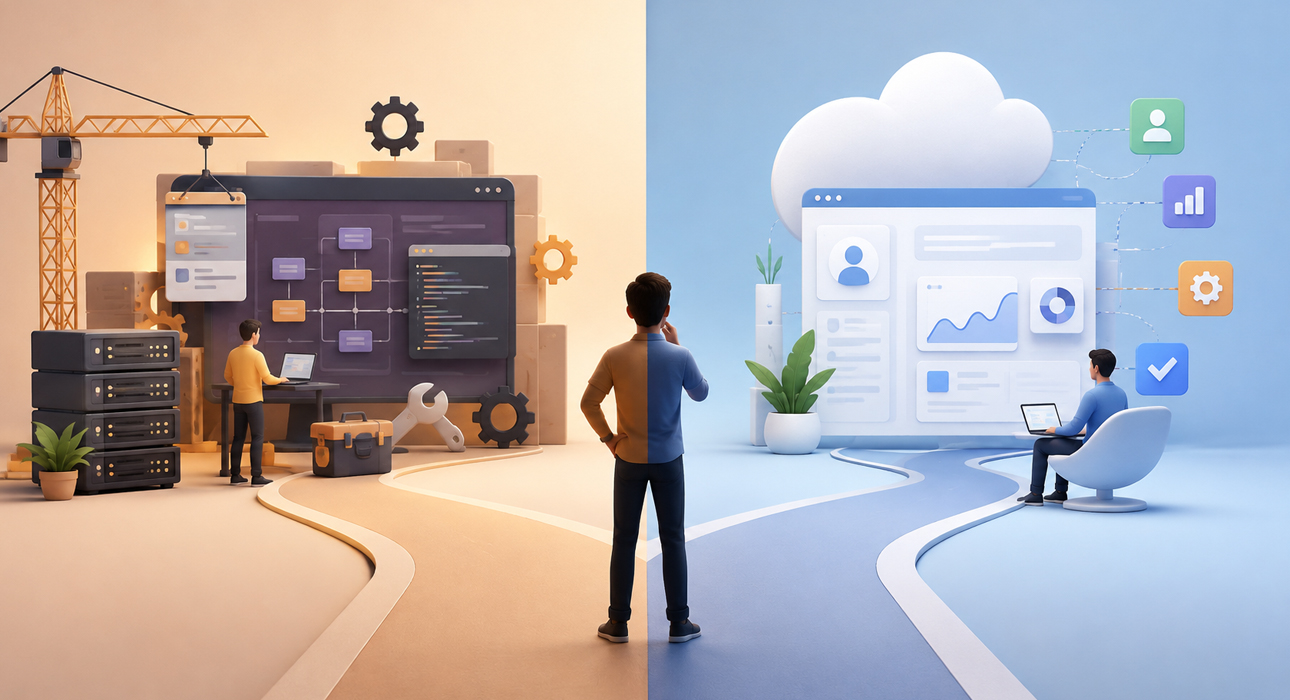
Every growing company reaches the same fork in the road: subscribe to a SaaS product that thousands of other businesses also use, or commission custom software built for the way your team actually works. Each side argues loudly (SaaS promises you can be live by Friday, custom promises software tailored to fit) and both are sometimes right. The expensive errors happen when a business picks the model that matches its mood rather than its situation. This guide compares the two models on the dimensions that decide the outcome, and shows where each one clearly wins.
Written for leaders weighing a subscription against a build, this guide works through the questions that actually drive the decision:
Software as a service is a finished product you rent. A vendor designs it for a broad market, hosts it on shared infrastructure, maintains and updates it continuously, and charges a recurring fee, usually per user, per month. You configure settings and switch features on or off, but the underlying product, roadmap, and data model belong to the vendor. Tools like a mainstream CRM, help desk, or office suite are the familiar examples: you adopt the way they already work.
Custom software is an application designed and built for one business: yours. Instead of adapting your process to a product, the product is shaped around your process, integrations, and rules. You, or the partner who builds it, own the source code, choose where it runs, and decide what it does next. The cost arrives as a project up front and ongoing maintenance thereafter, rather than a per-seat subscription. The trade is simple in principle: SaaS gives you speed and someone else’s upkeep; custom gives you fit and ownership.
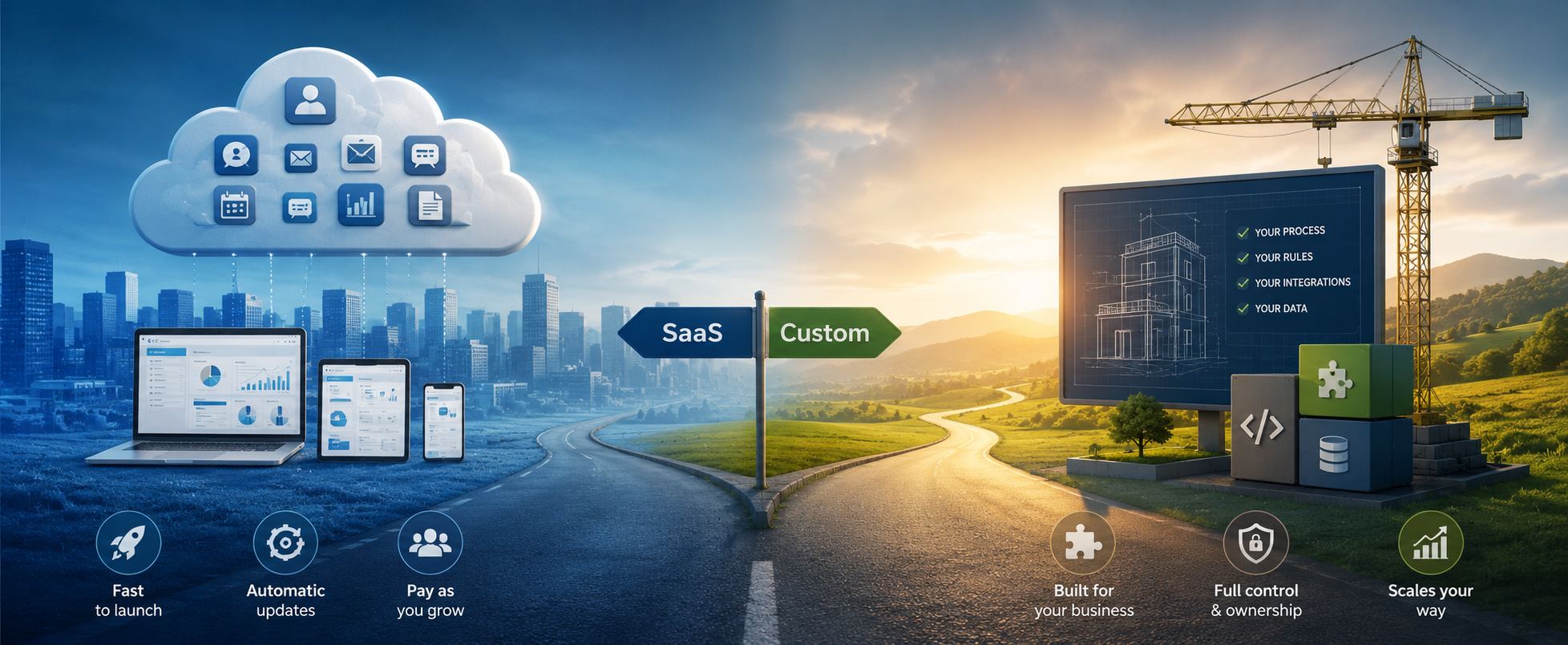
On the surface both give your team an application to log into. The differences surface over time, once cost scales with headcount and the product either bends to your process or refuses to.
| Dimension | SaaS product | Custom software |
|---|---|---|
| Time to value | Fast: subscribe and start | Slower: built over months |
| Cost model | Recurring fee per user | Project cost, then maintenance |
| Fit to your process | Bounded by configuration | Shaped exactly to your workflow |
| Ownership & IP | Vendor owns the product | You own the code and data model |
| Scalability | Instant, within plan tiers | As far as you engineer it |
| Data & security control | Vendor policies, shared infra | You choose hosting and controls |
| Updates & upkeep | Handled by the vendor | Your ongoing responsibility |
| Key dependency | Vendor pricing and roadmap | Your own capacity to maintain it |
SaaS wins wherever the problem is already solved and speed matters more than a perfect fit.
For email, payroll, accounting, or a conventional sales pipeline, the market offers products refined over years across millions of users. Rebuilding a solved problem in-house rarely produces anything a customer would notice or reward.
An early-stage team or a business testing a new line needs working software this week, not next quarter. A subscription turns that into a same-day decision, with no build risk and a small monthly commitment you can walk away from.
Custom pays off when the software is bound up with how you compete, or when no product fits without a fight.
When a pricing engine, logistics flow, or production workflow is a reason customers choose you, no off-the-shelf product models it, and forcing a generic tool to imitate it strips away the very edge you are trying to protect.
When you pay for modules you never use, stitch three subscriptions together, and keep spreadsheets alive to cover the gaps, the “cheaper” option has quietly become an expensive, brittle patchwork that a purpose-built application would replace.
SaaS almost always looks cheaper at the start, and that first impression is misleading. A per-seat fee is small for ten users and substantial for a thousand; because it recurs forever and rises with headcount, the lifetime total can eventually overtake the one-time cost of building and owning an equivalent application. Custom software inverts the curve: a heavy upfront investment followed by lower, steadier maintenance. Neither is cheaper in the abstract; the honest comparison is total cost of ownership projected at the scale you actually expect to reach, not the price on the first invoice.
Scalability cuts a similar way. SaaS absorbs growth in volume effortlessly, add users and the vendor’s infrastructure keeps up, but you scale strictly within the plan tiers, limits, and feature set the vendor offers. Custom software scales as far as you design it to, which means you can tune it for your specific load and add capabilities the market does not sell, at the price of carrying that engineering yourself. Ask not only whether a model handles more users, but whether it can grow into the new things you will need it to do.
SaaS is a ready-made product you rent by subscription, built for a broad market and maintained by a vendor. Custom software is an application built specifically for your business, which you own and control. One trades fit for speed; the other trades speed for fit.
Up front, almost always. Over time it depends: SaaS fees scale with your user count and never stop, while custom software carries a large initial build followed by lower ongoing maintenance. For large or fast-growing teams, subscription totals can eventually exceed the cost of owning an application.
Yes, and many businesses should. Using SaaS to move fast, then building custom once a capability becomes a genuine differentiator, is a sound path, provided you keep your data exportable and avoid lock-in that makes switching prohibitively costly.
Neither is inherently safer. Reputable SaaS vendors invest heavily in security but store your data on shared infrastructure under their policies. Custom software lets you control hosting, access, and encryption, but places the responsibility for securing it squarely on you.
Whether you’re evaluating SaaS platforms or planning a custom software solution, choosing the right technology starts with understanding your business goals. Our experts help organizations design scalable, secure, and future-ready digital solutions tailored to their unique requirements.