







Browse our current openings and find a role that matches your skills and ambition.
Know more ▸
Get a feel for our culture, our people and the way we work together every day.
Know more ▸
Health, flexibility and growth benefits designed to support you and your family.
Know more ▸

Kickstart your career with hands-on internship opportunities and mentorship.
Know more ▸

Written by 3Shadz Editorial Team
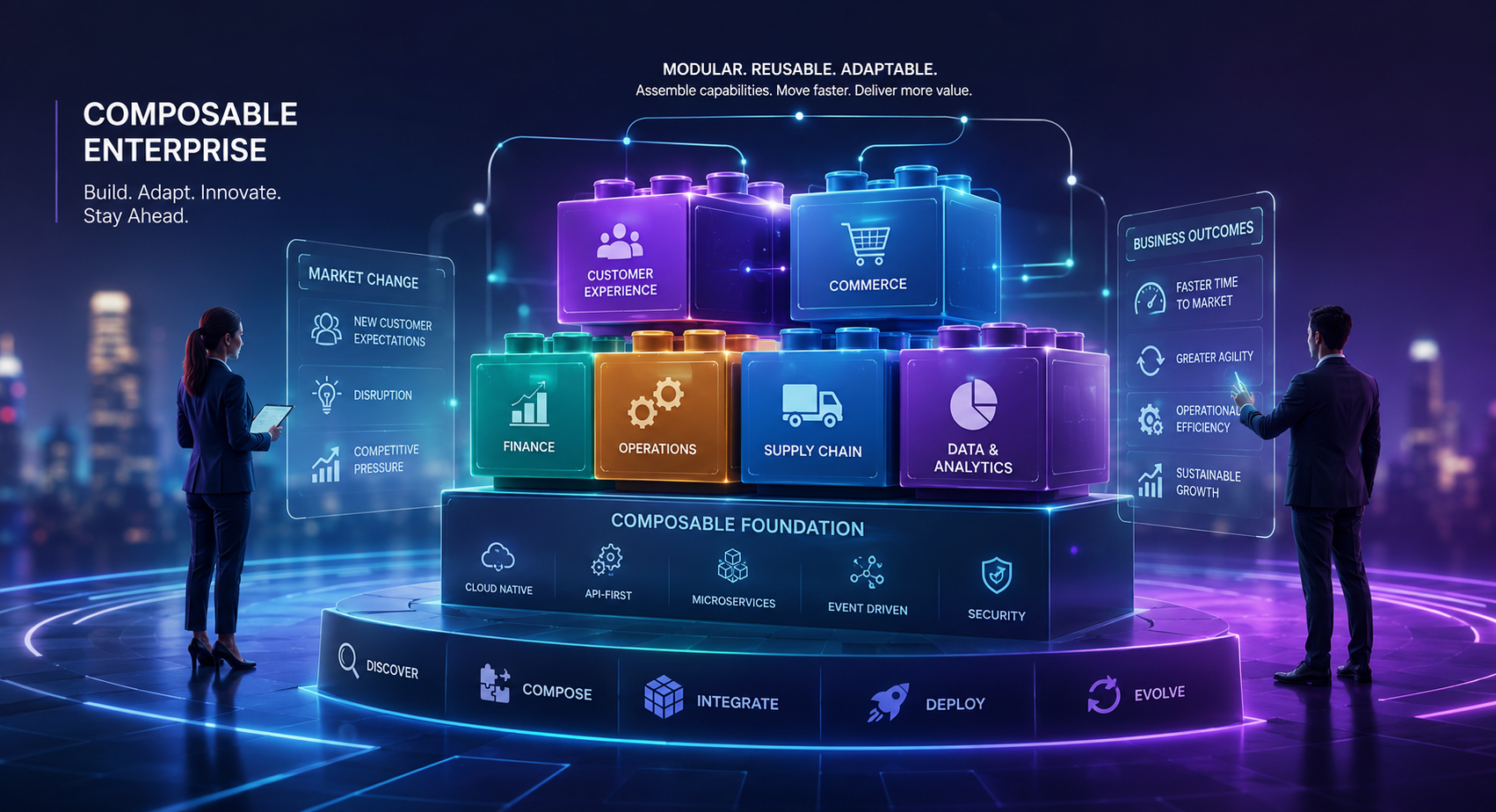
When a rival ships in three weeks what your teams would need a year to match, the gap is rarely talent or budget. More often it is architecture. A business assembled as one large, tightly interlocking system resists change by design: touch one part and you risk breaking the rest. The composable enterprise makes the opposite bet: build the organization from modular, reusable capabilities that can be pulled apart and recombined as fast as the market shifts. This article explains what that means beyond the slogan, the parts it is built from, and where the agility actually comes from.
Written for leaders and architects weighing how to make their technology estate easier to change, this piece covers:
Composability is an old engineering idea applied to the whole business. Rather than one sprawling application that owns every function (ordering, pricing, inventory, loyalty, billing), a composable enterprise treats each of those functions as a separate, self-contained building block with a clear interface. The blocks are designed to snap together and, just as importantly, to come apart. When a business need changes, you rearrange or replace the relevant blocks instead of re-engineering a single monolith around them.
The word that matters is recombination. Launching a new product line, entering a new market, or wiring up a new partner becomes largely a matter of assembling capabilities you already have, plus a few new ones, into a new configuration. The underlying technology (often summarized as MACH: microservices, API-first, cloud-native, and headless), exists to make that assembly practical. But composable is a business idea first. It is about how quickly the organization can be reshaped, with the architecture serving that goal rather than dictating it.

The building block has a name: the packaged business capability, or PBC. A PBC bundles the data, logic, and interface needed to deliver one recognizable business function: a pricing engine, a product catalog, a customer-identity service, a checkout, a loyalty program. It is defined by the outcome it produces, not by the technology inside it, and it exposes that outcome through a stable API so other capabilities can use it without knowing how it works.
This framing matters because it changes who can reason about the system. A block named “loyalty” or “returns” is something a product owner, not only an engineer, can understand, own, and decide to swap. Capabilities can be built in-house, bought as SaaS, or assembled from both, as long as each one honors its contract at the boundary. The estate stops being a diagram of servers and becomes a catalog of business functions.
Blocks are only composable if they behave well at their edges. Four properties, taken together, separate a genuinely composable capability from a component that merely lives in its own folder.
Each capability is self-contained, with its own data and logic behind a well-defined boundary. It can be developed, deployed, and scaled on its own timetable, so a change to pricing does not force a redeploy of the catalog. Modularity is what lets teams move in parallel without stepping on one another.
A capability keeps working even when its neighbors are unavailable or being replaced. It owns its data rather than reaching into someone else’s database, and it fails in isolation instead of taking the whole system down with it. Autonomy is what makes the pieces safe to rearrange.
Independent blocks are useless if nothing coordinates them. Orchestration (through APIs, events, and workflow logic that lives outside the capabilities themselves) is what turns a set of parts into an end-to-end process. This layer is where recombination actually happens, which is exactly why it must stay separate from the blocks it connects.
You cannot reuse what no one can find. Composable capabilities are registered, documented, and easy to locate, with clear contracts describing what each one does and how to call it. Discoverability is the difference between a library of reusable parts and a graveyard of forgotten services that teams quietly rebuild from scratch.
The contrast is clearest when both approaches are held against the dimensions leaders actually feel over the life of a system.
| Dimension | Monolithic | Composable |
|---|---|---|
| Unit of change | The whole application | A single capability |
| Pace of change | Coordinated, infrequent releases | Independent, frequent releases |
| Adding a capability | Re-engineer around it | Plug in a new block |
| Vendor choice | One suite, take it or leave it | Best-fit per capability |
| Failure blast radius | Wide: one fault can stall everything | Contained to one capability |
| Main risk | Rigidity and slow change | Integration and governance overhead |
The payoff is easiest to see in the moments when a traditional stack would demand a project and a composable one demands only a reconfiguration.
A retailer spins up a separate storefront by reusing its existing catalog, payment, and identity capabilities and adding only a new front end. Months of duplicate back-end work collapse into an assembly job.
The loyalty program underperforms, so the team replaces that one capability with a stronger provider behind the same API. Checkout, catalog, and billing never notice the change.
New tax and payment rules apply in the target region. The business adds region-specific capabilities and orchestrates them into the existing flow, rather than forking the entire application.
The team tests a new pricing model for one customer segment by routing it through an alternative pricing capability, then rolls it back or expands it on the evidence, without touching the rest of the system.
None of this is free. Composability trades the pain of rigid coupling for a different set of obligations, and teams that ignore them end up with a distributed monolith: all of the complexity and none of the agility. These are the mistakes that produce that outcome.
It is an organization built from modular, reusable business capabilities that can be recombined as needs change, rather than from one large, fixed application. The goal is agility: reshaping what the business does by rearranging building blocks instead of rebuilding a monolith.
A packaged business capability, or PBC, is a self-contained block that delivers one recognizable business function (pricing, checkout, loyalty), bundling its data, logic, and API. Because it is defined by the outcome it produces, product owners, not only engineers, can reason about it and decide to replace it.
Microservices are a technical pattern for structuring code. Composability is a business-level idea layered on top: capabilities are scoped to business outcomes, owned by the people responsible for them, and designed to be recombined. You can build microservices and still have a monolith in disguise if the pieces map to nothing the business recognizes.
No, and you should not. Composability is best adopted incrementally: carve out the capabilities that change most often or cause the most friction, give them clean boundaries and contracts, and expand from there. A big-bang rewrite carries the same risks it always has, only dressed in composable clothing.
Transform With Confidence
3Shadz partners with organizations to modernize technology, reimagine experiences, and build the platforms, processes, and culture that power lasting digital growth.